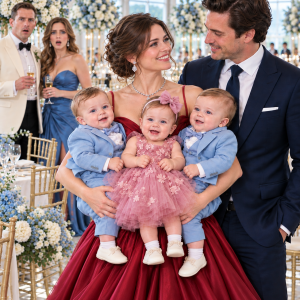
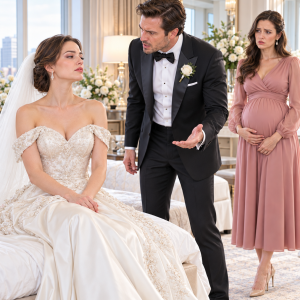
He signed the temporary separation terms several days later.
Allison received primary residential custody, while Blake maintained scheduled parenting time that could expand through consistent behavior. He moved into an apartment ten minutes away and continued attending Nora’s medical appointments.
He did not ask Allison to reassure Evelyn through prison letters.
When relatives argued that the child deserved a relationship with her grandmother, Blake answered directly.
“My mother attempted to remove Nora from her mother through fraud. Biology does not cancel consequences.”
That sentence cost him relationships with several family members.
He accepted the cost.
Allison returned to work after completing her maternity leave, but she did not return to the same assignment. She accepted a position directing stateside emergency-logistics training at Fort Liberty, allowing a predictable schedule without abandoning the career she had earned.
Evelyn had framed motherhood and military service as opposing identities.
Allison refused that premise.
She hired licensed childcare, created backup plans with trusted neighbors, and requested help without treating independence as the refusal of support.
Strength, she learned, did not require performing isolation.
Part 5 – The Father Who Learned to Ask

Nora’s first birthday took place in Allison’s backyard beneath strings of paper stars and broad summer shade.
June Carter brought peach cobbler. The military nurse who helped Allison leave the hospital arrived with a stack of board books. Deputy Hill attended briefly and gave Nora a wooden puzzle shaped like North Carolina.
Blake came carrying a small wrapped box and a diaper bag containing everything listed on Nora’s schedule.
He waited at the gate.
“May I come in?”
Allison opened it.
“Yes.”
He entered without asking where Evelyn’s relatives were or whether Allison had reconsidered the separation.
Nora stood near a low table, holding its edge while attempting uncertain steps. When she noticed Blake, she smiled and moved toward him.
He knelt but did not lift her immediately.
He looked at Allison.
“May I?”
She nodded.
Nora fell against his chest, and he held her carefully.
The moment did not restore the marriage. It demonstrated something smaller and more useful: Blake had learned that love did not erase another person’s authority over her own body, space, or child.
Later, while Nora slept, Blake and Allison sat several feet apart beneath the porch fan.
“My mother wrote again,” he said.
“What did she say?”
“She described counseling and asked for photographs. I did not send any.”
“Thank you for telling me.”
He looked toward the yard.
“I used to think boundaries were punishments imposed by angry people. Now I understand they are information about what safety requires.”
Allison studied him.
“Understanding that does not guarantee reconciliation.”
“I know.”
For the first time, he did not say the words as a strategy designed to change her answer.
Their divorce became final three months later.
Blake accepted shared legal responsibility with Allison retaining primary residence and final authority over medical decisions. His parenting time expanded gradually because he remained reliable, transparent, and willing to follow instructions.
He sold his electrical-contracting business after losing several institutional clients. Instead of blaming Allison or the investigation, he acknowledged that careless credential practices and informal access had made the crime possible.
He accepted a project-management position with another company where security protocols were externally monitored.
Allison retired from active service after twenty years, but not because Evelyn’s judgment became true.
She transitioned into civilian disaster-planning work for a regional healthcare network, preserving her expertise while building a schedule compatible with the family life she chose.
She and Nora moved into a modest craftsman house near Southern Pines. The home contained wide windows, a small garden, and one room converted into Allison’s planning office.
Nothing inside belonged to a family hierarchy.
Part 6 – The Document She Chose to Frame
Three years after the forged guardianship petition appeared on the porch, Allison received notice that the court evidence hold had ended.
Her attorney asked whether she wanted the pink box, handwritten note, and false documents returned or destroyed.
Allison requested only one page.
It was not the page containing Evelyn’s threat.
It was the counterfeit declaration claiming Allison had voluntarily surrendered her daughter because she could not manage motherhood.
Allison placed the page behind glass beside a genuine document from Nora’s preschool.
The preschool page contained a crayon drawing of two houses connected by a crooked road. Allison stood outside one house. Blake stood outside the other. Nora appeared in the center holding both parents’ hands.
Her teacher had written Nora’s explanation beneath the drawing:
My mom and dad live in different houses, but both ask before changing the plan.
The contrast mattered.
The forged document described motherhood as something another family could remove by attaching official-looking seals. Nora’s drawing described family as a structure protected through communication, boundaries, and repeated consent.
On a quiet Saturday afternoon, Blake arrived for his scheduled weekend.
He remained on the porch until Allison answered.
Nora ran toward him carrying a purple backpack.
“Dad, I packed six books.”
“That sounds necessary for one night.”
She whispered loudly.
“Mom said only three, but I negotiated.”
Allison raised an eyebrow.
“You placed three extra books beneath your pajamas.”
Nora looked impressed that the plan had been discovered.
Blake smiled.
“We will return every book on Sunday.”
Before leaving, he handed Allison an updated copy of Nora’s emergency-care information.
“The pediatrician changed the dosage instructions. I uploaded everything into the shared application.”
“I saw it.”
He nodded.
There was no demand for praise.
Blake had once believed remaining neutral between his wife and mother made him reasonable. He now understood that neutrality becomes participation when one person repeatedly crosses another’s boundaries.
Allison watched him fasten Nora into the car.
She no longer viewed Blake as the husband who failed to protect her or as the father who needed eternal punishment. He was simply a man living with permanent consequences while trying to behave better inside the life still available to him.
That distinction brought peace.
Evelyn remained prohibited from direct contact. She continued counseling during supervised release and eventually submitted a written acknowledgment that Nora was not an extension of the Ward family.
Allison preserved the letter but did not grant access.
Accountability did not operate as an application automatically approved after the correct words appeared.
One evening, Nora asked about the framed court page.
“Why does that paper say you could not take care of me?”
Allison sat beside her.
“Because some people believed they could decide what kind of mother I was without asking me or looking at how I cared for you.”
“Were they wrong?”
“Yes.”
“Did you yell at them?”
Allison smiled.
“I called the police, hired an attorney, provided evidence, and told the truth.”
Nora considered that answer.
“That sounds louder than yelling.”
“Sometimes it is.”
The child returned to her crayons.
Allison looked toward the false signature at the bottom of the page.
Evelyn believed motherhood could be stolen by copying a name. Paige believed grief gave her a moral claim over another woman’s child. Blake believed conflict avoidance allowed him to remain innocent.
All three assumptions had failed.
A name was not consent.
Grief was not ownership.
Silence was not neutrality.
Allison closed the frame’s small cabinet door, leaving the document protected from dust but no longer dominating the room.
Outside, evening light settled across the garden while Nora drew another road connecting two houses.
The life they built afterward was not the family Evelyn had imagined and not the marriage Allison once expected.
It was safer because nobody needed to pretend otherwise.
THE END