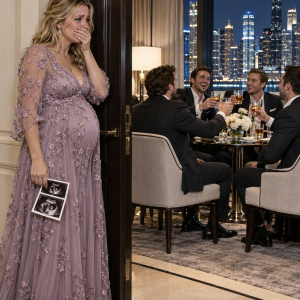
Evelyn assumed a strong woman would suffer privately rather than admit someone had successfully frightened her.
The same night, Paige requested to speak with Allison through counsel.
Allison declined.
She was not prepared to hear an apology from someone who entered a hospital records room while she recovered from surgery.
Blake received permission to remain in the guest room temporarily because investigators found no evidence he participated knowingly in the forgery. Allison agreed only because Nora’s medical appointments and the expanding investigation required practical support.
She established immediate conditions.
Blake would not contact Evelyn or Paige without notifying investigators. He would surrender every household access code and contractor credential. He would not answer questions for Allison, make decisions about Nora’s care, or invite anyone into the home.
“These are not punishments,” she said. “They are the minimum conditions required after your carelessness gave other people access to my medical information and our child.”
Blake nodded.
“I understand.”
“No. You understand the words. Whether you understand the damage will appear in what you do next.”
Part 3 – The Hearing Evelyn Expected to Control

The preliminary hearing drew local reporters because the allegations involved a newborn, fabricated court documents, stolen military medical records, and a respected family from a wealthy retirement community.
Allison arrived wearing a navy suit rather than her uniform. Nora slept against her chest in a soft carrier, protected from cameras by a lightweight blanket.
Her neighbor, Mrs. June Carter, accompanied her. June was a retired public-school principal who had found Allison sitting on the porch beside the forged paperwork and remained with Nora while deputies secured the scene.
“You have spent years protecting other people’s supply lines,” June said as they entered the courthouse. “Today, let everyone else carry something.”
Blake arrived separately.
He stopped several feet away from Allison.
“How is Nora?”
“Healthy.”
“May I see her face?”
Allison adjusted the blanket slightly, allowing him a brief view.
He did not reach forward.
That restraint was new.
Evelyn entered wearing a cream suit and carrying a small Bible. Paige followed in gray, her face swollen from crying. Colin appeared beside his attorney wearing county-issued clothing.
The prosecution presented surveillance footage from the hospital.
Paige entered through a service corridor using a volunteer jacket.
She used an access badge created from contractor information connected to Blake’s company.
She remained inside the records area for eight minutes.
A cybersecurity specialist explained that Blake’s contractor account had been used to obtain a directory of authorized service areas. Evelyn possessed the password because Blake emailed it to her without confirming why she needed it.
The account did not provide direct access to medical charts, but it helped Paige identify the physical records location and timing of staff movements.
A forensic document examiner then compared Allison’s genuine signature with the signature on the guardianship petition.
The false version had been traced from an old military power-of-attorney form. Several strokes repeated microscopic ink patterns impossible in a naturally written signature.
Colin testified next.
“Mrs. Ward said the major would believe the papers because she had just given birth and would be too weak to challenge them.”
“Did Mrs. Ward intend to file the documents with the court?” the prosecutor asked.
“No. She said filing would create unnecessary scrutiny. The goal was to make Major Ward surrender the baby voluntarily and sign a real consent afterward.”
“What would happen if she called the police?”
Colin looked toward Evelyn.
“Mrs. Ward said Major Ward would never risk looking unstable in front of the Army.”
The prosecutor played recovered voice messages.
Evelyn’s voice filled the courtroom.
“Allison built her whole identity around being competent. She would rather hand over the baby quietly than admit she cannot manage motherhood.”
Paige’s voice followed.
“What if Blake refuses?”
“Blake has spent his entire life avoiding conflict. He will stand between both sides, say everyone means well, and allow the stronger person to decide.”
Blake closed his eyes.
His mother had understood him perfectly.
When Paige testified, she admitted stealing the infant bracelet record and birth-registration form.
“My mother told me Allison would send Nora to daycare and return to deployments immediately. She said Nora needed someone who wanted motherhood more than promotion.”
“Did Major Ward ever say she did not want her child?”
“No.”
“Did Blake Ward say that?”
“No.”
“Then where did the belief come from?”
Paige looked toward Evelyn.
“My mother repeated it until it felt like something everyone knew.”
Evelyn refused a negotiated plea and requested permission to speak.
She stood before the judge with the posture of a woman accustomed to turning certainty into authority.
“I acted because my granddaughter required stability. Allison is forty-two, has spent almost two decades serving an institution that can relocate her anywhere, and believes personal discipline can replace maternal presence.”
The judge interrupted.
“Mrs. Ward, did you have legal authority to determine where the child should live?”
“I had moral authority as the grandmother.”
“Moral conviction does not authorize forgery, theft, impersonation, or coercion.”
Evelyn’s composure fractured.
“Nora belongs with the Ward family.”
Allison spoke before her attorney could stop her.
“Nora belongs to herself. Her parents carry responsibilities toward her, but none of us owns her.”
The judge looked toward Evelyn.
“The child already had a home, medical care, and a competent parent. You created danger where none existed because you preferred your imagined family structure to the mother standing before you.”
The court continued Evelyn’s detention and imposed a strict no-contact order protecting Allison and Nora.
Paige received release under supervision after agreeing to cooperate, surrender all devices, and avoid any contact with the baby.
Blake was not charged. However, the hospital terminated his company’s maintenance contract because of his credential violations, causing significant financial consequences.
Outside the courtroom, he approached Allison.
“I lost the hospital contract.”
She looked at him.
“Nora nearly lost her legal identity.”
He lowered his head.
“You are right. I am still measuring consequences by what happened to me.”
It was the first time he corrected himself without requiring Allison to do it for him.
Part 4 – The Marriage Built Around Avoidance
The criminal proceedings lasted eight months.
Evelyn eventually pleaded guilty to forgery, identity-related fraud, conspiracy, unlawful access to restricted records, and attempted custodial interference. She received a custodial sentence followed by supervised release and a long-term protective order.
Colin received a shorter sentence after cooperating and surrendering every template, device, and financial record connected to the scheme.
Paige avoided incarceration because prosecutors accepted evidence that Evelyn had manipulated her grief, but the court imposed probation, mandatory counseling, community service, and a complete prohibition against contacting Nora.
Allison did not request reduced consequences.
Neither did she request maximum punishment.
She submitted a statement focused on the damage caused by turning motherhood into a contest and exploiting a patient’s physical vulnerability.
Blake began individual therapy after the preliminary hearing. He also enrolled in a family-boundary program and surrendered control of the business credentials he had once shared carelessly.
For several months, he continued living in the guest room.
The arrangement eventually became impossible.
Allison could trust him to warm a bottle, attend an appointment, and follow Nora’s sleep schedule. She could not trust the marriage that placed them beneath the same roof.
One evening, while Nora slept beside the kitchen, Allison gave him a folder containing a separation agreement.
Blake read the first page silently.
“I thought we were making progress.”
“You are making progress as Nora’s father.”
“Does that mean nothing for us?”
“It means something, but it does not rebuild the husband I needed before the box appeared.”
He placed the folder down.
“I did not know what they planned.”
“You knew your mother entered our home without permission. You knew she collected copies of my documents. You knew Paige described Nora as though the baby were a second chance intended for her. You knew your mother considered my career evidence that I did not deserve motherhood.”
“I believed they were words.”
“Words become instructions when nobody challenges them.”
Blake wiped one hand across his face.
“I kept asking you to remain calm because I thought conflict would destroy the family.”
“Your version of peace required me to remain undefended.”