Part 1 – The Cradle Waiting Behind the Locked Door
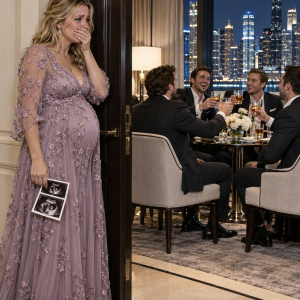
Major Allison Ward had survived nineteen years of military logistics without ever arriving home as unprepared as she did on the afternoon she brought her newborn daughter back from the hospital.
The July heat had settled heavily across Fayetteville, North Carolina, turning the sidewalks pale beneath the sun and filling the parked car with suffocating air before Allison managed to fasten the infant carrier. Her cesarean incision pulled painfully whenever she bent forward, while a low fever had begun moving through her body during the final hour of discharge paperwork.
Her husband, Blake Ward, had promised to meet her at Womack Army Medical Center with their family SUV, a cooler containing bottled water, and the small blue blanket Allison’s grandmother had made decades earlier.
He never arrived.
Blake answered one call at noon and claimed an electrical failure at a commercial project required his immediate attention. When Allison called again, his phone went directly to voicemail. A patient-support specialist eventually helped her secure the carrier inside her older sedan and watched until she drove away.
Her daughter, Nora, slept through most of the journey.
Allison kept one hand close to the carrier whenever traffic slowed, although every movement sharpened the pressure across her abdomen. She had coordinated relief convoys after hurricanes, directed emergency supply operations across several states, and managed personnel during overseas deployments where one delayed shipment could endanger an entire field hospital.
Yet the drive home felt harder than many missions because nobody was waiting at the destination.
A pale wooden bassinet stood on the front porch of their suburban house.
Pink ribbon had been tied around its handles, and a white envelope rested against the folded mattress. At first, Allison assumed Blake’s family had arranged an awkward surprise.
Then she saw the hospital bracelet secured around one side.
NORA ELIZABETH WARD.
Allison carried the baby inside before touching anything else. She locked the door, placed Nora safely inside the living-room cradle, and checked every window while trying to steady her breathing.
The envelope contained a handwritten message.
Do not embarrass everyone by fighting this. Sign the papers and allow Nora to grow up inside a family prepared to raise her properly.
Allison recognized the handwriting immediately.
It belonged to Blake’s mother, Evelyn Ward.
Beneath the note waited a stack of legal documents bearing seals from Cumberland County District Court. According to the petition, Allison had voluntarily admitted to severe postpartum instability, dangerous emotional episodes, and an inability to provide safe care for her daughter.
A second document appointed Evelyn temporary guardian.
The signature at the bottom closely resembled Allison’s signature from military personnel records.
A third page authorized Evelyn to obtain Nora’s medical information, insurance records, and birth documentation.
Allison stared at the papers until the words blurred.
The blanket folded beneath them was the blue family blanket Blake had promised to bring from the hospital. It had been locked inside Allison’s bedroom cedar chest before the delivery.
Someone had entered the house.
Someone had taken the blanket.
Someone had obtained Nora’s identification bracelet and produced documents designed to convince Allison that a judge had already decided she should lose her child.
She called emergency services.
Deputy Marcus Hill arrived nine minutes later with another officer. He photographed the porch, collected the envelope with gloves, and examined the court documents beneath the kitchen light.
“These seals do not match the current county format,” he said. “The case number also belongs to an unrelated property dispute.”
Allison looked toward Nora.
“They expected me to believe the order was real.”
“Do you know who might have access to examples of your signature?”
“My husband has copies of deployment forms, insurance documents, and powers of attorney. His mother helped organize our home office during my last assignment.”
Headlights moved across the front windows.
Blake’s truck stopped behind the patrol car.
He entered without knocking and immediately looked angry rather than concerned.
“Why are there deputies outside our house?”
Allison placed the forged petition before him.
The color left his face.
“Where did you get this?”
“It was waiting beside the bassinet on the porch.”
Blake read the handwritten note.
“My mother would not do something this extreme.”
“She wrote the message.”
“You are exhausted, Allison. Perhaps this was meant to frighten you into discussing childcare arrangements.”
Deputy Hill looked at him.
“Your wife returned from major surgery and found fabricated guardianship documents involving a newborn. That is not a family discussion.”
Blake rubbed his forehead.
“My mother believes Allison intends to return to active duty too quickly. She worries about Nora.”
“Your mother has never asked what I intend,” Allison said. “She decided that my uniform made me an unfit mother before Nora was born.”
A call came through Deputy Hill’s radio.
Military hospital security had received a report concerning unauthorized access to Nora’s birth records. A physical copy of the infant-identification form was missing, and an electronic account connected to a maintenance contractor had viewed Allison’s medical file.
Blake’s construction company serviced several electrical systems at the hospital.
Deputy Hill turned toward him.
“Who has access to your contractor credentials?”
Blake hesitated.
That hesitation changed the room.
“My mother asked for the login last month,” he admitted. “She said she wanted to verify invoices from a hospital renovation project.”
Allison looked at him.
“You gave her access to a military medical system?”
“It was supposed to be the contractor billing portal.”
“You never checked what she accessed.”
Blake lowered his eyes.
The deputy’s radio sounded again.
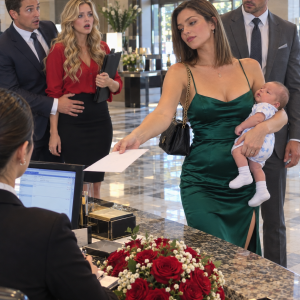
Security cameras had identified the woman who entered the maternity records area wearing a borrowed volunteer jacket.
It was Blake’s younger sister, Paige.
Part 2 – The Nursery Prepared for Someone Else
Military investigators interviewed Blake separately while Allison remained at home with Nora under the care of an Army family-support nurse.
The following morning, detectives executed a search warrant at Evelyn Ward’s house in Pinehurst. They found blank court forms, copied military signatures, hospital maps, and a file containing Allison’s medical appointments throughout the pregnancy.
They also found a fully furnished nursery.
The room had pale green walls, a white crib, shelves of children’s books, and framed photographs of Evelyn holding an empty blanket as though practicing for a portrait with Nora.
A wooden plaque above the crib read:
NORA WARD – GRANDMOTHER’S SECOND CHANCE.
Inside the closet were infant clothes labeled by month, daycare applications, baptism forms, and a drafted announcement claiming that Allison had suffered a serious postpartum breakdown requiring extended treatment.
The most disturbing item was a calendar beginning on Nora’s expected birth date.
Every page listed feeding schedules, pediatric appointments, and private-school waiting lists under Evelyn’s address.
Paige’s name appeared beside the word Mother on several handwritten pages.
Detective Hill returned to Allison’s home carrying a copy of the inventory.
“Your sister-in-law appears to have believed she would help raise Nora permanently.”
Allison looked at the nursery photographs.
Paige had experienced two pregnancy losses during the previous three years. Allison had sympathized with her grief, invited her to medical appointments, and allowed her to help choose nursery decorations.
Evelyn had transformed that grief into entitlement.
“Did Paige admit taking the records?”
“She says Evelyn convinced her that you secretly planned to place Nora with military childcare immediately after returning to duty. She claims the documents were intended to create an emergency arrangement before the baby entered what Evelyn described as institutional care.”
“I requested twelve weeks of leave and planned to transfer into a stateside training position.”
“Your husband knew that?”
“Yes.”
Blake entered the kitchen after finishing another interview. He looked exhausted and older than he had two days earlier.
“I told them everything I knew,” he said.
Allison waited.
“Mother asked about your leave plans, but I told her you had not finalized anything. She kept saying you would eventually choose the Army over the family.”
“Did you correct her?”
“Sometimes.”
“Sometimes is another word for when it felt convenient.”
He sat across from her.
For years, Evelyn had criticized Allison’s age, career, income, and independence. She called military childcare abandonment and described women in leadership as too hardened for motherhood.
Whenever Allison asked Blake to intervene, he replied that his mother came from another generation and feared losing connection with her first grandchild.
“You always asked me to absorb the insult because confronting her made you uncomfortable,” Allison said. “Every time you remained neutral, she understood that she could move closer.”
Blake stared at the photographs.
“I never imagined she would falsify a court order.”
“You did not need to imagine the final act to recognize the pattern.”
Later that afternoon, investigators arrested Paige’s boyfriend, Colin Mercer, a former legal-document processor who had lost his notary commission after improperly certifying signatures in a real-estate case.
He admitted assembling the false guardianship packet.
Evelyn promised him thirty thousand dollars from a home-equity account after Allison surrendered Nora without contest. Colin believed the documents only needed to appear credible long enough to create panic.
“Mrs. Ward said Major Ward would never report the documents,” he told investigators. “She believed military officers were terrified of having psychological concerns attached to their records.”
The plan depended upon Allison’s reputation for composure.