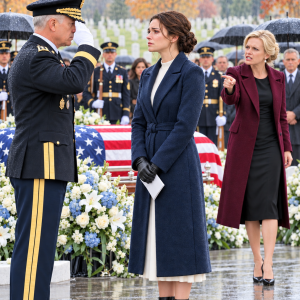
Part 1 – The Name Card Waiting at Her Plate
The place card waiting at Catherine Monroe’s plate did not carry her name.
Instead, someone had written TEMPORARY WIFE across the thick ivory paper, adding a tiny silver star beneath the final word. The decorative detail made the insult feel rehearsed rather than impulsive.
Catherine remained near the entrance of the private dining room while fourteen guests watched to see how she would respond. Her husband, Everett Monroe, stood behind the chair beside his own, one hand resting against the bare shoulder of Lillian Cross, the company’s recently appointed vice president of public affairs.
Everett’s mother studied the floral centerpiece. His father examined his bourbon. Three directors from Monroe Advanced Materials pretended the wine list required their complete concentration.
Only Catherine’s closest friend, Dr. Rachel Kim, looked prepared to intervene.
Catherine gave her the smallest shake of the head.
Not yet.
The private room occupied the top floor of the Bellweather Hotel in Seattle. White orchids stood beneath warm pendant lights, rain traced narrow lines down the windows, and the harbor beyond the glass appeared almost black beneath the evening sky.
Catherine walked toward the table and lifted the place card.
“The lettering is beautiful,” she said.
Lillian raised her champagne flute.
“I hoped humor might make tonight less uncomfortable.”
Everett released the patient sigh he used during television interviews whenever another person supposedly became emotional.
“Catherine, please do not turn a harmless label into a crisis.”
She turned the card between her fingers.
“You replaced my name with an insult.”
“It is symbolic,” Lillian replied. “Pretending this marriage still exists in any meaningful way would be more humiliating than acknowledging reality.”
Everett nodded.
“Exactly. Labels do not create facts.”
For twelve years, he had introduced Catherine as his indispensable partner whenever investors were listening. Inside their home, he called her controlling whenever she requested access to financial records or questioned expenses connected to Lillian’s consulting division.
Catherine looked toward the seat at the head of the table. Everett’s silver place card waited beside the largest wineglass.
She walked past the chair assigned to TEMPORARY WIFE, pulled out Everett’s seat, and sat down.
Wood scraped against the floor.
Everett stared at her.
“That is my place.”
Catherine placed the insulting card beside his empty plate.
“Are you certain? I thought labels did not create facts.”
Rachel lowered her napkin to hide a smile.
Everett moved to the chair six places away, preserving his public expression while anger tightened the skin around his eyes.
“Sit wherever you prefer. Tonight is about honesty.”
Catherine rested one hand on the black leather portfolio beside her plate.
“For once, we agree.”
The dinner had been presented as a private family anniversary, although nearly everyone present controlled something Everett needed. Two institutional investors were considering whether to support his elevation from chief operating officer to executive chairman. The independent board director beside Rachel held enough influence to delay that vote. Corporate counsel sat near the windows.
Everett had also invited his parents because they would later describe Catherine’s reaction as unstable if she refused the divorce settlement he planned to present after dessert.
He had not invited his thirty-year-old daughter, Sophie.
Catherine had helped raise Sophie since the girl was seventeen, supporting her through college applications, the death of her biological mother, an unsuccessful pregnancy, and the arrival of her first child. Everett knew that separating Catherine from Sophie would hurt more deeply than losing any house.
He told Sophie that Catherine requested distance.
He told Catherine that Sophie was traveling overseas.
The lie formed only one strand of a larger plan.
There were hotel invoices, company-purchased jewelry, a waterfront apartment leased through a subsidiary, and millions in public-relations payments made to entities connected to Lillian. There was also a draft press statement announcing that Catherine would resign from the Monroe Community Trust because of health concerns.
Most disturbing was the sealed petition inside Everett’s briefcase requesting an emergency evaluation of Catherine’s decision-making capacity.
If she became angry during dinner, Everett would describe the reaction as evidence. If she left quietly, he would call it voluntary withdrawal.
He believed every possible ending belonged to him.
He had forgotten that Catherine understood the building better than anyone else in the room.
Part 2 – The Speech Designed to Become Evidence
Dinner progressed through untouched soup and brittle conversation.
Everett’s mother, Judith, asked the same director about her grandchildren twice. His father, Malcolm, emptied most of his drink before the entrée arrived. Lillian praised the orchids and explained how carefully she had selected the room’s design, as though the hotel had rearranged itself around her preferences.
Catherine watched Everett avoid looking at the leather portfolio.
He recognized it from every important negotiation involving Northstar Heritage Group, Catherine’s family enterprise. For years, he had teased her for carrying documents as though they were armor.
Tonight, they were.
When the main course arrived, Everett stood and lifted his glass.
“My parents taught me that loyalty does not require people to remain inside relationships that no longer serve either person.”
Judith’s fingers tightened around her napkin.
Everett continued.
“Catherine and I shared twelve significant years. However, love can change shape, and dignity sometimes requires accepting that two lives have moved toward different futures.”
Lillian looked up at him with rehearsed tenderness.
“We should not treat transition as failure,” Everett said. “We should view it as an opportunity to become more truthful versions of ourselves.”
His voice softened as he looked toward Catherine.
“I hope she accepts this change with the grace everyone here has always associated with her.”
There was the trap.
Silence would be called grace. Resistance would be called instability.
Everett had spent months telling directors that Catherine had become forgetful and emotionally unpredictable. He told his parents she was exhausted, told Sophie she required medical supervision, and instructed a public-relations firm to prepare anonymous briefings suggesting that marital jealousy had damaged her judgment.
He raised his glass.
“To new beginnings.”
Nobody drank.
Catherine stood.
“I would also like to say something.”
Everett’s smile hardened.
“This evening does not need to become combative.”
“You requested honesty.”
Lillian offered a sympathetic laugh.
“Everyone understands that this must be painful. You do not need to involve business leaders in a personal reaction.”
Catherine looked at her.
“You changed my place card.”
“It was only a symbol.”
“Did Monroe Advanced Materials also pay for the diamond earrings you are wearing as a symbol?”
Lillian’s fingers rose toward her ears.
Independent director Helen Brooks put on her glasses. Malcolm closed his eyes. Everett maintained his calm tone.
“You found financial documents without understanding their context.”
“I read the invoices.”
“You interpreted technical expenses emotionally.”
Before marrying Everett, Catherine had spent fifteen years restructuring distressed companies, managing acquisition debt, and overseeing industrial trusts. He assumed she had forgotten contract law because she stopped correcting him at family dinners.
Catherine opened the portfolio.
Near the double doors, hotel director Samuel Ortiz stepped forward.
“Ms. North, would you like me to proceed?”
Everett blinked at Catherine’s maiden name. Lillian’s confidence vanished.
“Not yet, Samuel,” Catherine said. “Mr. Monroe deserves to finish demonstrating his honesty.”
She removed the room agreement.
“This dinner was booked by Lillian Cross and charged to Monroe Advanced Materials.”
Everett’s jaw shifted.
“That is an administrative matter.”
“The Bellweather Hotel is controlled by Northstar Heritage Group. Therefore, your administrative matter became visible to the owner.”
Lillian stared at her.
“You own this hotel?”
Catherine did not answer. She placed the TEMPORARY WIFE card beside the invoice.
“You converted the planned destruction of a marriage into a corporate expense.”
Samuel set a tablet beside her plate.
Three months earlier, Lillian had reserved another private conference suite and activated the hotel’s automated transcription service because she wanted meeting notes without allowing junior employees inside. After the official meeting ended, she and Everett remained in the room.
They forgot to deactivate the system.
Catherine touched the screen.
Everett’s recorded voice filled the dining room.
“Once Catherine signs the wellness acknowledgment, we can shift the voting interests before she understands what happened.”
Lillian’s recorded reply followed.
“What happens if she refuses the evaluation?”
“Sophie’s declaration will establish sufficient concern. After that, the court will appoint temporary oversight.”
The tablet displayed the next transcribed sentence.
NORTHSTAR WILL FINALLY BELONG TO US.
Everett lunged toward the device.
Samuel removed it beyond his reach.
A glass overturned, spreading dark wine across the white tablecloth.
“That recording is unlawful,” Everett said.
For the first time, his voice cracked.
“The transcription service was activated by an authorized corporate user,” Samuel replied. “The system preserved the recording requested through the room contract.”
Lillian’s face became pale as she remembered selecting the service herself.
Corporate counsel Marcus Webb requested the transcript. After reading two pages, he stopped.
“What is Silver Ridge Communications?”
Everett returned to his chair.
“A restructuring vendor.”
“It is owned by Ms. Cross.”
“That does not make the arrangement improper.”