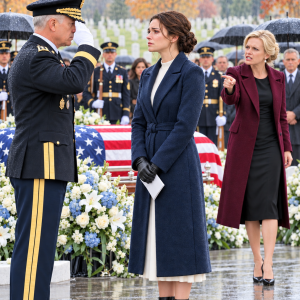
Diane looked toward the workshop.
“You slept out there even though this was happening?”
“Yes. The concrete floor clarified several decisions.”
Brooke attempted a laugh.
“Natalie, nobody knew you were doing anything serious. You cannot blame us for misunderstanding a hobby you refused to explain.”
“You did not ask what I was building. You decided what my silence meant because that version made treating me badly easier.”
Mason moved closer.
“Alexandria Meridian is negotiating to acquire Helix. Did you know that?”
Natalie opened the rear passenger door.
“I learned about the target list during yesterday’s executive briefing.”
The remaining color left his face.
She entered the vehicle without promising what the acquisition meant for him.
As the convoy departed, Natalie watched the house shrink behind tinted glass. She expected satisfaction, but what she felt was exhaustion.
Aaron handed her a leather portfolio.
Inside were the final acquisition papers, executive credentials, temporary housing documents, and a handwritten note from Meridian’s chief executive, retired Admiral Thomas Beckett.
Natalie, the technology was born from loss, but its future must be larger than vengeance. Welcome aboard. Executive dinner tonight at seven thirty. Several members of your family have been invited because boundaries are easier to establish when everyone hears them clearly.
Natalie looked at Aaron.
“Did Admiral Beckett invite my parents and Mason?”
“He did, although the evening is not intended as an ambush. Helix is already under acquisition review, and Mason Caldwell’s division appears in the personnel audit.”
Natalie closed the portfolio.
She did not want a public execution staged for entertainment. However, she also understood that remaining silent would allow her family to rewrite the workshop as a misunderstanding and her success as an opportunity they had somehow supported.
“I will attend,” she said. “But employment decisions must follow evidence, not family history.”
Aaron nodded.
“That is exactly why the admiral selected you.”
Part 3 – The Technology Built from Eleven Minutes

Alexandria Meridian’s integration center occupied several secure floors inside a modern research complex overlooking the Chesapeake Bay.
Admiral Beckett met Natalie inside the executive conference room. He was a tall, silver-haired man whose reserved manner carried more authority than louder executives achieved through performance.
He placed Jonah’s final mission timeline on the table.
“Your husband’s aircraft lost navigational integrity after coordinated signal deception redirected both primary and backup positioning systems,” he said. “The crew still had power, but rescue teams could not distinguish authentic coordinates from false ones.”
Natalie had memorized every line of the report.
“Beacon prevents that by distributing location confidence across multiple independent channels. It does not rely upon one source remaining trustworthy.”
Her platform combined satellite, inertial, terrain, and peer-network signals, continuously scoring each source for manipulation. When interference appeared, the system generated a shared rescue corridor rather than a single vulnerable coordinate.
Meridian’s engineers had spent three weeks testing her prototype under simulated jamming conditions. It maintained verified contact throughout every trial.
“You did not build a product,” Beckett said. “You built a different standard for how recovery teams define location.”
Natalie looked toward the water.
“Jonah remained alive for eleven minutes after the primary system failed. Eleven minutes should have been enough.”
“Now they will be.”
The acquisition provided Natalie with control over the new division, independent technical authority, and veto power over any deployment she considered unsafe. She insisted that part of the purchase price establish a support fund for military families navigating sudden loss.
Beckett accepted every condition.
During the afternoon, Natalie joined the team reviewing Helix Defense Technologies. The company manufactured components for aircraft navigation, but an internal audit revealed inflated sales projections, rushed compliance certifications, and a culture where commercial staff overruled engineering concerns.
Mason’s name appeared repeatedly.
He had pressured technical teams to describe several incomplete components as deployment-ready. He also claimed personal responsibility for government relationships developed by other employees.
His position was not merely unnecessary after acquisition. His conduct created risk.
“I want the personnel committee to review him without my involvement,” Natalie said. “Document every decision and apply the same standard used for everyone else.”
Beckett studied her.
“You would be justified in recusing yourself entirely.”
“I am not protecting him, and I am not punishing him privately. I want a record that survives every accusation about personal retaliation.”
By evening, Natalie changed into a midnight-blue maternity dress prepared by the executive office. Its clean lines emphasized confidence rather than vulnerability.
Grace Holloway, her new chief of staff, adjusted the identification pin near Natalie’s shoulder.
“You look like the person everyone will be waiting to hear.”
Natalie examined her reflection.
The woman in the mirror still carried grief beneath her eyes. Authority had not erased loss, nor had money transformed the previous night into something unreal.
“I want the dinner to remain professional,” she said.
“The admiral agrees. Your family will hear the facts, but you decide the boundaries.”
Part 4 – The Dinner Where Their Story Failed
The private dining room overlooked the bay through floor-to-ceiling windows. Senior engineers, emergency-response officials, military liaisons, and Meridian board members occupied the long table.
Diane, Edward, Brooke, and Mason arrived shortly before dinner.
They entered quietly, stripped of the confidence they displayed inside their own home.
Beckett welcomed them without warmth or cruelty.
“You are here because Dr. Pierce requested transparency regarding several changes that may affect your family.”
Diane stared at Natalie.
“We always knew she was talented.”
The statement arrived before anyone accused her of doubting Natalie.
A senior federal communications official turned toward the parents.
“Developing Beacon while managing pregnancy and bereavement required extraordinary endurance. You must have provided considerable support.”
Edward cleared his throat.
“We gave Natalie the space she requested.”
Natalie placed her fork down.
“You moved me into an unheated workshop because Mason wanted my bedroom.”
Silence covered the table.
Diane’s face tightened.
“That description removes the context. We believed you needed privacy.”
“You called me a financial burden and said my grief damaged the atmosphere of the house.”
Brooke intervened.
“Everyone was under stress. Mason’s company was facing major negotiations, while you refused to explain what you were doing.”
Admiral Beckett looked toward her.
“Dr. Pierce was developing technology that maintained verified navigation through every interference test our laboratory could produce.”
Brooke attempted to smile.
“Natalie has always enjoyed technical projects.”
“Beacon is not a personal project,” Beckett replied. “It will become the emergency-communications standard across multiple federal aviation networks.”
Mason shifted in his chair.
“My position at Helix gives me considerable experience with those networks.”
Natalie opened a thin folder.
“The acquisition committee completed the first personnel review this afternoon. Your files show repeated attempts to move products into government demonstrations before engineering approval.”