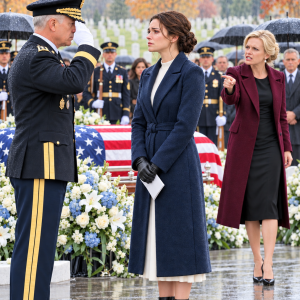
Part 1 – The Room They Gave Away
Only three hours after her husband’s memorial service, Natalie Pierce stood in the kitchen of her parents’ suburban Maryland home and learned that grief had made her inconvenient.
Her mother, Diane, delivered the decision while stirring cream into her coffee, as though she were rearranging furniture rather than evicting her pregnant daughter.
“Your sister and Mason will arrive this afternoon, so you need to clear the upstairs bedroom before lunch.”
Natalie remained beneath the kitchen archway, wearing the faded field jacket that had belonged to her husband. One hand rested over the small curve of her abdomen, while the other gripped the edge of the doorway.
At twenty-eight, she had already spent six months carrying two forms of absence: the death of her husband, Lieutenant Commander Jonah Pierce, and the child he never knew existed.
“Where am I supposed to sleep?” she asked.
Diane pointed toward the detached workshop behind the house.
“There is a folding cot beside the storage cabinets. It is temporary, and you will have more privacy there.”
The workshop had no insulation, reliable heat, or bathroom. December wind pushed through gaps around the metal door, and the concrete floor became slick whenever snow melted from the gardening equipment.
Natalie looked toward her father.
Edward Pierce sat at the breakfast table reading financial news on a tablet. He did not lift his eyes immediately.
“You have lived here for six months without contributing to household expenses,” he said. “Mason works from home and needs a proper office because his company is entering a major contracting cycle.”
Natalie felt Jonah’s identification tags against her collarbone.
Her parents believed she spent every day locked inside the bedroom, staring at a computer because grief had destroyed her ability to function. They never asked what appeared on the screens, why encrypted calls arrived after midnight, or why several packages bore federal research labels.
They preferred the version of Natalie that required pity and obedience.
The front door opened before she could respond. Her older sister, Brooke, entered wearing a camel-colored coat, followed by Mason Caldwell, her husband of four months. Mason worked as regional business-development director for Helix Defense Technologies, a company that manufactured navigation components for military aircraft.
He carried himself with the relaxed superiority of a man who believed proximity to important contracts made him important.
Brooke surveyed Natalie’s clothing and tired face.
“Please do not begin another emotional argument,” she said. “Mason has a difficult quarter ahead, and the atmosphere in this house has become unbearable.”
“My husband was buried this morning.”
Brooke sighed.
“That is exactly what I mean. Everything becomes about your grief.”
Mason glanced through the window toward the workshop.
“The building has electricity, and I noticed a portable heater near the lawn equipment. It is hardly a tragedy.”
Natalie studied his satisfied expression.
Mason had spent the previous month describing a possible acquisition that would transform Helix into a leading defense supplier. He repeatedly implied that his negotiations would make the entire family wealthy. Diane and Edward had already guaranteed part of Brooke’s mortgage because they expected Mason’s future bonuses to cover everything.
“The portable heater stopped working last winter,” Natalie said.
Her father finally looked up.
“Then wear another coat. Your sister has supported this family emotionally while you have withdrawn from everyone.”
Natalie understood that the argument had ended before it began. Her parents had assigned moral value according to appearances, and Mason’s tailored shirts looked more useful than her silence.
She nodded.
“Fine.”
Diane appeared pleased by the lack of resistance.
“Please keep your belongings against the far wall. Mason will park his car inside whenever the weather turns worse.”
Natalie climbed upstairs and packed without crying. She selected maternity clothes, Jonah’s field jacket, her engineering laptop, several encrypted storage drives, and the sealed letter delivered by his commanding officer.
The final item was a small prototype transceiver no larger than a deck of cards.
Seven months earlier, Jonah’s aircraft had vanished during a rescue mission over mountainous terrain after hostile interference corrupted its navigation signal. The crew remained in contact for eleven minutes before every tracking system failed. Search teams found the wreckage two days later.
The official report described an unavoidable systems failure.
Natalie refused to accept that description.
Before Jonah’s death, she had been a senior communications engineer specializing in resilient navigation networks. During the months following the accident, she built a new adaptive protocol capable of maintaining location and rescue data even when conventional channels were jammed.
That afternoon, while her family rearranged the bedroom for Mason, Natalie carried her suitcase across the frozen yard and entered the workshop.
The air smelled of motor oil, damp wood, and dust.
She placed the prototype beside her laptop and sat on the folding cot.
At seven forty-three, her secure phone displayed a message from Alexandria Meridian Systems.
ACQUISITION APPROVED. FEDERAL LICENSING CONFIRMED. EXECUTIVE TRANSPORT ARRIVES AT 0800. WELCOME TO MERIDIAN, DR. PIERCE.
Natalie read the message twice.
Alexandria Meridian was one of the country’s most respected aerospace and emergency-communications firms. Its board had agreed to purchase her private research company, Northstar Signal Labs, while appointing her executive vice president for resilient systems.
The acquisition included an amount large enough to secure generations of her child’s future.
Her parents believed she had nothing.
Natalie placed one hand over her abdomen.
“Your father’s signal disappeared,” she whispered. “I am going to make sure nobody else disappears with it.”
Part 2 – The Engines at Eight
The temperature fell below freezing overnight. Natalie slept in fragments while wind rattled the workshop door and cold traveled through the canvas cot.
At seven fifty-eight the following morning, the concrete floor began vibrating beneath her shoes.
She opened the door and stepped into bright winter sunlight.
Two black government-certified transport vehicles entered the driveway, followed by a smaller security car. Their presence overwhelmed the quiet neighborhood and completely blocked Mason’s leased sports sedan.
Captain Aaron Cole stepped from the lead vehicle wearing a formal naval uniform. He had commanded Jonah’s rescue squadron and personally delivered the folded flag after the memorial ceremony.
Two officers from Jonah’s unit joined him.
Aaron approached Natalie, stopped at attention, and saluted.
“Good morning, Dr. Pierce. Alexandria Meridian requested that our liaison team escort you to the integration facility. It is an honor to support your transition.”
Natalie returned the greeting with a slight nod.
Behind her, the front door opened.
Brooke appeared first, holding a coffee mug and wearing a silk robe. Mason followed, then Diane and Edward.
Mason’s confidence disappeared when he noticed the official plates and naval personnel.
“What is happening?” Brooke demanded.
Aaron turned toward the porch.
“We are collecting Dr. Natalie Pierce on behalf of Alexandria Meridian Systems and the federal emergency-communications directorate.”
Edward frowned.
“There must be some mistake. Natalie has not worked since her husband died.”
Natalie pulled her suitcase toward the vehicle.
“I have worked every day since Jonah died.”
Diane descended one step.
“Doing what?”
“Building a resilient navigation and rescue platform called the Beacon Continuity Network.”
Mason stared at her.
“That project was presented to Helix last month.”
Natalie recognized the sudden fear beneath his words.
Helix had reviewed an early proposal submitted through a neutral broker. The company rejected it after an internal committee described the system as commercially unrealistic. Mason had apparently attended that review without realizing the inventor belonged to the widow he mocked.
“Helix rejected the preliminary license,” Natalie said. “Alexandria Meridian purchased the company yesterday.”
Her father’s face changed.
“Purchased it for how much?”
“The amount is confidential, although it was sufficient for the board to create a permanent executive division around the technology.”
Aaron lifted the suitcase into the vehicle.