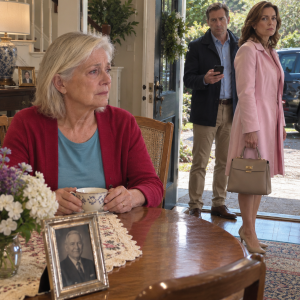
She returned carrying a small wrapped package.
“Your father bought this for Willa before he became ill. He asked me to save it for her first Christmas.”
I carefully removed the wrapping paper.
Inside was a soft gray stuffed elephant with floppy ears and a little blue ribbon around its neck.
I remembered Dad holding a similar toy in a department store months earlier.
He had laughed and said every little girl deserved a favorite stuffed animal.
My chest tightened.
“He picked this out?”
“He did. He said she could take it everywhere.”
I pressed the elephant gently against Willa’s sleeping hand.
Her fingers curled around one ear.
My mother watched quietly.
“Audrey, I know I have a lot to make up for. I don’t expect you to trust me because I apologized once.”
I looked at her.
“Thank you for understanding that.”
She stepped aside to let me pass.
Outside, snow drifted slowly beneath the porch light.
Before I reached the car, she called my name.
“Your father was very proud of you. He told me that more times than I can count.”
I turned around.
“I wish you had told me sooner.”
Her expression softened.
“So do I.”
I drove home with Willa sleeping peacefully in the back seat, her new elephant tucked beside her.
My father’s letter rested safely in my purse.
For the first time in months, I didn’t feel quite so alone.
A Year of Small Changes
My mother’s transformation didn’t happen immediately.
During the first few weeks, she sent messages asking how Willa was doing, but she respected my request for space.
She stopped asking Brooke to convince me to visit.
She didn’t send expensive gifts to make everything seem normal.
Instead, she began seeing a family counselor.
I learned about that from Brooke, who said Mom had finally started talking about the pressure she had experienced growing up.
My grandmother had cared deeply about appearances, and my mother had spent much of her childhood trying to avoid criticism.
Understanding that helped me see where some of her behavior came from.
It didn’t excuse it.
But it gave me hope that she could change.
Our first visit happened in March at a neighborhood park.
My mother arrived carrying two cups of coffee and a small bag of homemade muffins.
She didn’t comment on Willa’s outfit.
She didn’t offer unsolicited parenting advice.
She simply sat beside me and watched her granddaughter explore the grass.
When Willa reached for a fallen leaf, Mom smiled.
“She’s curious about everything, isn’t she?”
I nodded.
“She really is.”
“Your father would have loved watching her grow.”
We sat quietly for a moment.
Then Mom added:
“I think he would be glad you’re giving her the childhood he always wanted you to have.”
I looked at her.
For once, the words didn’t feel like criticism disguised as concern.
They felt sincere.
Over the following months, our visits became more frequent.
Sometimes we met for lunch.
Sometimes she came to my apartment and helped Willa build towers from wooden blocks.
When I told her I preferred to handle bedtime routines myself, she respected that.
When we disagreed, she listened instead of treating my opinion as disrespect.
There were still uncomfortable moments.
Old habits don’t disappear simply because someone wants them to.
But my mother began recognizing those moments and correcting herself.
And slowly, I began trusting her again.
The Christmas That Finally Felt Like Home
The following December, my mother called two weeks before Christmas.
“Audrey, I’d love for you and Willa to come over on Christmas Eve. But please don’t feel obligated. I want you to decide what’s best for both of you.”
I sat quietly for a moment.
A year earlier, those words would have seemed impossible.
“I think we’d like that, Mom.”
When Christmas Eve arrived, Willa walked into my parents’ living room holding her gray elephant by one ear.
She was nearly two now, full of energy and delighted by the colorful ornaments.
My mother knelt beside the Christmas tree.
“Hello, sweetheart. Merry Christmas.”
Willa smiled and hurried toward her.
“Grandma!”
My mother opened her arms.
Watching them embrace, I felt something loosen inside my chest.
There was no criticism about Willa’s clothes.
No complaints when she laughed loudly.
And when she accidentally knocked over a small tower of wooden blocks, my mother simply helped her rebuild it.
Later that evening, I noticed a small envelope beneath the tree.
My name was written on the front.
For a second, my heart skipped.
Inside was a handwritten card from my mother.
Audrey,
Last Christmas, your father gave you the courage to protect your daughter, and you gave me the chance to understand something I had been unwilling to see.
I spent too many years believing that being a good mother meant having the answers, maintaining appearances, and correcting every mistake.
You taught me that sometimes being a good mother means listening, admitting when you’re wrong, and allowing your children to become themselves.
Thank you for giving me the opportunity to learn.
I love you and Willa more than I have always known how to show.
Mom.
I looked across the room.
My mother was sitting on the carpet beside Willa, helping her arrange the wooden blocks into a crooked little house.
When the house collapsed, they both laughed.
Nobody corrected anyone.
Nobody demanded perfection.
They simply started again.
And I realized that the Christmas I had walked away hadn’t been the night our family fell apart.
It had been the night we finally stopped pretending everything was fine.
My father’s letter hadn’t changed my mother overnight.
It had helped me find the courage to change what I could control.
And by refusing to pass old expectations on to my daughter, I had made room for something better.
That evening, as Willa climbed into my lap and rested her head against my chest, I looked at my mother and smiled.
“Dad would have loved this Christmas.”
She wiped a tear from her cheek.
“Yes, sweetheart. I think he would have.”
For the first time in years, the house felt like somewhere I belonged.
Not because I had finally become the daughter my mother wanted.
But because we were learning to love one another without asking anyone to be someone else.
Messages About Family, Love, and the Courage to Change
Children should never have to grow up believing that their value depends on expensive clothes, perfect behavior, impressive achievements, or the approval of adults who have forgotten how important kindness can be.
A parent’s responsibility is not to create a child who never makes mistakes, but to raise someone who feels secure enough to learn, explore, ask questions, and discover who they are without fearing that love will disappear.
Sometimes the people who love us have also taught us painful lessons, and recognizing that truth does not mean we must stop loving them; it means we must learn where compassion ends and healthy boundaries begin.
Keeping peace within a family should never require one person to remain silent about repeated disrespect, because genuine harmony grows from understanding and accountability rather than the expectation that everyone must pretend nothing is wrong.
An apology is only the beginning of rebuilding trust, and its true meaning becomes visible through patient listening, changed behavior, respected boundaries, and the willingness to continue doing better long after the emotional conversation has ended.
We can acknowledge the difficult experiences that shaped our parents while still deciding that the next generation deserves a different kind of childhood, one filled with reassurance, encouragement, and the freedom to be imperfect.
Walking away from an uncomfortable family gathering does not always mean abandoning the people we love, because sometimes temporary distance is what allows everyone to recognize the importance of respect and reconsider the way they treat one another.
The greatest gift a parent can offer a child is the certainty that home will remain a place of comfort even when life becomes complicated, mistakes happen, or the world outside feels demanding and uncertain.
Real family healing rarely happens through one dramatic conversation or a beautiful holiday celebration; it develops through ordinary moments when people choose patience over criticism, understanding over pride, and connection over the need to be right.
And perhaps the most meaningful legacy we can leave our children is not a perfect family history, a large inheritance, or a beautiful home, but the knowledge that they are deeply loved exactly as they are and will never need to make themselves smaller to deserve that love.