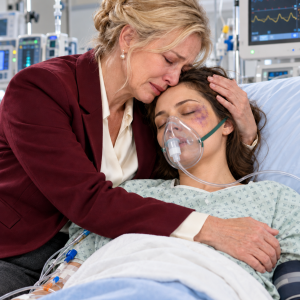
Cole lifted the sealed evidence bag containing Lauren’s USB drive.
“Fortunately, her memory isn’t our only source.”
Mom’s eyes immediately went to the USB.
“What’s that supposed to be?”
“Video evidence.”
Her jaw tightened.
“A video doesn’t tell you what happened before or after it. People see whatever they want to see.”
Cole remained calm.
“There’s audio too.”
That was when my mother stopped looking angry.
Cole opened the laptop.
I watched Diane instead of the screen while Dad’s voice filled the hospital room, followed by hers telling him to take my phone before I sent the video to anyone.
The color drained from her face.
Her attorney immediately touched her arm.
“Diane, don’t say anything else.”
Mom looked at me.
I waited for an apology, for horror, or even one glimpse of the woman who had once driven across town with soup because I’d told her I had the flu.
Instead, she said, “None of this would’ve happened if you’d had enough sense to stay out of your father’s private life.”
Something inside me went very still.
“Get out.”
Her eyebrows rose.
“Excuse me?”
“Get out of my room.”
She stared at me as though I’d insulted her.
“After everything I’ve done for you, you think you can speak to your mother like that?”
I didn’t raise my voice.
“You watched him hurt me, helped hide what happened, and then came here while I could barely move to explain why I deserved it. You don’t get to lecture me about respect anymore.”
“I never said you deserved it.”
“You haven’t said I didn’t.”
For once, my mother had no immediate answer.
I looked toward the door.
“Leave.”
Her attorney guided her into the hallway.
It was the first time since I’d awakened that Diane Bennett left my hospital room because I had decided she wasn’t welcome.
The investigation moved quickly after that. Forensic analysts authenticated the recordings, investigators recovered additional fragments from my damaged phone, and small pieces of its shattered screen were found beneath a cabinet in the garage.
Police also recovered a tire iron that had been hastily cleaned. Traces of my blood remained in a recessed section near the handle, and the physical evidence was consistent with my injuries.
My father was arrested.
Cole later asked whether I wanted to know what Robert had said when officers took him into custody.
“No.”
The answer surprised me.
For weeks, I’d desperately wanted explanations because explanations still belonged to the father I remembered—the man who taught me to ride a bicycle, took me for pancakes on Saturday mornings, and once told me never to let anybody make me feel small.
But there was no explanation that could turn Robert Bennett back into the person I’d believed he was.
My mother was separately investigated for helping clean the garage and providing false information to police. Her original statement claimed she’d discovered me after Dad had already left to find help.
The camera showed otherwise.
It showed Diane standing at the garage door while I was inside. It showed her checking the street, closing the garage, and helping my father control what happened afterward.
Lauren gave a formal statement and came to see me one final time before leaving the hospital.
“I was a coward,” she told me. “I believed what was convenient because admitting the truth would’ve required me to walk away. Helping now doesn’t make what I did before acceptable, and I’m not going to insult you by pretending it does.”
Then she reached into her coat pocket and placed the lighthouse keychain on my bedside table.
“Robert left this at the motel the last night I saw him. I think it belongs with you.”
I picked it up and ran my thumb across the scratched metal.
Years earlier, during our family trip to Maine, I’d bought it from a little gift shop near the water. Dad had held it toward the sunlight and smiled.
“You know what a lighthouse is for, Claire?”
I’d shrugged.
“Keeping boats from crashing?”
He’d laughed.
“It’s there so people know where the solid ground is.”
At twenty-two, I’d rolled my eyes.
Now I closed my fingers around the little lighthouse and wondered how a man could understand something so simple while spending years building his own life on lies.
WHAT MY MOTHER CHOSE
My father’s attorney eventually negotiated a plea after reviewing the evidence.
There was no dramatic courtroom confession, no last-minute witness, and no speech from me that made an entire room applaud. Robert simply reached the point where denying what happened no longer served him.
My mother also faced consequences for the false statements she’d made and for her role in covering up the scene.
She wrote to me twice.
Her first letter was six pages long, and most of those pages were about what she had lost. She wrote about her marriage, friends who no longer called, the possibility that she’d have to sell the house, people at church whispering about her, and relatives who had stopped inviting her to dinner.
I reached the final page before realizing she’d written more about her embarrassment than she had about my injuries.
I didn’t answer.
The second letter was much shorter.
This time, Mom admitted that she’d been afraid. She’d been afraid of losing her marriage, afraid of starting over, and terrified of everyone discovering what kind of life she’d been protecting.
I believed her.
Fear explained why she wanted the affair hidden.
It didn’t explain away her choices.
My mother had watched my father force me into that garage. She had heard what happened inside, helped conceal the aftermath, and then had fourteen days to sit with the possibility that her daughter might never wake up.
Fourteen days was a long time to reconsider what she’d done.
She had time to see the swelling in my face and the bruises on my body. She had time to listen to the machines beside my bed and wonder whether I would ever open my eyes again.
She could have changed her mind on any one of those days.
Then I woke up.
Instead of taking my hand, she stood beside my hospital bed and told me I’d destroyed the family.
Whenever guilt later tried to convince me that refusing her calls made me cruel, I remembered that moment. Not because I wanted to hate my mother, but because I’d spent too much of my life translating other people’s cruelty into excuses they hadn’t earned.
THE LIGHTHOUSE
Recovery wasn’t dramatic.
My wrist healed before my ribs stopped aching, and the headaches gradually became less frequent. For several months, the sound of a garage door closing could make my hands shake badly enough that I needed to sit down.
Some memories returned while others never did. Eventually, I stopped treating every missing minute as something I needed to recover, because there were parts of that night I no longer wanted back.
About eight months after I woke from the coma, I drove to the diner across from the motel.
The owner recognized me when I walked in.
“I haven’t seen you in a while.”
“I had a few things going on.”
She gave me a knowing look but didn’t ask.
“Your old table is free.”
I sat beside the window where I’d once spent Thursday afternoons watching truck 214 across the road. The motel was still there, but it looked smaller than I remembered.
Ordinary, even.
A waitress came over, and I ordered coffee. When I noticed strawberries listed with the breakfast sides, I added a bowl without thinking much about it.
She placed them beside my cup a few minutes later.
I stared at them longer than I meant to.
“Everything okay?” she asked.
I looked up.
“Yeah. They’re perfect.”
For months, I’d hated that strawberries were my last normal memory. My brain had somehow preserved the difference between two cartons of fruit while erasing the moment my own father became someone I needed to fear.
Now that memory felt different.
The woman standing in that grocery store hadn’t been stupid or naïve. She’d simply been safe enough to believe that choosing strawberries was the biggest problem she had that evening.
I reached into my purse and took out the lighthouse keychain.
The metal had become smoother over the months because I’d developed a habit of rubbing my thumb across it whenever I felt anxious.
My phone buzzed beside the coffee.
Unknown number.
For a moment, the old instinct returned. I wanted to answer, identify the caller, hear the explanation, and figure out whether there was one more problem I was somehow expected to fix.
Then the screen went dark.
I left the phone where it was.
Outside the window, a silver truck turned into the motel parking lot. My body reacted before my mind could catch up, but when the driver stepped out, he was a stranger.
I picked up a strawberry and ate it.
It was cold, sweet, and completely ordinary.
Before leaving, I set the lighthouse beside my coffee while I counted out the tip. Years earlier, my father had told me that a lighthouse showed people where solid ground was.
Robert Bennett had been wrong about many things.
He hadn’t been wrong about that.
I slipped the lighthouse back into my pocket, picked up the container of strawberries, and walked toward the door.
This time, I didn’t look across the road.