The Ring Beneath the Chandelier

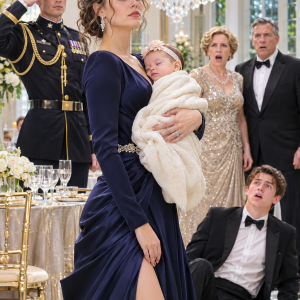
By the time the string quartet reached the final notes of “At Last,” I had begun to believe the hardest part of marrying Adrian Whitlock would be keeping my hands from shaking as I walked down the aisle. The ballroom at the Briarwood Hotel in Asheville was filled with candlelight, white roses, and the quiet expectancy of two hundred and eighty-six guests, most of whom had traveled from somewhere in the Carolinas to watch us promise our lives to each other. My father, Martin Bellamy, stood beside me in his charcoal suit, his arm steady beneath my hand, while Adrian waited under the flower-covered arch with the calm, handsome smile I had loved for five years.
Then he held out his palm.
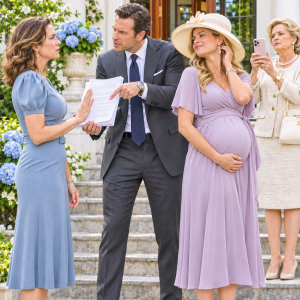
For a moment, I thought he was reaching for my hand. Instead, he turned toward Sloane Mercer, his oldest friend, who stood just behind the first row in a pale blue dress that looked far more like a bridal gown than anything a guest should wear. Adrian took the three-carat ring from my finger, where it had rested for the past eleven months, and slipped it onto hers.
A few people gasped. Someone near the back whispered his name. My father’s fingers tightened around my arm, but he did not move.
Adrian faced me again, as if he had just made a point in an argument we had been having privately and expected me to acknowledge it. “I need you to understand what our life is going to look like. Sloane has been part of my life since we were kids, and I won’t let you keep trying to push her out. If you can accept that she’ll always come first when she needs me, we can finish this ceremony. If you can’t, then I’ll marry her instead.”
I looked at the ring on Sloane’s hand. She lowered her eyes, but not before I saw the small, certain smile at the corner of her mouth. The scene had the polished quality of something rehearsed, and the realization came over me with a strange, almost gentle clarity: whatever I did next, I could not make this a marriage I would be proud to live inside.
So I reached for the ring.
Sloane hesitated, then let me ease it from her finger. I placed it in Adrian’s palm, took my engagement ring from my left hand, and set it beside his cuff link.
“Then we’re finished,” I said. My voice sounded much steadier than I felt. “Please stop the ceremony.”
The officiant looked toward me, then at Adrian, as if he hoped someone might explain that this was a misunderstanding. No one did. My father stepped forward, and I gathered the front of my ivory gown in one hand so I could turn away without catching its hem beneath my shoes.
Behind us, Adrian called my name. His mother, Marjorie, followed with the sharp, controlled voice she used whenever she wanted a room to remember who had the most money in it.
“You can’t just walk away from everything,” she said. “The house is in Adrian’s name. Your parents have no claim to it, and neither do you.”
For months, my parents had helped finance the renovation of a large, aging house outside Knoxville where Adrian and I planned to live. My father’s construction company had arranged the work and paid for materials while we waited for the final transfer to be completed. I had treated it as a family project, an act of trust built on the belief that the documents would be handled honestly.
Marjorie thought the house was a leash. She thought I would look at my gown, the guests, the years I had invested, and decide leaving would cost too much.
I looked back at her. “The last renovation payment is scheduled for Monday. It won’t be sent.”
Her expression changed so quickly that the guests nearest her noticed. My father touched my elbow, and we walked together through the hotel doors while the quartet fell silent behind us. I could feel the weight of every eye in the ballroom, and the long train of my dress brushed the stone floor as though it belonged to some other woman in some other story.
In the parking lot, the evening air was cool and smelled faintly of rain. My father opened the passenger door of his truck, then waited while I gathered my skirt and climbed inside. Only when he had settled behind the wheel did he ask whether I wanted him to say anything.
I watched the hotel lights recede in the side mirror.
“No,” I said. “I want to go home.”
What the Paper Tried to Say

For the first two days, I moved through my parents’ house as if my body had arrived before the rest of me. I took off the wedding gown only after my mother helped me unpin its train, then folded it across the guest-room bed and closed the door. I did not cry as much as I expected. Instead, I kept replaying the ceremony, searching for a moment when Adrian might have changed his mind, as though the right expression or a different answer from me could have turned his ultimatum into a joke.
My closest friend, Tessa Lang, came over on Tuesday with coffee and a paper bag of breakfast sandwiches. She had been my roommate after college and had known me long enough to tell when I was trying to make sense of something by refusing to say it aloud. She sat across from me at the kitchen table while I told her about Marjorie’s comment about the house.
“Did your father keep copies of the renovation paperwork?” she asked.
I called him. He had every invoice, every transfer confirmation, and every draft agreement saved in a file at his office. Tessa came with me to look through them, carrying a notebook and the kind of quiet focus that had once helped her find a missing contract during a major project at her law firm. In the bottom of an envelope, she found a photograph of a page I had never seen before: an acknowledgment stating that my father’s contribution of nearly two hundred thousand dollars had been an unconditional gift to Adrian.
The signature at the bottom looked like my father’s from a distance. Up close, it did not. The first letter leaned too far to the right, and the final stroke was unusually short. My father stared at the page for a long time before saying anything.
“I never signed this,” he said. “And I never gave him that money.”
“We’ll make a clear record of what your father paid, what Adrian received, and who created this document,” she told us. “Don’t contact anyone about the paperwork until we’ve secured the originals and the account records.”
A week later, Adrian’s younger sister, Hallie, asked to see me. She chose a coffee shop halfway between our towns, arrived without makeup, and kept turning a paper cup between her hands. She said she had not known about the false document, but she had heard Marjorie and Sloane discussing the wedding in the weeks before it happened. They had talked about making me accept Sloane’s place in Adrian’s life in front of everyone, so that if I objected, I would look jealous and unreasonable. If I went through with the ceremony, they believed Adrian could keep the house and make me feel too invested to challenge the arrangement.
Hallie’s face tightened as she spoke.
“They thought you’d be too embarrassed to make a scene,” she said. “They thought once you were in that dress, you’d do whatever it took to keep the wedding from falling apart.”
I thought of the small smile on Sloane’s face and realized how carefully she had counted on my silence.
Then Hallie told me something else. Sloane was expecting a baby and had told Adrian he was the father. She was nearly four months along, Hallie said, and the timing had been used to explain why Adrian needed to be close to her, why she needed his help, and why I was expected to accept their unusual closeness without question.
Two days later, a sonogram photograph arrived in the mail, sent anonymously to my parents’ address. On the back, in Sloane’s handwriting, was a message addressed to a man named Peter. I showed it to Laura, who advised me to keep it with the other evidence and not to treat it as proof by itself.
Still, I could not stop wondering who Peter was.