I looked at her. “Did you know I was assigned to sleep in the pantry before we got there?”
Brooke hesitated. “The house was full. Everybody makes sacrifices.”
“That wasn’t my question.”
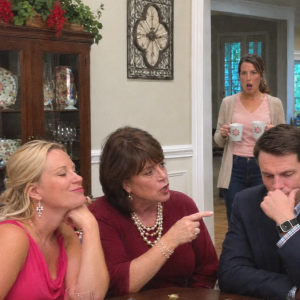
Lorraine leaned forward. “It was a practical decision. Someone had to start breakfast.”
Andrew turned toward her. “If it was practical, why did you write ‘Do not tell Andrew’ on the plan?”
The room became quiet. Tessa stood up.
“I saw the list, Grandma. You wrote that Aunt Mara had to sleep in the pantry and start breakfast at four.”
Lorraine’s cheeks reddened. “You have no business involving yourself in this.”
“I’m involved because I watched you make her do all the work while telling everybody Brooke had paid for it,” Tessa replied.
I opened the photograph on my phone and held it up. The note was plain to see. Lorraine looked at it, then turned her attention to the rest of the room.
“Mara has always wanted credit for every little thing she does,” she said. “She keeps track of everything.”
Andrew took a sheet of paper from his jacket. It summarized our records over the past three years.
“This is a summary of the money Mara and I provided for the household, repairs, and family gatherings. It comes to a little more than twenty-eight thousand dollars.”
Lorraine’s expression changed, but she quickly recovered.
“I never asked for money.”
“You asked for help with specific expenses, and we provided it. Then you told the family that Brooke had covered those costs.”
Pauline rose from her chair and rested one hand on her cane.
“She told me Brooke paid for Thanksgiving dinner,” she said. “I knew Mara had cooked it, but I didn’t know she had paid for it too.”
Brooke looked from her mother to the paper in Andrew’s hand.
“I didn’t know who paid for the groceries,” she said. “Mom told me you were helping me.”
Andrew looked at his sister. “Did you know Mom was giving you the transfers I sent for medical and household expenses?”
Brooke’s mouth opened, but no answer came.
Lorraine stood. “I was trying to help my daughter. Her business was struggling.”
“Then why tell the family that Brooke was paying your bills?” Andrew asked. “And why tell them Mara did nothing?”
“You have no idea what it takes to hold a family together,” Lorraine said. “You’ve spent your life following orders.”
Andrew’s face remained calm, but something in his posture changed. The family had spent years treating him as an ordinary enlisted man who was useful when a heavy job needed doing. They had never asked why his work required secure calls or why he sometimes disappeared for briefings.
“I’m a brigadier general in the United States Armed Forces,” he said. “I lead a large command and manage responsibilities far beyond anything you’ve imagined. I never told you because I wanted one part of my life to stay private, and because I knew you would treat my position as another resource to use.”
No one spoke. Brooke stared at him. Leonard lowered his eyes. Lorraine sank back into her chair, as if the words had changed the shape of the room.
Andrew continued, his voice steady.
“I didn’t need you to admire my rank. I needed you to treat my wife with basic respect. You didn’t do that.”
Lorraine’s eyes filled, though her voice remained sharp.
“If you walk out now, don’t expect to come back.”
Andrew looked toward the front door.
“We’ve been trying to come back for years. We’re done trying to earn a place by accepting whatever you decide to give us.”
He and I left together. Pauline followed us to the porch and took my hand.
“Family isn’t a title one person gets to hand out,” she said.
In the weeks that followed, Lorraine sent long emails to relatives, describing herself as abandoned and suggesting I had turned Andrew against her. But the people who had heard the conversation—or seen the receipts—were less willing to accept her version without question. Brooke withdrew from the family gatherings for a time. She had her own problems with the shop, and the money Andrew had been sending was no longer available to keep it afloat.
Andrew and I made a new plan for helping his parents. We would pay a specific bill directly if we chose to help, but we would no longer send money without knowing where it went. It was a practical boundary, and it gave Andrew room to care about his father without pretending that nothing had happened.
The quiet that followed was difficult for him. I could see how much he missed the family he had hoped they might become, even while he knew that distance was necessary. I tried not to rush him through it. Some decisions are clear in the moment and still hurt later.
By July, Leonard came to visit us alone. He brought a cardboard box filled with tomatoes from his garden, bruised from the ride but fragrant and ripe. We sat on the back deck while the summer insects hummed in the trees.
“I owe you an apology,” he said. “I saw the room list before Christmas. I knew what Lorraine had planned, and I stayed quiet because I didn’t want to start another argument.”
I looked at him. “Staying quiet didn’t keep the peace. It just left me and Lucy to carry it.”
He nodded, accepting the words without trying to soften them.
“You’re right,” he said. “I’m sorry.”
A few months later, Lorraine called Andrew and asked to meet me alone. He told me exactly what she had said, then left the choice to me. I agreed to meet her at a diner outside Cedarville, a neutral place where neither of us had the advantage of familiar rooms and family members.
Lorraine looked smaller than I remembered. She wore a plain sweater and held a cup of coffee between both hands.
“You asked to meet,” I said. “I’m listening.”
She stared at the table.
“The farmhouse is too expensive to keep up. Brooke’s business closed. Walter and I are struggling.”
“I’m sorry to hear that,” I said, though I knew this wasn’t why she had asked me there.
Lorraine glanced up. “I also wanted to explain why I put you in the pantry.”
I waited.
“You were independent, and you had a career I didn’t understand. You were confident in a way that made me feel as if I was losing my place in the family. I thought if I gave you the worst jobs and the least comfortable room, you would eventually stop challenging me.”
Her voice faltered.
“And the money?”
She looked down again. “Brooke was failing, and I couldn’t accept it. I told myself the money was helping her get back on her feet. I told the family she was supporting us because I wanted them to believe she was doing well. I made it worse by pretending you hadn’t helped.”
For the first time, Lorraine spoke about what she had done without blaming me for it. I could see regret in her face, but regret did not erase the choices she had made.
“I accept that you’re telling me the truth now,” I said. “I’m not ready to forgive you. If that changes, it will be because your actions keep matching your words.”
She nodded, and neither of us reached across the table. We left without a hug.
In November, Leonard invited the family to lunch at a restaurant. I went with Andrew. Brooke was there, quieter than before, and Tessa sat near Pauline. Before the food arrived, Lorraine stood beside the table.
“I owe Mara and Andrew an apology,” she said. “I misrepresented the help they gave us, and I treated Mara cruelly because I was insecure and wanted to control the family. They helped us, and I gave them contempt in return. I was wrong.”
The room stayed quiet. Brooke looked down at her hands. Pauline took a sip of water and said, “That is the first time the story has matched the facts.”
No one embraced. Nothing was suddenly repaired. Still, the truth had finally been spoken in front of the people who had been asked to believe otherwise.
That evening, Andrew and I brought the Christmas decorations down from the attic. I found the thin plaid blanket I had wrapped around Lucy in the pantry. I held it for a moment, remembering the cold room and the sound of the door opening at two in the morning.
Then I placed the blanket in a donation box.
Andrew came into the living room carrying a carton of ornaments.
“We could host Christmas here this year,” he said. “Just us, and whoever can join us with kindness.”
I smiled. “That sounds like a good plan.”
For a long time, I had believed that strength meant absorbing discomfort without complaint, especially when the people causing it were family. I had thought that patience and generosity would eventually make me welcome. What I learned was simpler and harder: love does not require a person to keep proving how much mistreatment they can endure. Sometimes the bravest thing you can do is take your child’s hand, walk out of the cold, and decide that home will be a place where both of you are wanted.