The Papers on My Blanket

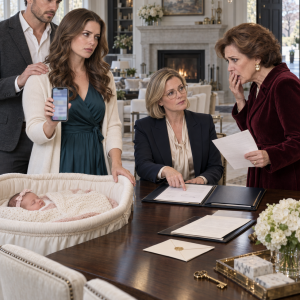
Two hours before surgeons were scheduled to remove a growth from my brain, my husband walked into my hospital room carrying divorce papers.
I was forty-six years old, frightened in a way I had never known how to describe, and still trying to convince myself that the trembling in my hands came from the chilly air inside the private medical center in Raleigh. For nearly sixteen years, I had believed I was married to an imperfect but fundamentally decent man. I expected Grant Holloway to sit beside me, take my hand, and tell me we would face whatever came next together.
Instead, he arrived wearing a charcoal suit I had never seen before, a silk tie, and enough expensive cologne to fill the room before he reached my bed. Under one arm, he carried a brown leather portfolio.
“Why are you dressed for a business dinner?” I asked.
He glanced at his watch rather than at me.
“Because I have one after this.”
He opened the portfolio, removed a stack of documents, and placed them on the blanket covering my legs.
For a moment, I thought they were forms from the hospital. Then I saw the heading.
Petition for Dissolution of Marriage.
My fingers tightened around the edge of the blanket.
“What is this?”
“Exactly what it looks like.”
Grant pulled the visitor’s chair closer but did not sit. He looked impatient, almost inconvenienced, as if my surgery had interrupted a full afternoon.
“Natalie and I want to begin our life without this hanging over us,” he said. “Her little boy turned fourteen months old last week. He’s mine, Evelyn. I’ve already waited long enough.”
The monitor beside my bed began recording the change in my pulse.
Natalie Price was not a stranger whose name I had discovered on a hotel receipt. She had been my closest friend since our first year at college. When doctors found the growth six months earlier, she had stood in my kitchen, held both my hands, and promised she would make sure Grant had meals, company, and whatever help he needed while I concentrated on treatment.
At last, I understood what kind of help she had been providing.
“How long?” I asked.
Grant exhaled as if the question were beneath him.
“Does it matter now?”
“It matters to me.”
“Then tell yourself whatever makes this easier.”
He paced to the window and looked down at the hospital courtyard.
“The point is, Natalie gave me something you never could. I have a son now. I finally have a real family.”
That sentence should have broken me, and perhaps a part of me did break, but not the part he expected. For years, I had carried the sorrow of being unable to have children, and Grant knew exactly where that sorrow lived. He had once held me after every disappointing appointment and said that the two of us were enough. Now he was using the most tender wound in my heart as proof that I had failed him.
Then he turned and added, “You’re not well, Evelyn. Natalie is younger, healthy, and ready to build a future. I deserve that.”
“And you needed to tell me this today?”
“I need your signature today. If the procedure doesn’t go as planned and you don’t wake up, I don’t want Natalie and me trapped in months of paperwork over the condo, the accounts, and everything else.”
There it was: the truth beneath the confession.
He was not clearing his conscience. He was protecting what he believed he owned.
Fifteen years and ten months of marriage had been reduced to a line above my printed name, presented to me while an intravenous tube ran into my arm and a surgical cap waited on the bedside table.
I studied his face and wondered how long I had mistaken confidence for character. Then, very quietly, the fear inside me changed shape. I was still afraid of the procedure, but I was no longer afraid of losing Grant.
“All right,” I said.
He blinked.
“What?”
“Give me the pen.”
Suspicion passed across his expression.
“You’re not going to make a scene?”
“Would a scene change your mind?”
“No.”
“Then give me the pen.”
I signed where he indicated. My handwriting looked unsteady, but my name was perfectly legible.
Grant gathered the pages with visible relief.
“I knew you’d eventually be reasonable.”
He tucked the papers into the portfolio, adjusted his cuffs, and walked toward the door.
“I hope everything goes well in there,” he said, as casually as if I were having a tooth repaired.
He did not kiss my forehead. He did not touch my shoulder. He did not look back.
I waited until the door closed before allowing myself one deep breath.
Grant had overlooked something important.
The luxury condominium in Charlotte where he intended to live with Natalie had not been purchased with his salary. Neither had the watches, tailored suits, vacations, or restaurant dinners he enjoyed. The premium cards in his wallet were additional cards on accounts held in my name, and the monthly deposits that had kept his parents’ custom-furniture workshop open for the past five years had never come from a mysterious investment he had made on their behalf.
Every dollar came from me.
My father had spent four decades building a network of warehouses, distribution centers, and commercial properties across the Carolinas. After my parents were gone, those holdings passed to me through family companies and trusts established long before my marriage. I kept everything separate, not because I wanted to deceive Grant, but because my father had taught me to protect what generations of work had created.
Grant knew my family had once been comfortable, but he had no idea how much remained. Whenever he assumed his income supported our life, I let him. I told myself I was preserving his pride.
Lying beneath those hospital sheets, I finally understood that I had not protected his pride. I had allowed it to grow without truth, gratitude, or restraint.
A nurse entered to take me downstairs. As she adjusted the rails on my bed, I closed my eyes and made myself a promise.
If I opened them again, the life built on silence would be over.
The procedure lasted most of the day.
When awareness slowly returned, my throat was dry, my head felt unbearably heavy, and the lights above me seemed blurred around the edges. A surgeon leaned into view with a gentle smile.
“Evelyn, the procedure went beautifully. We removed the growth, and everything looks encouraging.”
I could not yet speak, so I closed my eyes in gratitude.
I had been given more time.
And for the first time in years, I intended to use that time for myself.
When the Accounts Fell Silent

A week later, I could walk slowly through the hospital corridor without someone holding my arm. That morning, I called Meredith Shaw, the attorney who had managed my family’s business affairs since before my wedding.
Meredith listened without interrupting as I described the papers, Natalie, the child, and Grant’s concern about avoiding complications if I failed to wake.
When I finished, there was a long silence.
“I need your authorization for three immediate steps,” she said. “First, I’ll end the voluntary transfers to Grant’s parents. Second, I’ll remove him as an authorized user on your cards. Third, I’ll move your personal funds out of the joint household account, leaving a documented amount sufficient for ordinary shared obligations while the case proceeds.”
“Do all three today.”
“What about the condominium?”
“Protect it through the proper process. I don’t want revenge, Meredith. I want clarity, distance, and the law followed exactly.”
By nine the following morning, Grant discovered that the cards he had carried for years would no longer purchase so much as a cup of coffee.
He called me from a luxury automobile showroom.
“What did you do to my money?”
Even with my head aching, I nearly laughed.
“Your money?”
“Don’t play games with me. I’m trying to buy Natalie an SUV, and the card was declined.”
“Then use the account where your salary is deposited.”
“You had no right to humiliate me in public.”
“You asked me to sign away our marriage beside an operating room. I think you’ll recover from an awkward conversation with a salesman.”
He used several words that confirmed I had made the correct decision, then ended the call.
Two hours later, Natalie appeared in my room carrying a designer handbag but no flowers.
She looked polished and pleased with herself in a pale pink dress, her blond hair arranged as though she had come from a salon rather than to visit a recovering friend.
“Well,” she said, stopping near the bed. “You really did make it through.”
“You sound disappointed.”
“Don’t be dramatic. This is already uncomfortable enough.”
She sat down, crossed her legs, and smiled with the satisfaction of someone arriving to collect a prize.
“Grant told me you signed. Thank you for not dragging this out. We can finally be a proper family.”
She opened her phone and showed me a photograph of herself, Grant, and the little boy beside the fountain of an expensive resort. Grant was wearing the silver watch I had given him on our fifteenth anniversary.