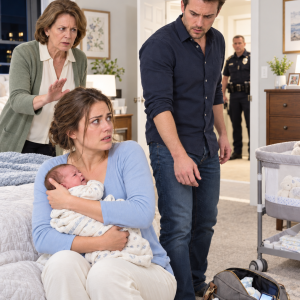
Grant stared at his mother.
“She was going to.”
“No,” I said quietly. “You decided I was going to.”
The hospital supervisor entered with two members of security.
She introduced herself as Dr. Evelyn Mercer, the patient-services administrator.
She looked at the wet bedding.
Then at me.
“Mrs. Whitlock, do you feel safe with these visitors in your room?”
“No.”
That single word changed everything.
One security officer stood near the bassinets.
The other asked Brooke to hand over my phone.
Grant tried to maintain his usual calm.
“This is a private marital disagreement.”
Dr. Mercer shook her head.
“Not inside this hospital, it isn’t. A patient asked for space and that request was ignored.”
Tessa stepped forward.
“I witnessed part of what happened, and I heard Mr. Whitlock’s statement.”
Grant looked at her.
“You misunderstood me.”
Tessa’s voice remained steady.
“I did not.”
The Moment I Stopped Being Afraid
For most of my marriage, Grant’s greatest strength had been certainty.
He spoke like a man who had already won.
He made decisions quickly.
He expected people to follow.
That afternoon, for the first time, I watched that certainty disappear.
The custody papers remained unsigned.
The estate was no longer his.
His sister had created her own evidence.
A nurse had witnessed the confrontation.
And his mother had finally begun asking questions he could not easily answer.
Marissa sat beside me.
“You do not have to make another major decision today.”
I looked toward Caleb and Owen.
They slept through everything.
Two tiny boys who knew nothing about property deeds, lawyers, family names, or power.
They only knew warmth.
Food.
A familiar voice.
Arms that held them gently.
I touched Caleb’s small hand.
“I already made the important decision.”
Grant looked at me.
“Which is?”
I met his eyes.
“They stay with me until a court decides otherwise. And you will never again bring papers into my hospital room expecting me to sign them because I’m tired, frightened, or alone.”
He stared at me for several seconds.
Then Marissa added quietly:
“And all future communication goes through counsel.”
Security escorted Grant, Brooke, and Lorraine from the maternity floor.
Lorraine paused at the door.
For the first time in nine years, she did not look powerful.
She looked tired.
“Laurel,” she said, “I didn’t know all of this.”
I believed that she did not know everything.
But she had known enough to stand beside him while he tried to pressure me.
So I gave her the only answer I had left.
“You knew I was here alone with two newborn babies, Lorraine. That should have been enough.”
She lowered her eyes and left.
What Happened After the Hospital
The next several months were not simple.
Real life rarely changes because of one dramatic document.
There were hearings.
Financial reviews.
Parenting evaluations.
Long meetings with attorneys.
Grant challenged the property transfer, but the signatures were valid and the deadlines were clear.
Whitlock Ridge remained in my trust.
More importantly, I never used the estate as a weapon against him.
I did not want revenge.
I wanted stability.
The recorded video became only one piece of a much larger picture showing how decisions had been made around me for years without my informed consent.
Eventually, Grant was given structured parenting time with the twins under conditions designed to keep conflict away from them.
Brooke was not permitted to visit them for a long period.
Lorraine wrote me three letters.
I answered only the third.
By then, she had stopped defending what happened and finally apologized without adding an excuse.
I sold Whitlock Ridge eighteen months later.
People were shocked.
They assumed winning the estate meant I would spend the rest of my life enjoying the fact that the Whitlock family had lost it.
But I never wanted their house.
I wanted my own life.
I bought a smaller home outside Charlottesville with a wide front porch, maple trees in the backyard, and enough space for two little boys to race toy trucks across the kitchen floor.
The first morning there, Caleb and Owen were eating pancakes when Caleb pointed toward the window.
Sunlight was coming through the trees.
“Mommy, this is our house?”
I smiled.
“Yes.”
Owen looked around.
“Forever?”
I thought about that question.
Nothing in life is guaranteed forever.
Not houses.
Not marriages.
Not money.
But some promises can still be made.
I knelt beside them.
“As long as this is where we feel safe, loved, and happy, this is home.”
Caleb wrapped his arms around my neck.
Owen joined him.
And for the first time in years, home did not feel like something I had to earn the right to keep.
It simply belonged to us.
Sometimes the most important form of strength is not raising your voice, but quietly preparing yourself so that when someone tries to make decisions for you, you still have the knowledge and courage to choose your own path.
A beautiful home, an important last name, or financial success means very little when the people inside that life forget that respect must exist before anything can truly feel like family.
When someone repeatedly tells you that your concerns are too small to matter, pay attention, because your discomfort may be warning you about a pattern that has been hidden beneath ordinary excuses for far too long.
Protecting yourself does not always mean planning revenge; sometimes it simply means keeping records, understanding what you sign, asking questions, and refusing to hand complete control of your future to another person.
Children do not need adults to win every argument around them; they need adults who are willing to put pride aside and build a calm, stable environment where love is never used as leverage.
The moment you stop believing that another person has the right to decide what you deserve can become the beginning of a completely different life, even if that new beginning first appears during one of your hardest days.
People who are used to controlling every room often appear powerful only because others have been conditioned to remain silent, and sometimes one clear boundary is enough to reveal how fragile that power really is.
Walking away from a valuable house, a prestigious family name, or a life that looks impressive from the outside is not necessarily losing when what you gain in return is peace, freedom, and the ability to recognize yourself again.
An apology becomes meaningful only when it stops explaining away the harm and begins acknowledging the choices that allowed another person to feel dismissed, isolated, or powerless.
Home is not defined by whose name appears on a gate or how much property lies behind it; home is the place where you no longer have to prove that you deserve to feel safe, respected, heard, and loved.