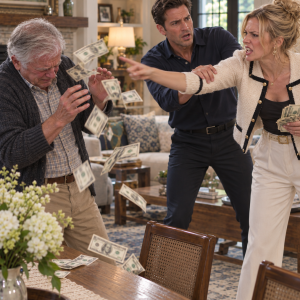
It was not an unreasonable legal question.
It was simply the worst possible first question.
“You didn’t ask whether I was all right.”
His face changed.
“Julia—”
“You asked for documentation.”
That night, I did not return to our house.
The Box I Had Left Behind

Shortly after one in the morning, I unlocked a rented storage room beneath an old dance school outside Baltimore.
My former studio manager had kept several boxes for me after I vanished from professional life.
Dust covered almost everything.
Inside the largest box were notebooks, rehearsal schedules, photographs, programs and an old external drive.
Near the bottom, I found a picture taken during the Santa Fe residency.
I was standing beside Adrian, laughing at something outside the frame.
Around us were dancers and workshop fellows.
Three people away from me stood Brooke Kendall.
Younger.
Less polished.
But unmistakably Brooke.
I sat on the floor.
She had known me before Owen.
She had known Lila Hart.
She had watched me rehearse.
And for years she had stood beside my husband pretending I had never been anyone worth recognizing.
At roughly the same time, Owen was reopening acquisition records at his office.
By morning, his corporate counsel had identified the person who had reviewed the dance archive before the purchase.
Brooke Kendall.
When Owen confronted her later that day, she remained calm.
“The seller represented that the rights were complete.”
“Did you know Julia created some of the material?”
Brooke waited too long.
“I learned that later.”
“When?”
“I don’t remember exactly.”
Owen stared at her.
“You remember what coffee every board member drinks.”
Her posture stiffened.
“What exactly has Julia accused me of?”
Owen went quiet.
“I never said she accused you.”
For the first time, Brooke looked unsettled.
That afternoon Owen visited Lorraine.
His mother’s response was predictable.
“Julia needs to make a statement before this harms the company.”
“What kind of statement?”
“Something calm. She can say similarities between choreography are common.”
Owen stared at her.
“What if the work is hers?”
Lorraine’s expression hardened.
“Then she should remember that your company supports the life she enjoys.”
Something in Owen finally shifted.
“Maybe that’s the problem.”
While they argued, Adrian offered me something I had not expected.
A job.
The National Partnership for Social Dance was preparing a new production series at the Capital Arts Pavilion in Washington, D.C., and he wanted me as co-artistic director.
I closed the binder after reading the first page.
“I haven’t worked professionally in years.”
“You stopped performing,” Adrian said. “You didn’t stop knowing.”
I opened the binder again.
One of the companies bidding to provide venues and national touring support was Mercer Urban Venues.
My phone rang.
Owen.
“Brooke reviewed the archive,” he said.
“I know.”
“How?”
“Because she was in Santa Fe with me.”
He went silent.
Then came the sentence that told me we still had a long way to go.
“Don’t handle this without me.”
I closed my eyes.
“Owen, I don’t need you walking in front of me anymore.”
“I’m trying to protect you.”
“Then stand beside me when I ask.”
I picked up Adrian’s pen.
“What are you doing?” Owen asked.
“Accepting the artistic-director position.”
“For the project our company is bidding on?”
“Yes.”
My hand was trembling when I signed.
My voice was not.
“The next time we meet professionally, I won’t be sitting at your table.”
Opposite Sides of the Room
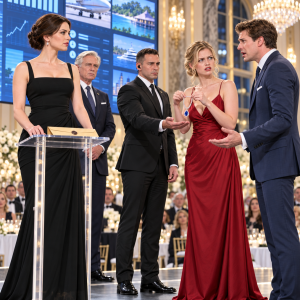
Three days later, Owen walked into a presentation room at the Capital Arts Pavilion and found me seated across from him.
In front of me was a simple nameplate:
JULIA HARPER
CO-ARTISTIC DIRECTOR
For the first time in our marriage, he was entering a room where my judgment mattered more than his approval.
His company gave an excellent presentation.
That irritated me more than I expected.
Owen was good at what he did, and Mercer Urban Venues had created a thoughtful national plan connecting theaters, arts districts and community spaces across several American cities.
Then a movement diagram appeared on the screen.
I stopped writing.
Two performers moved apart.
Waited three counts.
Crossed on opposing lines.
My choreography.
An unfinished piece I had called Quiet Street.
I raised my hand.
“Who created the movement structure for the second section?”
One of Owen’s executives checked his notes.
“It came from our legacy archive.”
“Who is the original creator?”
“The attribution is incomplete.”
I looked at Owen.
“Then why is work with incomplete attribution being used in a proposal?”
After the meeting, Owen found me in the parking level.
“Were you questioning our proposal more aggressively because it’s mine?”
I turned slowly.
“Is that what Brooke told you?”
His expression gave me my answer.
I removed photocopies from my bag and placed them on the hood of my car beside pages from his presentation.
Same floor pattern.
Same count structure.
Same handwritten directional logic.
“My notebook,” I said. “Your company’s proposal.”
Owen looked down.
“I didn’t know.”
“I know.”
My voice softened.
“That is what hurts.”
He looked at me.
“You never told me who you were.”
“That’s true.”
He seemed surprised that I admitted it.
“I shut down after Santa Fe. I expected you to understand things I was too afraid to explain. That wasn’t fair.”
Then I pointed toward the pages.
“But when the truth finally stood in front of you, you still trusted everyone’s interpretation of me before you trusted mine.”
The next morning I disclosed the personal conflict to the arts committee and removed myself from decisions specifically involving ownership of my archived work.
I wanted fairness even if fairness made my own case harder.
Meanwhile, Adrian continued examining old records.
Late that afternoon, he sent me a photograph.
The timestamp read 9:36 p.m., eleven minutes before the figure entered the equipment room in the old footage.
Brooke stood in a hallway.
She was carrying a black shoe bag.
My initials were stitched beneath the handle.
J.H.
My hands began to shake.
I called Owen.
“Brooke had my shoes shortly before someone entered the storage room.”
He did not interrupt.
“For four years,” I said, “I’ve told myself what happened in rehearsal was simply bad luck.”
A long silence followed.
“Julia,” he finally said, “I’m listening.”
It was the first time I noticed the difference between those words and an instruction.
The Truth Brooke Had Buried

The matter might have remained quiet if Lorraine had not invited me to her townhouse two days later.
Two attorneys were waiting.
So was a public-relations consultant.
A prepared statement sat on the dining table.
It claimed that I had no evidence Mercer Urban Venues knowingly used my work and that similarities could reflect common conventions within tango.
I pushed the pages away.
“You want me to question my own authorship in public.”
Lorraine folded her hands.
“I want you to protect your husband.”
“Does Owen know about this?”
“My son does not need to know every step taken on his behalf.”
Before I could answer, the front door opened.
Owen had arrived unexpectedly.
He saw the lawyers.
Then the statement.
“What is that?”
Lorraine stood.
“Something that will keep this family from becoming a spectacle.”
Owen read the document.
His face went quiet.
Then he tore it in half.
“Do not ask Julia to sign anything in my name again.”
Lorraine stared at him.
“I’m protecting you.”
“No. You’re protecting an image.”
Within hours, Owen authorized an external review of every artistic archive Mercer Urban Venues had acquired.
One email changed everything.
Years earlier, Brooke had written to an acquisitions manager:
Keep the Santa Fe source inside the packaged archive. No need to reopen individual attribution.
When Owen confronted her again, I was present.
At first she denied remembering.
Then the years of careful composure simply gave way.
“You don’t even remember me from Santa Fe, do you?” she asked.
“I remember you now.”
Brooke laughed without humor.
“Everyone remembered you. That was the problem.”
She told me how the instructors praised me, how visiting photographers followed my performances, how other fellows would rehearse for days only to watch me change one musical phrase and receive all the attention.
“I resented you,” she admitted.
I pointed toward the photograph of my shoe bag.
“Did you interfere with my shoes?”
Her face tightened.
“No.”
“Then why were you carrying them?”
Brooke told us a wardrobe technician named Martin Hale had asked her to deliver the bag to the equipment room, claiming he needed to inspect several pairs before rehearsal.
She had done it.
After my injury, she later discovered that Martin had copied choreography files from shared computers while the residency’s parent organization was collapsing financially.
He told people I would never return.
Brooke stayed quiet.
Years later, when the same archive appeared in Mercer’s acquisition process, she recognized my work immediately.
She hid the source.
“Why?” Owen asked.
Brooke looked at me.
“Because by then she was married to you.”
I understood.
“You needed me to remain the quiet wife who didn’t dance.”
Brooke lowered her eyes.
“If people connected Julia Harper to Lila Hart, they would start asking where those works came from.”
“So every time you joked about my dancing…”
“I was hoping you would keep believing that part of your life was over.”
Then I asked the question I had avoided.
“And Owen?”
She looked toward him.
“Being close to him gave me influence.”
Owen’s face hardened.
Brooke did not need to say more.
That evening, my husband finally understood something larger than Brooke’s dishonesty.
His habit of dismissing me had created a space where another person could shape what he believed about his own wife.
What It Cost to Tell the Truth
Mercer Urban Venues immediately paused every production connected to the disputed archive.
The decision cost money.
Board members protested.
Investors asked questions.