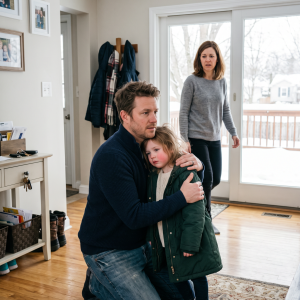
He lowered his eyes.
“Okay.”
For once, he didn’t argue.
The next several months were not dramatic.
They were paperwork, counseling appointments, financial disclosures, separate accounts, difficult conversations, and long afternoons when I wondered whether love could survive after trust had been reduced to almost nothing.
Grant sold things he didn’t need and returned the money he had hidden.
He canceled the daycare reservation.
He found another job.
He began counseling on his own.
Most importantly, he stopped asking me to reward him for improving.
When he spent time with Lucy, he changed diapers, washed bottles, packed bags, handled appointments, and learned that parenting wasn’t something he was “helping” me do.
It was his work too.
I moved into a small two-bedroom apartment.
The bathroom had ugly beige tile and weak water pressure.
I loved it.
The first night, I took a shower.
After four minutes, my body automatically tensed.
I expected a beep.
Nothing happened.
Five minutes.
Seven.
Ten.
I stood beneath the warm water and cried quietly, because I finally understood how small I had allowed my world to become.
A shower shouldn’t have felt like freedom.
But that night, it did.
Learning to Ask Instead of Decide
Nearly a year passed before Grant and I began couples counseling.
Not to save our marriage at any cost.
To decide whether there was still a healthy marriage available to us.
At our first session, Grant didn’t blame his job loss, his father, or financial pressure.
He simply said:
“I used money to control her because I was scared.”
Then:
“I treated her time like it belonged to the household, while mine belonged to me.”
And finally:
“I made her basic needs feel selfish.”
The counselor asked what I needed from Grant if we were going to continue.
I answered with one word.
“Choice.”
Choice about work.
Choice about money.
Choice about motherhood.
Choice about my own time.
Choice about whether our marriage continued at all.
Grant nodded.
Then, perhaps remembering everything we had learned, he corrected himself.
“I understand.”
That mattered more.
We didn’t move back together immediately.
Trust returned in inches.
He showed me financial statements without being asked. We created one household account for shared expenses and kept separate personal accounts. Childcare decisions required two yeses. Neither of us could secretly take on debt.
And when Grant worried about money, he learned to say:
“I’m scared about money.”
Not:
“You’re spending too much.”
There is an enormous difference between those sentences.
One reveals fear.
The other turns fear into someone else’s cage.
Twelve Minutes
Three years after Lucy was born, our second child arrived, a little boy named Owen.
By then, Grant and I were living together again in a smaller house we had purchased jointly.
Both names were on every important document.
Nothing hidden.
Nothing assumed.
During the first weeks after we brought Owen home, Grant took leave from work.
One night, the baby woke shortly after two.
Grant climbed out of bed before I could move.
“I’ve got him.”
“I’m already awake.”
“Then be awake horizontally.”
I laughed.
He carried Owen downstairs.
When I woke again later, the room was quiet.
I found Grant in the living room folding laundry so badly that one of my shirts was inside out.
“What are you doing?”
“Contributing.”
“That isn’t how you fold a shirt.”
He looked at it.
“It has fewer wrinkles than when I started.”
I smiled and went upstairs.
Then I took a shower.
I washed my hair slowly.
Used conditioner.
Stood under the warm water without hurrying.
Nobody knocked.
Nobody called my name.
Nobody told me the baby needed me because Grant was already caring for him.
When I finally turned off the water and walked into the bedroom, twelve minutes had passed.
Three times the limit Grant had once decided was enough for me.
For a moment, I almost told him.
Then I realized I didn’t need to.
That was the part of our story that mattered most.
Not the house.
Not the hidden account.
Not even whether our marriage survived, although eventually, carefully, it did.
What mattered was that I no longer counted the minutes required to take care of myself.
Years later, when Lucy was old enough to understand a softened version of the story, I told her that her father had once made a very foolish household rule.
“What rule?” she asked.
“He thought he could decide how long somebody else was allowed to shower.”
Her eyes widened.
“That’s weird.”
From the kitchen, Grant called, “Extremely weird.”
Lucy turned toward him.
“Why did you do that?”
Grant walked in carrying a plate of pancakes and sat beside her.
He thought for a moment.
“Because I was scared about things I didn’t know how to talk about.”
Lucy considered this carefully.
“So you got bossy?”
Grant smiled sadly.
“Very bossy.”
She looked at me.
“Did Mom fix you?”
I laughed.
Grant didn’t.
He shook his head.
“No, sweetheart. Mom protected herself.”
Then he tapped his chest.
“I had to fix me.”
Lucy nodded as though this were the most obvious thing in the world, then poured far too much syrup over her pancakes.
Grant opened his mouth.
I looked at him.
He closed it again.
Lucy noticed.
“Were you going to tell me that’s too much syrup?”
Grant cleared his throat.
“I was considering it.”
“Bossy.”
I laughed so hard I nearly spilled my coffee.
Grant laughed too.
And sitting there in that noisy kitchen, with syrup on the table, laundry waiting upstairs, a baby beginning to fuss, and absolutely nothing under control, I finally understood what I wished both of us had understood from the beginning.
Love does not make another person smaller so that you can feel safer.
Love does not measure affection in dollars, obedience, efficiency, or minutes.
And love is never proven by how much someone is willing to surrender just to keep the peace.
Sometimes a family changes because someone finally says, “Enough.”
Sometimes it changes because the person who caused the hurt accepts that regret is not the same thing as repair.
And sometimes repair is nothing grander than a father getting up with his baby at two in the morning, a husband asking instead of deciding, a woman taking twelve peaceful minutes beneath warm water without once looking at the clock, and a little girl growing up in a home where she will never be taught that love requires permission to breathe.
There were no timers in our house anymore.
And eventually, I stopped counting altogether.