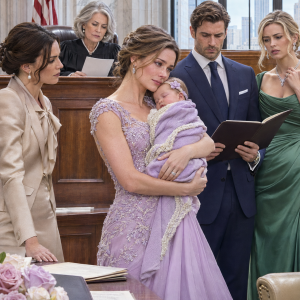
“You could have damaged everything I spent years building.”
“I know.”
“You confirmed I was a lawyer and accused me anyway.”
“I know.”
“I don’t trust you.”
She nodded.
“You shouldn’t.”
That answer surprised me more than an excuse would have.
The Apology Without an Excuse
The months afterward were difficult.
Jocelyn faced professional consequences because the investigation became known at the organization where she worked.
She resigned.
Several community boards asked her to step away.
My parents initially blamed me for refusing to make the problem disappear.
I stopped answering their calls.
For once, silence was not punishment.
It was protection.
Jocelyn did something I never expected.
She told the truth.
Whenever someone asked what happened, she said she had knowingly made a false accusation against her sister.
No excuses.
Six months later, she mailed me a letter.
I left it unopened for more than a week.
When I finally read it, one paragraph stayed with me.
“I spent years believing I loved you because I never openly wished for your life to go badly. Now I understand that I enjoyed every moment when our parents made you seem smaller, because your smallness made me feel secure. When I discovered the life you had built, I felt threatened instead of proud. That was my failure, not yours.”
I cried.
Not because the letter repaired our relationship.
It did not.
I cried because it was the first apology from anyone in my family that did not contain an excuse.
The Box My Mother Had Hidden
Nearly two years later, my mother asked me to visit the house in Connecticut.
She placed an old cardboard box on the dining table.
Inside were documents from my life.
My community-college graduation photograph.
My university acceptance letter.
My law-school scholarship notice.
My graduation announcement.
A newspaper article about the Westbrook trial.
I looked at her.
“You kept all of this?”
She nodded.
“Why?”
Her eyes filled.
“Because I was proud of you.”
Instead of comforting me, the answer made me angry.
“Then why didn’t you ever say that?”
She looked down.
Finally, she whispered:
“Because every time you succeeded, I had to admit that I had been wrong about you.”
The room became very quiet.
My father sat across from us.
“I did the same thing,” he said. “We kept minimizing what you accomplished because admitting how well you were doing meant admitting how unfairly we had judged you.”
At the bottom of the box was an envelope in my grandmother’s handwriting.
She had passed away when I was in college.
Inside was a note.
It said she believed I would eventually become an attorney and hoped someone would encourage me when I was ready to try.
I pressed the paper against my chest.
All those years, I had believed no one in my family had seen me.
I had been wrong.
One person had.
And sometimes one person is enough to keep a small light burning.
The Life I Finally Chose for Myself
Years later, I became a partner at my firm.
My name appeared on the glass outside my office.
Mallory Keene.
I stood there the first morning longer than I expected.
Once, I had dreamed about my parents seeing my name on a law-office door and finally admitting they had underestimated me.
But standing there, I realized I no longer needed that moment.
Their recognition was no longer the prize.
I had learned something more important.
Success is not valuable because it forces people who doubted you to apologize.
It is valuable when it gives you the freedom to become fully yourself.
I later created a small scholarship for community-college students planning to pursue legal careers.
The application included one question:
What is something people have underestimated about you?
At the first award ceremony, the recipient was a young woman working nights while attending school.
She told me her family believed law school was unrealistic.
I smiled.
“Mine did too.”
Her eyes widened.
“Really?”
“Really.”
Then I told her the words someone should have told me when I was seventeen.
“You do not need to prove that you are extraordinary before you are allowed to believe in your own future.”
Her entire expression changed.
And in that moment, I understood something my grandmother had known long before I did.
Sometimes changing a person’s life does not require carrying them all the way to the destination.
Sometimes you simply make sure there is one light waiting when they reach the darkest part of the road.
Jocelyn and I never returned to the relationship we had as children.
We built something different.
Smaller.
Slower.
More honest.
Occasional coffee.
Birthday messages.
Conversations without competition.
My parents changed too, although some boundaries remained.
I learned that forgiveness did not mean pretending the past had never happened.
And healing did not require forgetting the hearing, my sister’s accusation, or all those dinners where I had been introduced as the daughter expected to do something ordinary.
Healing meant remembering those things without allowing them to define me.
One evening, long after becoming partner, I sat alone in my office reviewing a difficult case.
My law license hung on the wall.
The same license my sister had once claimed could not possibly exist.
I looked at it and smiled.
Years earlier, that document had felt like proof.
Proof that I belonged.
Proof that my family had been wrong.
Proof that I was not the person they had decided I would become.
Now it was simply paper behind glass.
I no longer needed evidence that I was worthy of my own life.
I turned off the office light, picked up my coat, and walked toward the elevator.
For years, I thought my greatest victory would be making my family finally see me.
I had been wrong.
My greatest victory was learning to see myself.
Sometimes the people closest to us become so attached to an old version of who we are that they would rather question our growth than admit we have become someone they never expected, which is why our future cannot depend on receiving permission from people who only understand our past.
Being underestimated can hurt deeply, but spending your entire life trying to prove others wrong can become another kind of prison, because true freedom begins when your choices are guided by the life you want rather than by the reaction you hope to receive from those who once doubted you.
Parents may believe that constant comparison motivates their children, yet favoritism can quietly teach one child that they are never enough while teaching another that they must always remain superior, leaving both children carrying wounds that may follow them far beyond childhood.
A sincere apology does not erase the consequences of a harmful choice, but an apology without excuses can become the first honest step toward rebuilding something healthier because real accountability begins when a person stops explaining why they were wrong and simply acknowledges that they were.
You do not have to minimize your achievements simply because your success makes someone else uncomfortable, and you should never feel guilty for becoming capable, confident, educated, successful, or happy merely because another person built their identity around believing you would remain beneath them.
One teacher, mentor, grandparent, friend, colleague, or stranger who genuinely believes in us at the right moment can change the direction of an entire life, because sometimes we do not need someone to build the road for us—we only need someone to remind us that the road is worth taking.
Forgiveness and reconciliation are not the same thing, and you are allowed to forgive someone internally while still maintaining distance, boundaries, and caution if rebuilding trust would require more time than the other person wishes it did.
Success is not the moment when everyone who underestimated you finally admits they were wrong; success is the quieter moment when their opinion stops determining how you see yourself, what risks you are willing to take, and how much happiness you believe you deserve.
Never assume that an ordinary beginning guarantees an ordinary destination, because community colleges, small apartments, secondhand textbooks, difficult seasons, quiet sacrifices, and paths that impress nobody at first can still lead to extraordinary lives when someone continues moving forward with patience and purpose.
The strongest way to answer years of being underestimated is not to spend your life demanding recognition from the people who withheld it, but to become the person you were meant to be and then turn around to offer another overlooked person the encouragement you once desperately needed yourself.