I hadn’t wanted my brother to spend Christmas feeling isolated.
“The invitation is still open,” I told him.
“I don’t think she’ll come.”
“That’s her choice. But there’s room for all three of you.”
The next morning, I woke before sunrise to prepare our holiday meal.
By early afternoon, relatives began arriving.
Rosemary entered carrying a homemade dessert.
When she saw her name card, she stopped.
“You saved a place for me.”
I hugged her.
“There should always have been one.”
By three o’clock, twenty-six family members were gathered around our table.
My father was laughing with Howard.
My mother was helping Lacey serve bread.
Wyatt proudly showed everyone his name card.
The house was crowded, noisy, and wonderful.
Then my phone rang.
It was Spencer.
“Bennett, can my daughter and I still come?”
I looked toward the extra chairs waiting near the dining room.
“Of course. Come over.”
Twenty minutes later, Spencer arrived with his daughter.
The children ran to greet each other.
My brother stood in the doorway, looking at the room full of relatives he hadn’t seen together in years.
His eyes filled with tears.
“I forgot what Christmas used to feel like,” he whispered.
Celeste didn’t come.
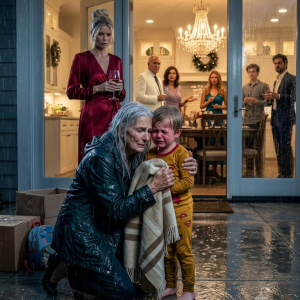
She spent the holiday in her beautifully decorated home, surrounded by an elaborate dinner prepared for guests who had chosen to celebrate elsewhere.
For years, she had controlled who could sit at her table.
Now, everyone had found another place to belong.
The Apology I Had Waited Years to Hear
After dinner, my mother joined me in the kitchen.
She picked up a towel and began drying dishes.
For several minutes, neither of us spoke.
Then she looked at me.
“Bennett, I owe you an apology.”
I turned off the faucet.
“For what, Mom?”
“For watching it happen. For telling myself it wasn’t serious. And for not speaking up when Wyatt needed someone to defend him.”
Her voice trembled.
She admitted that allowing Celeste to organize everything had been convenient.
Whenever something seemed wrong, she accepted the easiest explanation.
But those little compromises had gradually separated the entire family.
“I should have protected my grandchildren’s place in this family,” she said.
I hugged her.
It didn’t erase the previous six Christmases.
But it meant we could finally begin repairing what had been damaged.
Later that evening, Spencer found me near the front door.
“I’m sorry I kept making excuses for her.”
“You should have said something years ago.”
He nodded.
“I know.”
Then he asked something I hadn’t expected.
“Do you think things can ever be normal again?”
I considered his question.
“Maybe not the way they were. But they can be better, if everyone starts being honest.”
He looked toward the dining room, where our children were still playing.
“I want my daughter to grow up knowing this family.”
“Then make sure she does.”
The Chair We Will Always Keep
Seven months have passed since that Christmas.
Celeste and Spencer are still married.
They’ve started couples counseling, and Spencer has been making a greater effort to stay connected with our relatives.
He brings his daughter to our house regularly.
Aunt Rosemary comes over for dinner at least once a month.
Our cousins have started a family group chat, and my parents visit more often.
The family that once depended on Celeste’s invitations now communicates directly.
Our long dining table is still standing.
Mallory suggested putting it away after Christmas, but I couldn’t bring myself to do it.
It reminds me of the afternoon Wyatt finally understood that he belonged.
Recently, he asked whether Aunt Celeste would ever come to our house.
“She might,” I told him.
“Would she have a chair?”
I looked at my son.
“Yes, buddy. She would.”
He thought about that for a moment.
“Even after what she said to me?”
I nodded.
“Because in this house, we don’t make people earn a place at the table.”
He smiled and went back to playing.
I don’t know whether Celeste will ever truly understand what she did.
Maybe she’ll apologize someday.
Maybe she won’t.
But I do know something now that I wish I’d understood sooner.
Family isn’t defined by a beautiful house, expensive decorations, or carefully printed invitations.
It’s defined by the way people make one another feel when they walk through the door.
And next Christmas, when Wyatt comes running into the dining room, he won’t have to search for his name.
His chair will already be waiting.
Right beside mine.
Ten Messages About Family, Love, and Belonging
A beautiful home means very little when the people inside it are made to feel unwelcome, because the greatest luxury any family can offer is the simple comfort of knowing you belong.
Children may eventually forget what was served at Christmas dinner, but they will remember how the adults around them made them feel when they were searching for love, kindness, and acceptance.
Sometimes protecting your family’s peace means walking away from a tradition you once treasured, especially when that tradition has become a place where the people you love are repeatedly made to feel small.
The true meaning of family isn’t found in matching decorations, expensive gifts, or perfectly arranged tables, but in the quiet willingness to pull up another chair whenever someone needs a place.
A parent cannot always prevent disappointment, but they can teach their children that nobody has the right to make them question their worth or their place among the people who should love them.
When relatives remain silent in the face of unfair treatment, they may believe they are preserving peace, but genuine peace can only grow when kindness and respect matter more than appearances.
The strongest family traditions are not necessarily the oldest ones, because sometimes a new beginning filled with warmth and understanding becomes more meaningful than decades of familiar celebrations.
Forgiveness does not require pretending that hurtful moments never happened, and offering someone another opportunity to belong does not mean allowing them to repeat the same behavior without accountability.
One thoughtful invitation can restore a connection that has been neglected for years, reminding someone who felt forgotten that their presence still matters and their story still belongs within the family.
At the end of our lives, we will not remember how many perfect holiday dinners we hosted, but we will remember the people who welcomed us, the hands that reached for ours, and the tables where there was always one more chair.