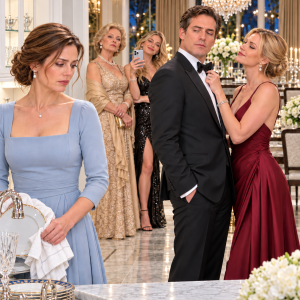
A chair scraped against the floor. Then another. A former commander stood near the aisle, followed by a pilot whose crew I had once helped bring safely home. Across the ballroom, men and women rose in widening waves until nearly everyone with a connection to the service was standing.
From the front came a clear, practiced call.
“Admiral on deck!”
Every service member came to attention. The room fell so quiet that I could hear the ocean against the seawall. I had entered command centers to those words many times, yet they had never reached me so deeply, because this time they were not merely acknowledging rank. They were answering my father’s message.
One by one, people spoke. A helicopter pilot remembered the night I delayed a risky launch until the weather gave his crew a safer window. A young captain described how I challenged an unfair report that nearly ended her career. A retired mechanic recalled that I sat with his family through a long hospital vigil. None of these had felt heroic when I did them; they had felt necessary.
My father looked around as though the room had revealed a language he had refused to learn.
Then the groom, Aaron Prescott, walked down the aisle carrying a faded photograph. In it, a much younger me stood aboard a cutter beside an engine technician named Samuel Reed.
“That was my father,” Aaron said. “During the Calypso machinery failure, you refused to abandon the rescue effort. Because you stayed, I had him through my childhood and well into adulthood.”
He handed me a yellowed envelope bearing my new name, written in Samuel’s unsteady hand.
“He told me to give you this on the day you forgot who you were.”
Natalie stepped forward before I could open it. Her voice trembled, but it did not retreat.
“I blamed Evelyn for making me feel ordinary,” she said. “Yesterday I finally understood that she never compared us. You did.”
She looked at our parents. She described the small remarks that had turned two sisters into rivals: Evelyn is too ambitious; Natalie lacks ambition. Evelyn cannot settle down; Natalie has never done anything daring. Our parents had used each of us to correct the other, then acted surprised when affection hardened into distance.
Natalie faced me. “I am sorry.”
I embraced her, careful of her veil. “So am I.”
The ceremony began late, but it began with something our family had not possessed that morning: honesty. Aaron and Natalie exchanged vows, my father walked her down the aisle with newly lowered shoulders, and for forty minutes we stopped pretending the past had not happened.
The Letter Above the Ocean
At sunset, I took Samuel’s envelope to a quiet balcony. His first page thanked me for staying when leaving would have been easier. The second page changed everything.
The Calypso failure, he wrote, had been caused by a substandard pressure assembly knowingly placed into the supply system. Samuel had found tracing documents, reported them, and then watched the report disappear. He named a celebrated former officer, Vice Admiral Graham Sloane, who had overseen the inquiry.
At the bottom of the final page, Samuel had written: Ask Walter Hartwell.
When I looked up, my father stood across the terrace watching me, and the fear on his face was not embarrassment. It was recognition.
We entered an unused conference room with Owen. For several minutes, Walter stared through the dark window before admitting that his quiet career in government procurement had been a cover for investigative work. Long before I joined the service, he had examined a shipbuilding supplier called Harbor Crown Industries. The company charged for military-grade components while quietly substituting cheaper materials, protected by officers and officials receiving concealed payments.
“You knew about the Calypso?” I asked.
“I recognized the serial number in the preliminary file.”
“And you never told me.”
“Sloane was above you. I thought knowledge would put you at greater risk.”
Every old wound rearranged itself. “So you ridiculed my career to protect me?”
He lowered his eyes. “I was afraid. I believed if I made the service seem ugly enough, you would choose a safer life.”
“You made me believe you were ashamed of me.”
“I know.”
Fear did not excuse what he had done, but it changed its shape. He placed a small brass key on the table and explained that he had kept copies of the Harbor Crown files in a safe-deposit box near Pasadena. Owen admitted that he had supplied Walter with related shipping records years earlier after his boarding team found counterfeit component manifests on a commercial freighter.
I was still absorbing the fact that both men had hidden the truth when an anonymous message reached my phone. It contained a photograph of my San Diego townhouse taken that morning and one sentence: Enjoy retirement. Leave old machinery alone.
My father’s face lost its color. “They know you have the letter.”
I slipped the key into my pocket. “Then tomorrow we collect the box.”
“It may not be safe.”
“I held major commands, Dad. I am not invincible, but I am exceptionally difficult to frighten.”
For the first time all day, he smiled—not from relief, but because he finally recognized the daughter he had spent a lifetime trying to send away.
The History My Mother Hid

The deposit box held invoices, inspection reports, old photographs, two tapes, a payment ledger, and a sealed note addressed to me. My father’s note contained the sentence I had waited thirty-four years to hear: I was never ashamed that you became an admiral. I was ashamed that I lacked the courage to tell you I was proud.
Before either of us could speak, the bank manager warned us that two unidentified men were asking for Walter upstairs. We left through a service corridor and took the files to a secure office run by Rear Admiral Rebecca Sloan, a trusted colleague with no connection to Graham Sloane despite the similar surname.
By evening, investigators had matched Harbor Crown supplier codes to equipment installed on nine active cutters. Most components appeared functional, but several required immediate inspection. What began as a family secret had become a readiness concern.
Then an older woman named Lydia Voss called my phone and said Harbor Crown had evolved into a private access network embedded in legitimate maintenance contracts. Before she could explain further, she added, “The story did not begin with your father, Evelyn. It began with your mother.”
My father closed his eyes.
Laurel’s birth name, I learned, had been Crown. Her father founded Harbor Crown Industries, and she had grown up with tutors, summer houses, and an inheritance she refused to touch. At twenty-one, while reviewing company accounts, she discovered falsified supplier records and carried copies to a young federal investigator named Walter Hartwell. That was how my parents met.
We drove to an old ranch house in the Santa Ynez Valley that my mother had quietly owned for decades. Behind a pantry cabinet, she opened a reinforced storage room filled with records dating back to the 1970s.
Owen stared at the filing cabinets. “Laurel, I owe you an apology. I underestimated you.”
My mother gave him a thin smile. “Most men did.”
She had withheld the archive after realizing that someone inside the government received every file Walter submitted. She feared he would lose everything by continuing. Again, love in our family had disguised itself as secrecy, each person deciding alone what truths the others were strong enough to bear.
Among the files was a list of officials, investigators, and officers monitored by the company. Rebecca’s name appeared there as a junior lieutenant, not because she belonged to the network, but because she had once questioned unusual shipping records. Lydia Voss, a former civilian defense official, had infiltrated Harbor Crown’s political circle and quietly passed information outward, though nobody fully trusted which loyalties remained.
The largest payments in the ledger carried the initials C.H. They belonged to my father’s older brother, Calvin Hartwell—a relative Natalie and I had never been told existed. Calvin had worked for my grandfather, discovered the hidden scheme, and chosen profit over exposure. He used the records to control executives, then built a network called Beacon Ridge that sold maintenance access and logistical information to anyone willing to pay.
He had been presumed gone from public life for decades. He was not gone. He was back in California, and he wanted Samuel’s letter.