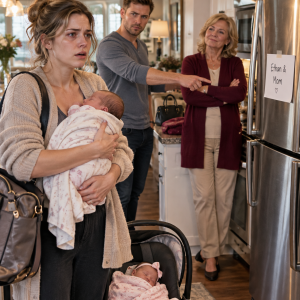
“You don’t have a grandson.”
Her eyes narrowed.
“Do not be childish. Owen is our daughter’s son. He carries our blood.”
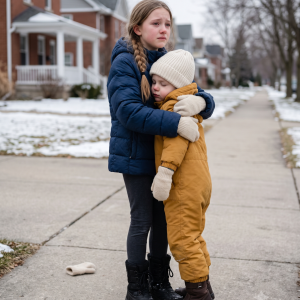
I remembered the snow.
“You were not interested in your blood when it needed a place to sleep.”
My father lowered his voice.
“We are not here to reopen ancient grievances.”
“You left a pregnant seventeen-year-old outside in winter. I think I’m allowed to classify that as more than a grievance.”
Before he could respond, the elevator doors opened.
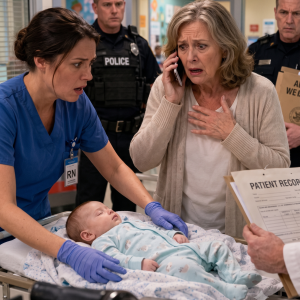
Owen stepped into the lobby wearing dark blue scrubs.
His hair was slightly messy beneath his surgical cap, and exhaustion showed beneath his eyes.
He saw me first.
Then he noticed them.
“Mom?”
He approached.
“Is everything okay?”
I looked at my parents.
“Owen, meet Graham and Celia Penfield.”
His expression changed immediately.
I had told him the entire story years earlier.
“These are the people from Boston Common?”
My mother flinched.
Then something extraordinary happened.
Her face softened.
Her hands lifted toward him.
“Owen, darling, we have waited so long to meet you.”
He stared at her.
“That’s strange. You had my whole life.”
When They Tried To Purchase A Relationship
My father stepped closer.
“Young man, there are complicated circumstances you may not fully understand.”
Owen glanced at me.
“I understand enough.”
“Your mother was very young.”
“So was I when she raised me.”
My mother spoke quickly.
“We made decisions we regret. But you are part of the Penfield family. There are opportunities available to you that Audrey could never provide.”
I felt something sharp rise inside me.
Owen answered before I could.
“She provided everything.”
My father sighed.
“That is sentimental, not practical. Our family has relationships with research institutions, private foundations, medical boards, and some of the most respected specialists in the country.”
Owen looked around the hospital lobby.
“I already work with respected specialists.”
My father stiffened.
“Do not mistake independence for wisdom.”
Owen took one slow step forward.
“And don’t mistake money for being important to me.”
My mother reached toward his arm.
He moved back.
“Please don’t touch me.”
She looked wounded.
“I am your grandmother.”
Owen’s voice remained calm.
“Teresa Delaney was my grandmother.”
My mother’s expression froze.
“Who?”
That one word told Owen everything he needed to know.
“Exactly.”
He pointed toward me.
“She took Mom in when you threw her out. She taught me how to make pancakes, helped me with homework, came to every school event, and sat in the front row when I graduated. If you don’t even know her name, you don’t get to use hers.”
My father’s patience disappeared.
“We have contributed millions of dollars to healthcare institutions across New England. We will not be treated like unwanted visitors.”
The head of hospital security had already approached.
I looked at him.
“Please escort Mr. and Mrs. Penfield from the surgical area.”
My mother stared at me.
“You are making a serious mistake.”
I held her gaze.
“No. I made my serious mistakes when I was seventeen. This is called learning.”
The Story They Told The Public
By that evening, my parents had contacted reporters.
Their public statement was carefully polished.
They admitted that our relationship had been “difficult.”
They said misunderstandings had separated us.
They claimed they had spent years hoping for reconciliation while I had deliberately kept Owen away.
My mother appeared on local television with tears in her eyes.
“We simply want a chance to know our only grandson.”
My father added:
“Families should be allowed to heal.”
When I arrived home, Daniel was sitting at the kitchen table with a folder.
Owen was beside him.
“They’re threatening legal action,” Daniel said.
I sat down.
“Can they actually do that?”
“Anyone can file something. That does not mean they will succeed.”
He opened the folder.
Inside were court records from twenty-two years earlier.
I recognized Teresa’s handwriting on the old envelope.
Daniel placed one document in front of me.
It was an agreement my parents had signed when Teresa helped secure my legal protection.
One paragraph made my hands tremble.
Graham and Celia Penfield had voluntarily relinquished all parental, custodial, visitation, inheritance, and future familial claims connected to me and any children I might have.
I read it twice.
Then a third time.
“They signed away Owen before he was even born.”
Daniel nodded.
“Teresa understood exactly who she was dealing with.”
There was more.
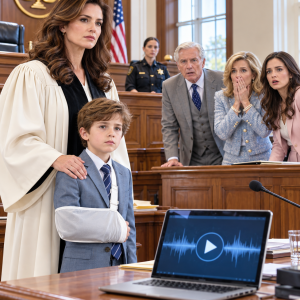
A recording from the attorney’s office had survived in the archived case file.
Daniel pressed play.
My father’s younger voice filled the kitchen.
“We understand the agreement. We want no future contact with Audrey or any child connected to this situation.”
Then came my mother.
“We consider the matter finished.”
Owen stared at the speaker.
His face did not show anger.
It showed certainty.
“Then maybe we should help them remember.”
The Gala Where Their Own Words Returned
Three weeks later, the Penfield Health Foundation held its annual gala at a luxury hotel near Copley Square.
Nearly four hundred physicians, donors, executives, and local leaders attended.
My parents expected to control the evening.
Instead, hospital leadership invited Owen to give a short speech about the next generation of cardiac medicine.
He walked onto the stage wearing a simple dark suit.
My parents sat near the front.
My mother smiled proudly as though she had personally raised him.
Owen began calmly.
“Tonight, we are here to talk about legacy.”
He paused.
“Most people think legacy is something we inherit. I think it is something we choose.”
The ballroom became quiet.
“More than twenty years ago, a seventeen-year-old girl was told by her parents that her pregnancy threatened their reputation. They left her alone in Boston during winter and later signed documents removing themselves from her future.”