My mother once told me:
“You act as though you don’t need your family anymore.”
I answered:
“Needing family and allowing family to control my life are two different things.”
She never forgot that sentence.
Things became worse when I refused to move closer to them and declined my father’s repeated requests to become involved in my finances.
The highway incident was apparently supposed to frighten me.
They expected me to panic.
They expected me to call them later, apologize, and agree to their demands.
Instead, they had crossed a boundary that could never be uncrossed.
What My Son Said That Morning
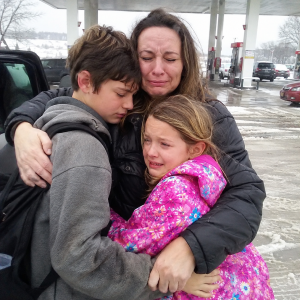
Shortly after sunrise, Noah and I were sitting in a warm room while arrangements were being made for us to return home.
He was wrapped in a blanket and drinking hot chocolate.
For the first time all night, he seemed relaxed.
Then he looked at me.
“Mom?”
“Yeah, buddy?”
“Were you scared?”
I could have pretended I wasn’t.
But children learn courage incorrectly when adults teach them that brave people never feel afraid.
So I told him the truth.
“Yes. I was scared.”
He frowned.
“But you didn’t look scared.”
I pulled him closer.
“Being brave doesn’t mean you aren’t scared. It means you still make good choices while you’re scared.”
He thought about that.
Then he leaned his head against my shoulder.
“I think you were really brave.”
That meant more to me than any professional recognition I had received in my career.
The Boundary They Could Never Cross Again
I did not celebrate what happened next.
There was nothing satisfying about watching a family break apart.
But consequences are different from revenge.
My parents had made their decisions.
Now I had to make mine.
I cooperated fully with the authorities and documented everything.
More importantly, I made it clear that my parents would no longer have unsupervised access to Noah.
When my mother eventually tried to contact me, her first concern was not how frightened Noah had been.
She wanted to know why I had “made everything so serious.”
That told me I had made the right decision.
“You left a six-year-old child beside a highway in the middle of the night,” I told her. “I didn’t make this serious. Your choices did.”
She went silent.
Then she said something I had heard in different forms my entire life.
“We’re still your parents.”
I closed my eyes.
For years, that sentence had been used as though it erased every boundary.
Not anymore.
“And I’m still Noah’s mother. Protecting him comes first.”
I ended the call.
The Lesson I Carried Home
People sometimes imagine strength as something loud.
They picture shouting, confrontation, or dramatic revenge.
But the strongest thing I did that night was much quieter.
I stayed calm.
I held my son’s hand.
I paid attention.
I accepted help when it arrived.
And when morning came, I told the truth.
My parents had believed they could remove every advantage I had.
They took my wallet.
They kept my keys.
They disconnected my charger.
They drove away with the vehicle.
But they could not take my experience.
They could not take my judgment.
And they could not decide what kind of mother I would be.
Several weeks later, Noah asked me whether I still remembered the truck driver who had stopped.
“Of course I do.”
He smiled.
“When I’m big, I’m going to stop too.”
“Stop for what?”
“For people who need help.”
I looked at him and realized that maybe the worst night of our lives had still managed to leave behind something good.
My parents wanted that lonely highway to teach me helplessness.
Instead, it taught my son compassion.
They wanted me frightened enough to return to the role they had chosen for me.
Instead, I finally understood that some boundaries exist because the people we love most are sometimes the people from whom we need them most.
At 2:13 that morning, my parents believed they were driving away from two powerless people standing alone in the desert.
By sunrise, a traffic camera had preserved what happened, a stranger had reminded us that kindness still existed, and the truth had begun speaking for itself.
My parents had planned the night carefully.
They simply made one mistake.
They believed taking away my possessions would take away my strength.
They were wrong.
Sometimes the people closest to us expect love to mean unlimited obedience, but genuine love should never require us to surrender the boundaries that protect ourselves and our children.
Strength is not always visible in dramatic confrontation; sometimes it appears in the quiet decision to remain calm, think clearly, and take the next responsible step when everything feels uncertain.
A difficult moment does not erase the skills, wisdom, and resilience you have built over years, even when someone deliberately tries to make you feel as though you have nothing left.
Children remember more than the frightening moments they experience; they also remember who held their hand, who protected them, and who showed them what courage looks like when life becomes difficult.
Accepting help from a stranger, friend, neighbor, or professional does not diminish your independence, because sometimes real strength means recognizing that you do not have to solve every crisis completely alone.
Family relationships deserve love and patience, but being related to someone does not give that person unlimited permission to disregard boundaries, manipulate circumstances, or place a child in an unacceptable situation.
When someone expects panic, anger, or desperation from you, responding with patience, documentation, and clear thinking can often protect you far more effectively than giving them the emotional reaction they hoped to create.
Courage does not mean living without fear; courage means acknowledging that fear is present while refusing to let it decide what you do next or what kind of person you become.
One painful night can change a family forever, but it can also reveal unexpected kindness, clarify necessary boundaries, and teach a child that good people still exist even after someone they trusted disappointed them.
No matter how carefully another person tries to control the circumstances around you, they cannot easily take away your judgment, your experience, your values, or your determination to protect the people who depend on you.