She looked over my shoulder.
“Who’s Nathan?”
I turned the page.
The date made my stomach tighten.
He had been born less than a week before my parents left me with Grandpa.
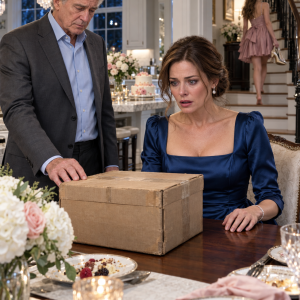
We carried the box back into the dining room.
The moment my mother saw the document, she stopped breathing normally.
Sophie placed it on the table.
“Who is Nathan?”
Mom sat down.
Dad’s shoulders seemed to collapse.
Finally Mom whispered, “Your brother.”
Neither Sophie nor I spoke.
Mom explained in pieces.
Nathan had arrived unexpectedly early during the hardest period of their marriage. Dad had recently lost steady work. Their rent was overdue. Mom was exhausted and overwhelmed. Grandpa had helped them arrange for another family to care for the baby temporarily.
Temporary.
That word again.
A family in Oregon later offered Nathan a permanent home.
My parents agreed.
“Why didn’t you tell us?” Sophie asked.
Mom stared at the little hospital bracelet.
“Because we were ashamed.”
“You were ashamed for thirty years?”
“Yes.”
Dad leaned forward.
“We told ourselves we were protecting everyone.”
I almost laughed.
“You protected yourselves.”
He did not argue.
Grandpa’s records showed that Nathan’s new family had occasionally sent updates.
At twelve, he had asked whether he had sisters.
My parents never replied.
Sophie began crying.
“He knew we existed?”
Mom nodded.
Margaret reached into her folder and placed another letter on the table.
It had been sent to Grandpa eight years earlier.
Nathan, now an adult, had found his name in old family documents and written asking whether Walter might be his grandfather.
He explained that he wanted nothing from anyone.
He only wanted to know whether the two sisters he had heard about were real.
Grandpa had asked Margaret to locate him.
She had.
Nathan now lived outside Worcester, Massachusetts. He was a structural engineer, married, and raising a young daughter.
A daughter.
Somewhere across the country, I had a niece.
Sophie wiped her cheeks.
“Does Nathan know about us?”
Margaret nodded.
“He knows he has two sisters. Walter never gave him your contact information because he wanted that decision to belong to you.”
For a moment, the word decision bothered me.
So many decisions had been made around me.
For me.
About me.
My parents decided I would live with Grandpa.
They decided Sophie would never receive his cards.
They decided Nathan would grow up without knowing us.
Grandpa decided there were truths I was not yet ready to hear.
Everybody had been choosing for us.
Now, finally, Sophie and I were adults sitting at the same table, being given a choice of our own.
She reached across and took my hand.
It was the first time my sister had held my hand since we were children.
“I want to meet him.”
I looked at her.
“So do I.”
Mom began crying quietly.
Dad stared toward the window where the empty moving truck remained parked in the driveway.
Then, incredibly, he asked Margaret, “Does Nathan have any legal interest in Walter’s property?”
Even Mom turned toward him.
I felt something inside me become unexpectedly calm.
“Dad.”
He looked at me.
“This isn’t about Grandpa’s property.”
“I was only asking—”
“I know exactly what you’re asking.”
He lowered his eyes.
For years I had imagined confronting my parents and finally telling them everything they had done to me.
When the moment came, I discovered I did not want revenge.
I did not even want them humiliated.
I simply wanted their choices to stop controlling my life.
The Letter With My Name
Margaret gathered the documents, but then paused.
“There is one last thing.”
She removed a cream envelope from her briefcase.
My name was written across it in unfamiliar handwriting.
Emma Bennett.
“This arrived at my office yesterday,” she said. “Walter arranged for anything Nathan sent to be forwarded to me if he was no longer able to receive it himself.”
My heart began beating faster.
I opened the envelope.
Nathan’s letter was short.
He wrote that he did not know what name I used now, what I had been told about him or whether I wanted another family relationship after so many years.
He was not asking me to excuse anyone.
He was not asking to arrive in my life and immediately be treated like a brother.
He simply wanted a chance to begin somewhere truthful.
Near the bottom, he had written one sentence that I read three times.
“I spent most of my childhood hoping my sisters were real.”
Below it was his phone number.
Sophie was crying again, but this time she smiled through it.
“Are you going to call?”
I looked around Grandpa’s dining room.
At my mother, who had spent decades avoiding what she had done.
At my father, who had arrived expecting to empty a house that was never his.
At Sophie, who had grown up only a few hours from me but had known almost nothing about the sister Grandpa loved enough to call her every birthday in letters she never received.
Then I looked toward Grandpa’s empty chair.
For twenty-five years, some part of me had been waiting for the car that disappeared down his driveway to turn around.
I had imagined my mother stepping out.
I had imagined my father coming back for the little girl with the stuffed rabbit.
I had imagined hearing someone say they had made a terrible mistake and had finally come to bring me home.
None of those things happened.
But perhaps growing older means understanding that healing does not always arrive through the door you spent your childhood watching.
Sometimes it arrives quietly, years later, in a cardboard box.
Sometimes it comes in your grandfather’s handwriting.
Sometimes it comes through the hand of a sister who was never told enough to know what she had lost.
And sometimes it comes as a phone number belonging to a brother who had been waiting too.
I unlocked my phone.
Sophie leaned closer.
“What are you going to say?”
I looked at Nathan’s number.
“I have no idea.”
She laughed softly through her tears.
For the first time that morning, I did too.
Then I pressed the call button.
It rang once.
Twice.
Three times.
A man’s voice answered.
“Hello?”
For one second, I could not speak.
Sophie squeezed my hand.
I closed my eyes and pictured Grandpa standing beside that old porch twenty-five years earlier, telling a frightened little girl that she had him now.
Then I finally understood the last gift he had been trying to leave me.
It wasn’t the farmhouse.
It wasn’t the land.
It wasn’t the notebooks or the legal papers or even the truth about my parents.
It was the freedom to stop defining my life by the people who had walked away from it.
I took a breath.
“Hi, Nathan. My name is Emma.”
There was silence on the other end.
Then his voice changed.
Softer.
Unsteady.
“Emma?”
I looked at Sophie.
She nodded.
And for the first time in twenty-five years, I was no longer waiting for someone to come back.
I was choosing who I wanted to walk toward.
“Yes,” I said. “Your sister.”