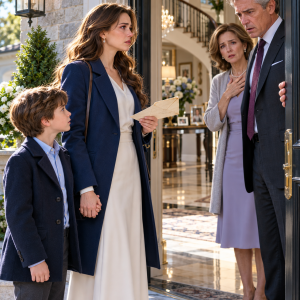
“For what?”
He glanced at Mom.
“To decide how I want to live.”
I didn’t ask for details.
“You have thirty days.”
Mom looked at me.
For the first time that evening, she seemed genuinely worried that I might tell her to leave.
I didn’t.
“Nobody is being thrown out tonight.”
Then I put the deed back into the blue folder.
“But things are changing.”
I gave Mom three boundaries.
She would stop telling relatives that she was financially supporting Ava and me.
No money would leave the household account without everyone knowing where it went.
And Dad would control his own finances unless he specifically asked someone to help.
Mom stared at me.
“You’re giving me rules in my own house?”
I didn’t answer.
Her eyes dropped to the folder.
She knew whose house it legally was.
The House Became Very Quiet
Before Eric left, he came into the kitchen while I was putting away Ava’s graduation cake.
“How much do I owe you?”
“We’ll calculate it tomorrow.”
He took out his phone.
“I’m sending back what I still have.”
A few seconds later, my phone buzzed.
He had returned part of the most recent transfer.
“I’ll repay the rest.”
“I know you didn’t understand where it came from.”
Eric looked toward the dining room.
“I should’ve asked.”
We later arranged monthly payments.
Mom didn’t speak to me for nine days.
She wasn’t openly hostile.
She simply disappeared whenever I entered a room.
We lived in the same house like polite strangers.
On the tenth morning, I walked into the kitchen and stopped.
The blue folder was sitting on the table.
Mom sat behind it with a cup of coffee.
“Where did you get that?”
“From the cabinet.”
“You could’ve asked.”
She nodded.
“I know.”
I stayed standing.
Then she said something I hadn’t expected.
“I knew the money I sent Eric came from you.”
I pulled out the chair across from her.
“Then why did you tell him it was Dad’s?”
Mom stared into her coffee.
“Because I wanted to be the person helping my children.”
She told me that falling six months behind on the mortgage had terrified her.
Then Dad had his stroke.
She had spent most of her adult life believing she was the person who kept the family together.
Suddenly, she couldn’t keep the house.
She couldn’t fix Dad’s health.
She couldn’t help Eric.
Then I stepped in.
I refinanced the house.
I paid the mortgage.
I covered Dad’s rehabilitation.
And instead of feeling relieved, Mom felt humiliated.
“When people asked how you were doing after the divorce,” she said, “I told them we were helping you.”
“You weren’t.”
“I know.”
“You told people you were supporting Ava too.”
She nodded.
“I know.”
There was a long silence.
“Why?”
Mom rubbed her thumb along the edge of the blue folder.
“Because saying my daughter saved my house felt like admitting I had failed.”
I looked at her.
“So you made me look like the failure instead.”
She closed her eyes briefly.
“Yes.”
That was the first apology she gave me that didn’t contain an excuse.
“I’m sorry.”
I didn’t forgive her that morning.
I simply said:
“I need time.”
“I understand.”
Six Weeks Later, She Tapped the Glass Again
Dad kept control of his pension.
We created a household account where every transaction was visible.
Mom started counseling.
Eric made his repayments every month.
None of that suddenly made us a perfect family.
But six weeks later, something happened that mattered.
We were having a barbecue with some of the same relatives who had attended Ava’s graduation dinner.
Mom picked up her glass.
Then she tapped it with a spoon.
The sound made me turn immediately.
“I need to correct something I said at Ava’s graduation.”
Everyone became quiet.
Mom looked directly at me.
“Claire was never living here for free.”
Nobody interrupted her.
“The truth is that Claire saved this house when Richard and I were in financial trouble. She has paid the mortgage and helped support us for years.”
My aunt looked at me.
Eric lowered his eyes.
Mom continued.
“I told people otherwise because I was embarrassed to admit that I needed my daughter’s help.”
Then she sat down.
No dramatic speech.
No request for forgiveness.
Just the truth she should have told years earlier.
By September, Ava was preparing to leave for the University of Washington on scholarship.
Before we left for the airport, Mom handed her an envelope.
Inside was money for textbooks.
Across the front, she had written:
“No strings attached.”
Ava hugged her.
Then Mom looked at me.
“Claire, I’m sorry I turned your sacrifices into a story that made me look generous.”
I nodded.
“Thank you for finally saying it.”
Dad still avoided arguments sometimes.
Eric still owed me money.
Mom still had work to do.
So did I.
That evening, after Ava left, I came home and found the blue folder on the kitchen counter.
I picked it up and put it back in the cabinet.
For three years, I had believed the mortgage was the biggest price I paid to keep that house.
I was wrong.
The most expensive thing had been staying silent so someone else could keep a lie.