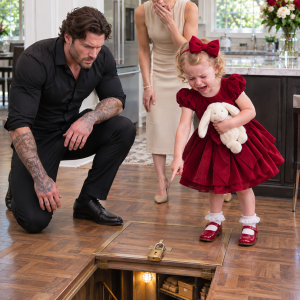
He smiled uncertainly.
“I’ve missed you.”
She looked down.
For a while, they played with wooden blocks. Cole tried to make her laugh, but she remained quiet.
Then she asked:
“Did Mommy wake up?”
Cole stopped moving.
“No, sweetheart.”
“Is she still sleeping?”
He looked toward Peter, who gently encouraged him to answer honestly.
“Mommy died, Maisie. That means she can’t come home anymore.”
My daughter stared at him.
“Because I couldn’t help?”
Cole’s face crumpled.
“No, honey. You didn’t do anything wrong.”
She opened her little backpack and pulled out a folded drawing.
“I made this.”
Cole took it carefully.
There were three people in the picture.
A woman lying on the floor.
A little girl beside her.
And a man standing at the top of a staircase.
Cole looked at the drawing for a long time.
“Is that me?”
Maisie nodded.
“You were upstairs.”
He swallowed.
“I know.”
“I called you.”
“I know, sweetheart.”
She looked directly at him.
“Why didn’t you come?”
Cole lowered his head.
For once, he didn’t blame me, Brooke, or anyone else.
“I should have come,” he whispered. “I’m so sorry.”
Maisie studied his face.
Then she reached for Peter.
“Can we go now?”
Peter stood.
“Of course.”
Cole remained seated as they left.
I followed my daughter out of the room.
I couldn’t tell whether she’d ever feel comfortable with her father again. But I was grateful that she hadn’t been made to comfort him simply because he was crying.
Several weeks later, Peter returned to our old house to collect some of Maisie’s belongings.
In the closet of our bedroom, he found a small keepsake box.
Inside were her hospital bracelet, her first pair of baby shoes, and a lock of hair from her first haircut.
Beneath them lay an envelope.
On the front, in my handwriting, were the words:
For Maisie, when you’re older.
I’d written that letter when she was six months old, after reading an article about parents saving messages for their children. I’d tucked it away and almost forgotten about it.
Peter sat on the edge of the bed and opened it.
My sweet Maisie,
When you were born, you cried so loudly that your daddy and I both started laughing. Then the nurse placed you against my chest, and you wrapped your tiny fingers around mine.
I don’t know what you’ll be like when you read this. Maybe you’ll love music, painting, animals, or books. Maybe you’ll grow up to be completely different from the little girl I imagine, and that will be wonderful too.
But there’s something I hope you’ll always remember.
You never have to earn love by being perfect. You don’t have to make everybody happy, and you don’t have to solve problems that belong to grown-ups.
You’re allowed to be little. You’re allowed to make mistakes. And you’re allowed to tell someone when you’re frightened.
If there’s ever a day when I can’t be beside you, I hope you’ll remember how much I loved holding your hand.
You have been loved since the moment I knew you existed.
Love, Mommy.
Peter stopped reading.
He pressed the letter against his chest and cried quietly.
I sat beside him, remembering the afternoon I’d written it while Maisie slept in her crib.
At the time, I’d imagined her reading it as a teenager, perhaps rolling her eyes at how sentimental her mother could be.
I hadn’t imagined Peter would be the one keeping it safe.
He placed the letter back in its envelope and decided to save it until Maisie was older.
Meanwhile, he kept the memory box where they could look through it together.
Whenever she asked about me, he told her ordinary stories.
He told her how I sang badly while making pancakes, how I always misplaced my glasses, and how I’d once spent an entire afternoon helping him assemble a bookshelf because he refused to read the instructions.
Slowly, my daughter began remembering more than the night I fell.
She started laughing again.
She made friends at preschool and learned to ride a little bicycle with training wheels. Some nights were still difficult, but she no longer asked every morning whether I was coming home.
Cole continued counseling.
He ended his relationship with Brooke and began working with professionals to understand how his behavior had affected Maisie. His visits remained carefully structured, and Peter made it clear that her comfort mattered more than anyone’s wish for a quick reconciliation.
One afternoon, Cole arrived carrying a small white wooden chair.
He’d made it himself.
“I thought Maisie might like this,” he told Peter.
My brother-in-law examined it.
“Why a chair?”
Cole looked down.
“I can’t stop thinking about what she said. That she tried to hold Mara’s chair so she could sit up.”
Peter was quiet.
“Cole, a chair won’t fix what happened.”
“I know.”
“And Maisie doesn’t have to make you feel better about it.”
Cole nodded.
Then Maisie appeared in the doorway holding her stuffed bear.
“Is that for me?”
Cole crouched beside the chair.
“Yes, sweetheart. I made it for you.”
She touched the backrest.
“Does it move?”
“It’s sturdy. See?”
He pressed his hand against it.
Maisie watched him.
Then she said quietly, “Mommy thought her chair was sturdy too.”
Cole closed his eyes.
Peter placed a gentle hand on Maisie’s shoulder.
“Would you like to put it in your room, honey?”
She thought for a moment.
“Maybe later.”
Then she went back to her toys.
Cole didn’t follow her.
I was grateful for that.
A year after my birthday dinner, Peter took Maisie to the cemetery.
She was four now, wearing a yellow cardigan, white sneakers, and carrying a little bouquet of daisies she’d chosen herself.
Cole came separately after asking Peter’s permission.
Judith also attended, standing a short distance away.
My mother-in-law looked older than I remembered. When she approached my grave, she began crying.
“Mara, I was cruel to you,” she whispered. “I kept telling myself I was protecting my son. I wish I’d listened.”
Peter stood beside Maisie.
“We’re here for Mara today,” he said gently. “Let’s let Maisie remember her mother in her own way.”
Judith nodded and stepped back.
My daughter knelt beside the flowers.
She took a folded drawing from her pocket.
This time, there was no dining room and no woman lying on the floor.
There was a garden, a bright yellow sun, and a little girl holding her mother’s hand.
“Look, Mommy,” she said. “This is us.”
I knelt beside her.
She placed the drawing carefully near my photograph.
“Uncle Peter says you can’t come home,” she continued. “But I still love you.”
I reached toward her cheek.
My fingers passed through the air.
“I went on the big slide yesterday,” she told me. “Uncle Peter caught me at the bottom.”
She smiled.
“I wasn’t scared.”
Peter wiped his eyes.
Maisie looked at my photograph for another moment.
“I can go play now, Mommy. Okay?”
I wanted to tell her yes.
That she could run, laugh, fall down on the playground, and get up again.
That she didn’t need to stay beside a chair waiting for someone who couldn’t return.
She stood and reached for Peter’s hand.
“Can we get ice cream?”
Peter smiled.
“Of course. What flavor?”
“Strawberry! The big one!”
Cole stepped forward.
“Maisie, would you like Daddy to come too?”
She considered the question.
“Not today. I want Uncle Peter.”
Cole’s face tightened, but he nodded.
“Okay, sweetheart. Maybe another time.”
There was no sudden embrace or perfect forgiveness.
There was only a little girl learning that she could say what she wanted, and a father beginning to understand that he had to respect her answer.
As Peter and Maisie walked toward the cemetery gate, my daughter stopped.
“Wait! I forgot something!”
She ran back to my grave and wrapped her small arms around the stone.
“I love you, Mommy!”
I knelt behind her and reached for her one last time.
For a brief, impossible moment, I felt the warmth of her little shoulders beneath my hands.
Maisie grew still.
Then she smiled.
“Uncle Peter,” she called, “I think Mommy hugged me.”
Peter crouched beside her.
“Maybe you felt how much she loves you.”
Maisie nodded.
“I love her lots too.”
She took his hand, and together they walked toward the gate.
I watched until they disappeared beyond the trees.
Then I looked down at the daisies, the bright drawing, and the little girl I’d been so frightened to leave behind.
She wasn’t waiting beside an empty chair anymore.
She was going to get strawberry ice cream, with someone who would hold her hand when she crossed the street.
I touched the corner of her drawing.
A breeze lifted the paper slightly, revealing the yellow sun she’d colored above our heads.
Then I stood and let her go.