He sat quietly.
Then he asked, “Do you think he’ll ever forgive me?”
“I don’t know. That’s something only Nicholas can answer.”
Gabriel nodded slowly.
“Will you tell him I came?”
“Yes.”
That evening, I told Nicholas about the visit.
He listened while closing his laptop.
“He wants to see me now?”
“He says he does.”
Nicholas looked toward the window.
“Did he ask how I’ve been?”
I thought about the conversation.
“He asked about MIT.”
My son gave a small, disappointed smile.
“That sounds about right.”
I sat beside him.
“You don’t have to decide anything tonight.”
“I know.”
He was quiet for another moment.
“I used to think if I did something impressive enough, he’d finally want to know me.”
I felt my throat tighten.
“Nicholas…”
He shook his head gently.
“I’m okay, Mom. I just wish he’d wanted to know me before any of this happened.”
I put my arm around him.
“You deserved that.”
He leaned against me for a moment, just as he had when he was little.
A few weeks later, Gabriel contacted Nicholas directly and asked whether they could meet before he left for college.
Nicholas thought about it for several days.
Then he agreed.
They met at a quiet restaurant in Milwaukee on a Saturday afternoon. Nicholas asked me to drive him there but wanted to speak to his father alone.
I waited at a nearby coffee shop.
An hour later, Nicholas returned.
He looked thoughtful rather than upset.
“How did it go?” I asked.
He sat across from me.
“He apologized.”
“That’s good.”
“He said he was proud of me. He talked about MIT and the software project.”
Nicholas paused.
“Then I asked him something.”
I waited.
“I asked whether he would’ve wanted to see me if I hadn’t gotten into MIT.”
My chest tightened.
“What did he say?”
“He said of course he would. But he couldn’t really explain why he hadn’t tried harder before.”
Nicholas looked down at his hands.
“I told him I wasn’t angry about the money anymore. I was angry that he made me feel like something he could choose not to bother with.”
I reached across the table.
“That must have been difficult to say.”
He nodded.
“It was. But I needed him to hear it.”
“And what happened?”
“He cried.”
Nicholas looked surprised by the memory.
“I’ve never seen him cry before.”
I squeezed his hand.
“How do you feel?”
He thought for a moment.
“Sad, I guess. But also relieved.”
“Do you want to see him again?”
“Maybe someday. I don’t know yet.”
I nodded.
“You don’t have to know.”
That evening, Nicholas went upstairs to finish packing for college.
I stayed in the kitchen, thinking about the little boy who’d once asked whether I was going to leave him behind.
He was seventeen now, nearly grown, and he’d found the courage to tell his father something I had never been able to explain for him.
A few days later, Gabriel sent me a short email.
He thanked me for encouraging Nicholas to meet him. Then he wrote that he finally understood how much damage he’d done by treating our son as part of a financial negotiation.
I read the message twice.
For years, I’d imagined that an apology from Gabriel would make everything feel different.
It didn’t.
But I was glad Nicholas had been able to speak for himself.
When I drove him to the airport that August, he wore a gray MIT sweatshirt and carried a backpack full of things he’d insisted he couldn’t live without.
I made pancakes before sunrise, and we ate together at the kitchen table.
“Call me when you land,” I said.
“I will.”
“And don’t forget to eat something besides pizza.”
He laughed.
“Mom, I’m going to college, not disappearing into the wilderness.”
At the security checkpoint, he hugged me.
“You can stop worrying about me a little now.”
I held him tighter.
“I’ll work on it.”
After he disappeared into the crowd, I sat near the airport windows and cried.
Not because I thought I was losing him.
Because the little boy who’d once been frightened of being left behind was walking toward a future he’d chosen for himself.
Nicholas called every Sunday.
He told me about difficult classes, new friends, and research projects I barely understood. Sometimes he called because he was excited. Sometimes he called because he was overwhelmed.
I learned to listen without trying to solve everything.
His relationship with Gabriel remained distant, although they exchanged occasional messages. Nicholas had made his boundaries clear, and Gabriel appeared to be trying to respect them.
I stopped worrying about whether they would ever become close.
That was no longer something I could arrange for either of them.
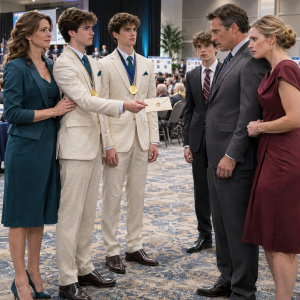
Four years later, I sat in the audience at MIT watching Nicholas graduate.
He was twenty-one, taller than his father, and smiling so broadly that I could recognize him from across the crowd.
When his name was called, I stood with the other families and applauded until my hands hurt.
After the ceremony, he found me near the entrance to the auditorium.
“Mom!”
He wrapped his arms around me.
“You did it,” I whispered.
He laughed.
“We did.”
I shook my head.
“You earned that diploma, Nicholas.”
He pulled back and looked at me.
“And you made sure I had the chance.”
I couldn’t answer.
He placed the diploma in my hands for a moment, then took it back with a grin.
“Don’t worry. I’ll let you frame a picture of it.”
We laughed, and I wiped my eyes.
A few years later, Nicholas and two friends started a small technology company developing software for healthcare organizations. I continued working in finance before eventually helping establish a scholarship fund for students from single-parent households.
Our lives weren’t perfect. We had disagreements, financial worries, and ordinary disappointments. Nicholas made mistakes, and so did I.
But we had built something steady.
One Thanksgiving, he came home for a long weekend.
After dinner, we were clearing the table when he noticed the old blue lamp on the bookshelf in my home office.
“You still have this?” he asked.
I smiled.
“Of course.”
He picked it up carefully.
The shade was scratched, and the switch had stopped working years earlier.
“I could buy you a new one.”
“I have plenty of lamps.”
He turned it over in his hands.
“You know, when we lived in that basement apartment, I thought this was the nicest thing we owned.”
I looked at him.
“For a while, it probably was.”
He laughed softly.
“I remember you putting it on my desk and telling me I could study as long as I wanted, but I still had to go to bed at nine.”
“You were eight years old.”
“And apparently very unreasonable.”
I smiled.
He set the lamp back on the shelf, then went into the kitchen to make coffee.
I stayed there for another moment.
I remembered the day Gabriel placed twenty million dollars in front of me and told me what I’d have to give up to take it.
I remembered Nicholas’s small hand holding mine beneath the conference table.
And I remembered carrying that eight-dollar lamp into our basement apartment, hoping it would make one dark corner feel a little more like home.
From the kitchen, Nicholas called out.
“Mom, where do you keep the good coffee?”
“Second cabinet on the left!”
“Found it!”
I brushed a little dust from the blue shade, turned off the office light, and went to join my son.