Several months later, Caleb agreed to supervised visits. Graham arrived at the first meeting carrying an expensive gaming device, but Caleb left it wrapped.
“Do you want to know how I really am,” Caleb asked, “or do you want something useful to tell your lawyer?”
The counselor encouraged Graham to listen.
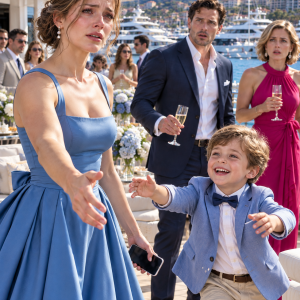
“Why did you bring Noah to Grandma’s party?” Caleb continued.
“I wanted the family to meet him.”
“No. You wanted them to see the grandson you thought was better.”
Graham lowered his eyes.
“I’m sorry.”
“Are you sorry you did it, or sorry everyone saw?”
Graham’s silence answered for him.
On the drive home, Caleb told me he was not ready to forgive his father.
“You don’t have to forgive anyone on a schedule,” I said. “Just don’t let your hurt teach you to become unkind.”
The Life Afterward

When the divorce was finalized, I retained my shares, my independent savings, and primary physical custody of Caleb. Graham received structured visitation supported by counseling.
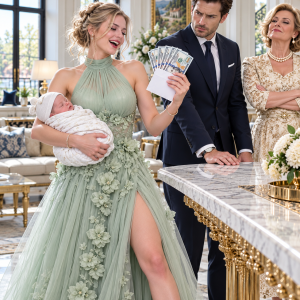
Outside the courthouse, he told me Vanessa had left Richmond with Noah. She had finally realized that Margaret did not see her as family and that Noah was being treated as a future title rather than a child.
“I hope they find some peace,” I said.
Graham frowned.
“You’re not going to tell me I received exactly what I deserved?”
“You did. I simply don’t need to celebrate it.”
“You used to be kinder.”
“I used to remain silent when I should have spoken.”
He looked toward the courthouse doors.
“I miss Caleb.”
“Then become someone he can trust. Gifts and apologies with excuses won’t do it.”
Two years later, Caleb was healthier, taller, and learning piano. Some visits with Graham went well; others ended early. Progress came in inches rather than grand gestures.
Margaret sent costly presents and long letters. Caleb ignored them until he was fourteen, when he finally opened one in which she admitted that she had confused physical strength with character and inheritance with love.
“Do you think she means it?” he asked.
“She may. But someone’s regret does not automatically give them access to your life. You’re allowed to set the distance that feels safe.”
He eventually agreed to meet her in a public garden. Margaret arrived with a walker and waited for Caleb to decide whether he wanted to approach.
“If we talk,” he told her, “you can never compare children by money, health, or family names again.”
“I won’t,” she promised.
They spoke for twenty minutes. Caleb did not offer forgiveness, but he returned to the car with a peaceful expression.
I rebuilt my life as carefully as he rebuilt his. I kept my board seat and created a charitable program that helped families afford pediatric respiratory care. At its first benefit dinner, Caleb sat in the front row.
Afterward, he hugged me.
“You looked like yourself tonight, Mom.”
“What did I look like before?”
“Like someone trying very hard not to inconvenience anybody.”
Years later, on Caleb’s college graduation day, Graham and I sat in the same row. We were no longer a family in the old sense, yet when Caleb asked for a photograph with both parents, we stood on either side of him and smiled.
We were not pretending the past had never happened. We were simply refusing to let it dictate every moment that followed.
Caleb eventually chose to study child psychology.
“Is that because of our family?” I once asked.
“Partly,” he replied. “But I don’t want to spend my life studying how people get hurt. I want to help them stop passing that hurt to someone else.”
Everyone who attended Margaret’s birthday remembered the child with the microphone and the flash drive. What they rarely understood was that exposing the truth took only a few minutes; building a new life required years.
If I could return to that ballroom, I would reach the stage before Caleb, place my hand on his shoulder, and tell him to sit down because his mother could handle the adults herself.
I cannot change the fact that he found his voice before I found mine.
What I could change was everything that came afterward. I stopped treating silence as dignity, stopped mistaking endurance for love, and created a home where my son would never again believe he had to rescue me.
That night, I lost a marriage and the illusion of belonging to an impressive family. Yet I recovered something far more important—something that had always been mine, even when I had forgotten how to use it.
My own voice.