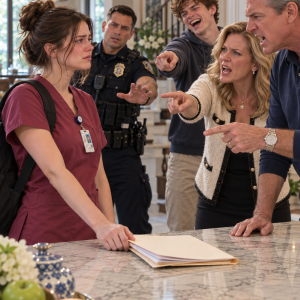
“I know, and I’m not trying to be insensitive.”
“You haven’t asked one question about her.”
“Because I can’t change what happened thirty-five years ago. I’m talking about what we do now.”
That sentence clarified something Dad had been unable to explain without sounding like he was attacking my wife.
Samantha wasn’t evil.
She was practical in a way that made other people’s emotional attachments feel inefficient whenever money was involved.
“I’m not selling the house.”
Her expression hardened.
“You can’t decide that alone.”
“Actually, I can.”
“We’re married.”
“I know.”
“Then stop talking like this belongs only to you.”
I remembered Dad’s letter.
Learn what belongs to you before somebody else decides what should happen to it.
“Evelyn left it to me.”
Samantha stared at me.
“Your father planned this, didn’t he?”
“Planned what?”
“Keeping me away from it.”
“Dad didn’t create Evelyn’s will.”
“But he brought in a lawyer.”
“Because he wanted the records handled properly.”
“And because he doesn’t trust me.”
I didn’t answer.
She gave a humorless laugh.
“Unbelievable.”
Then she said the sentence I still remember most clearly.
“After everything I’ve put into this marriage, you’re going to let a dead woman and your father decide what happens to our future?”
I looked around the kitchen.
The same kitchen where Dad had stood with his eyes lowered while Samantha told him we weren’t a bank.
The house had been mine before our marriage.
Dad had helped me buy it.
And yet Samantha spoke as if every piece of my past became joint property the moment it acquired financial value.
“I’m not making any decisions tonight.”
“Of course not. You’ll ask your father first.”
“No.”
I picked up Dad’s sealed envelope from the counter where I’d brought it to return to my office.
“I’m going to Cedar Ridge.”
The Wooden Box
Evelyn’s house sat on a quiet street lined with maples and modest ranch homes.
There were no gates, no sweeping driveway, nothing that looked like an inheritance worth destroying a marriage over. The flower beds were overgrown, one gutter sagged near the garage, and a faded ceramic bird sat beside the front steps.
Ms. Patel met me there and handed me the key.
Inside, the house smelled faintly of lavender and old books.
Photographs covered one wall.
Most were ordinary: Evelyn beside coworkers, Evelyn holding somebody’s baby at a picnic, Evelyn standing near a Christmas tree.
Then I found a photograph of myself.
High-school graduation.
I was seventeen, wearing a blue cap and gown.
The picture had clearly been taken from a distance.
Another showed me playing baseball.
Another was from my college graduation.
I touched the edge of the frame.
Evelyn had been watching my life from the edges of photographs.
In the bedroom, the wooden box sat on the nightstand.
Inside were envelopes arranged by year.
Brandon — 18.
Brandon — 19.
Brandon — 20.
There were seventeen in total.
Not thirty-two, as I’d initially imagined when Ms. Patel said she’d written every year after I turned eighteen.
I opened the first.
Evelyn didn’t call herself Mom.
She wrote:
You don’t know what today means to me, but I hope wherever you are tonight, somebody has made you feel celebrated.
The next letter mentioned college.
Another mentioned seeing my name in the local newspaper.
One from the year I married Samantha was only two pages long.
I heard you got married. I hope she is kind to you. Terrance says you’re happy, and I have decided that must be enough for me.
I stopped there.
That line sat differently after the previous weeks.
I didn’t decide to divorce Samantha while sitting in Evelyn’s bedroom.
Real life usually isn’t that clean.
I went home.
We tried counseling.
For several months we had the same argument in different forms. Samantha believed marriage meant major financial assets should be treated as shared opportunities. I believed the deeper problem was that she couldn’t understand why I might want to preserve Evelyn’s house before deciding what it was worth.
The inheritance didn’t destroy our marriage.
It exposed an argument we’d apparently been having for years without naming it.
Eventually, we separated.
The divorce was quieter than the marriage had become.
There was no dramatic courtroom reveal and no moment where Samantha lost everything. We divided what needed dividing, followed our attorneys’ advice, and went separate ways.
Evelyn’s house remained mine.
More importantly, Dad remained alive.
The Last Trip
Two months after his surgery, I drove Dad to Cedar Ridge.
He walked with a cane and complained about it constantly.
“Makes me look ninety.”
“You nearly died.”
“That’s not the same as being ninety.”
I laughed.
It was the first time we’d joked about his surgery.
When we entered Evelyn’s kitchen, Dad stopped.
He looked toward the window above the sink.
For a long time, he said nothing.
Then he noticed the wooden box on the table.
I’d brought it downstairs.
Beside it was the original white envelope containing Dad’s hospital letter.
Two envelopes.
Two people who had spent years waiting to tell me something.
Dad sat down.
“You read them?”
“Most.”
He nodded.
“She loved you.”
“I know.”
His eyes filled.
“I should’ve brought you here.”
I pulled out the chair beside him.
“Probably.”
He looked surprised by the answer.
I smiled.
“I’m not going to tell you every decision you made was right just because you almost died.”
Dad laughed, then winced and pressed a hand against his chest.
“Don’t make me laugh. Surgeon said it hurts the incision.”
We sat quietly.
Eventually he touched the white hospital envelope.
“You know, I still owe you a thousand dollars.”
I looked at him.
“Absolutely not.”
“I borrowed it.”
“You spent it proving who my mother was.”
“Still borrowed it.”
That was Dad.
I reached into my jacket and pulled out something I’d brought with me.
Ten one-hundred-dollar bills.
His eyebrows rose.
“What’s that?”
I put them inside the same white envelope and slid it across the table.
“Your money.”
“Brandon—”
“Use it on the garden.”
He looked through the window at Evelyn’s neglected flower beds.
“Garden?”
“She apparently liked roses. Half of them are dead.”
Dad ran one finger over my name on the envelope.
Three months earlier, that thousand dollars had looked like a loan to an old man who hadn’t planned properly.
Then it became legal records.
DNA results.
A house.
Seventeen birthday letters.
And finally, sitting in Evelyn’s kitchen beside the man who had raised me, it became something much simpler.
Dad folded the envelope and slipped it carefully into his jacket.
“She liked yellow roses,” he said.
I hadn’t known that.
I stood, found two pairs of old gardening gloves beneath Evelyn’s sink, and tossed one pair onto the table in front of him.
Dad looked at the gloves, then at his cane.
“Doctor said I’m supposed to take it easy.”
“Good. You can point at everything I’m doing wrong.”
That made him smile.
We went outside together.
Dad settled into a chair beneath the maple tree while I knelt beside the first rosebush and began cutting away the dead branches. After a few minutes, he started giving instructions exactly as I’d predicted.
I let him.
The white envelope stayed tucked inside his jacket, and the wooden box remained on Evelyn’s kitchen table behind us.
Neither of them felt like a secret anymore.