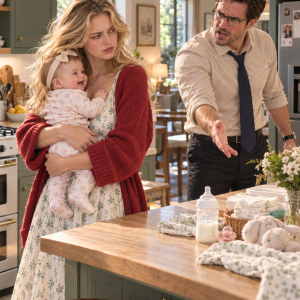
“Then perhaps you shouldn’t have made my child part of it without asking me.”
She turned toward Lukas.
“You told me you were separated from Evelyn. You told me the divorce was being finalized. Was any of that true?”
Lukas looked down.
“We were having problems.”
“That wasn’t my question.”
“No,” he admitted.
Sophia nodded slowly.
“Thank you. That’s the first straight answer you’ve given me in months.”
Then she faced Ingrid.
“You told me Evelyn knew about the pregnancy. You said she’d agreed to help after the birth.”
Ingrid folded her hands.
“I was trying to create a supportive arrangement.”
“You were trying to make decisions about my baby without my permission.”
“Nobody was going to take your child away.”
“Then why did you keep talking about him staying with Evelyn permanently?”
Ingrid’s face reddened.
“Because we were thinking about what’s best for him.”
“Then you should’ve started by asking his mother.”
I watched Sophia speak and felt something shift.
I had spent days imagining her as the woman who’d taken my husband. But the truth was more complicated. She’d believed his lies, and now she was dealing with the consequences while preparing to become a mother.
We didn’t have to become friends.
We only had to refuse to let Lukas and Ingrid control the story.
Walter finally spoke.
“I heard what was said last Sunday. I should’ve stopped it.”
Ingrid turned toward him.
“Walter, don’t start.”
“No. I’ve stayed quiet long enough. These women aren’t problems for us to manage.”
Elisa nodded.
“Dad’s right.”
For the first time, Ingrid looked around the table and found that nobody was willing to support her explanation.
Lukas turned to me.
“Evelyn, you know how badly we wanted a child. I thought maybe, eventually, we could make something good out of this.”
I stared at the man I’d loved for ten years.
“You don’t get to use my wish to be a mother as permission to lie to me.”
His eyes filled.
“I love you.”
“Then why did you let me keep going through treatments while you knew Sophia was pregnant?”
He looked away.
I waited.
Finally, he said, “I didn’t know how to tell you.”
“So you decided everyone else could know instead.”
He didn’t answer.
I closed the folder.
“I’ve spoken with an attorney. I want to separate, and I’ll be filing for divorce.”
Lukas looked stunned.
“Evelyn, please. We can work through this.”
“I don’t know how to rebuild a marriage when I can’t even trust you to tell me where our money went.”
He followed me toward the door.
“You’re really going to throw away ten years?”
I stopped.
“I didn’t throw them away, Lukas. I spent ten years believing we were building the same life.”
Then I left.
THE LIFE AFTER THE DINNER
The first few weeks were harder than I expected.
I stayed with a friend while we worked through arrangements concerning the house. I woke up some mornings expecting to hear Lukas making coffee, and for a few seconds I forgot that our marriage was ending.
Then I remembered.
I missed him.
That was the part I hated admitting.
I missed the man who knew how I took my tea, who could make me laugh during a terrible movie, who once drove through a snowstorm to bring me home when my car broke down.
Those memories were real.
So were the lies.
My friend Marta listened without telling me what I should feel.
“You can miss someone and still know you shouldn’t go back,” she said one evening.
I held my coffee between both hands.
“I keep wondering whether I should’ve confronted him sooner.”
“You confronted him when you were ready.”
She was right.
I hadn’t waited because I was weak.
I’d waited because I needed facts, advice, and a plan.
The divorce took several months.
Our attorneys reviewed the financial records, including the $5,000 transfer. It became part of the discussions over our marital assets, along with the mortgage, savings, and other shared expenses.
There was no dramatic courtroom scene.
No judge delivered a speech about betrayal.
We exchanged documents, negotiated, and eventually reached an agreement.
Lukas sent several messages asking whether I would reconsider.
I responded only when we needed to discuss practical matters.
Ingrid tried contacting me twice.
The first message accused me of breaking up the family.
The second said she had only wanted to help.
I didn’t answer either one.
Elisa apologized again and told me she understood if I needed distance.
I thanked her.
Walter sent a short note saying he was sorry he’d remained silent.
I kept it.
Not because it repaired anything, but because it was the first time someone in that family had acknowledged that silence could also cause harm.
SOPHIA’S CHOICE
Sophia and I stayed in occasional contact while she prepared for the baby’s arrival.
She sought legal guidance about parenting arrangements and financial support. Lukas would have responsibilities as the child’s father, but Sophia made it clear that she intended to make decisions about her son’s care herself.
I respected that.
We never discussed me raising him.
We didn’t need to.
A few months later, she sent me a message.
He’s here. We’re both doing well.
I stared at the words for a long time.
Then I typed:
I’m glad you’re both safe. Wishing you and your little boy all the best.
I didn’t ask for pictures.
That child deserved a peaceful beginning, separate from the circumstances that had ended my marriage.
THE BEIGE FOLDER
One afternoon, almost a year after that first Sunday dinner, I was cleaning out a drawer when I found the beige folder.
Inside were the bank statements, the screenshots, and the notes I’d written after hearing Lukas speak German at his parents’ table.
I sat on the floor and opened my notebook.
The first page contained a list of dates and questions.
The last line read:
Why would they think I’d agree?
I remembered standing beside the cake, listening to Ingrid laugh about my desperation to become a mother.
For six years, I’d measured so much of my life by appointments, test results, and treatments that hadn’t worked.
I still wanted to be a mother.
That hadn’t changed.
But I no longer wanted to build my future around someone else’s promises.
I returned to hobbies I’d neglected, visited friends without worrying about treatment schedules, and started taking weekend trips simply because I could.
I continued studying German.
At first, I considered quitting. The language reminded me of the dinner and everything I’d discovered.
Then I remembered why I’d started.
I’d wanted to understand people.
There was nothing wrong with that.
The mistake had been assuming that understanding them would make them treat me better.
One Saturday, I attended a small German-language conversation group at a neighborhood café. We talked about travel, food, and favorite books. Nobody switched languages to exclude someone. Nobody laughed because another person didn’t understand.
When the meeting ended, I stayed for another cup of coffee.
The woman beside me asked, in German, whether I had studied the language for work.
I smiled.
“No. I started learning it for my family.”
“And now?” she asked.
I thought about the beige folder sitting in my desk drawer.
“Now I learn it for myself.”
That evening, I went home and placed the folder on a shelf with my other important documents.
Then I made coffee, opened the window, and sat down with a new German novel.
For the first time, nobody was speaking around me as though I didn’t exist.
And I no longer needed anyone’s permission to join the conversation.