Conrad’s smile disappeared.
Camille turned toward him.
Evelyn gripped the stone railing as though the ground had shifted beneath her.
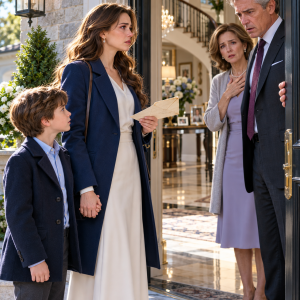
Owen walked ahead of Lydia and stopped several feet from Conrad. Snow gathered on his shoulders, but he did not seem to notice.
“Are you Conrad Ashby?”
Conrad looked from Owen to the other boys.
“Who are you?”
“I’m Owen Bennett. Those are my brothers, Caleb, Miles, and Henry.” He lifted his chin. “Are you the man who told everyone we never existed?”
No one behind Conrad moved.
For several seconds, only the slowing helicopter blades and the winter wind disturbed the silence.
Then Conrad’s astonishment hardened into anger.
“Lydia, what do you think you’re doing?”
She held his gaze.
“Accepting your invitation.”
The Evidence He Thought Had Disappeared
The gathering moved inside, although the warmth of the great room did little to ease the tension.
Camille stood a few feet away from Conrad, her expression no longer composed.
“Are these children yours?”
Conrad gave a short, dismissive laugh that convinced no one.
“Lydia has always known how to create a scene.”
Caleb immediately stepped forward. Of the four boys, he was the quickest to react whenever he believed Lydia was being treated unfairly.
“My mother doesn’t create scenes. She takes care of babies at the hospital, works until she can barely stand, and still comes home to help four kids with homework.”
Lydia placed a hand on his shoulder.
“Thank you, sweetheart, but let me handle this.”
Evelyn approached slowly. At seventy-one, she was still an elegant woman, accustomed to rooms becoming quieter when she entered. Yet before the boys, she seemed uncertain and suddenly much older.
“What are your full names?”
Owen answered first. Caleb followed, then Miles.
Henry glanced toward the dining room before speaking.
“I’m Henry James Bennett, and I’m hungry, but I understand that this is more important right now.”
A few guests released nervous laughs. Lydia pressed her lips together, caught between tears and amusement.
Evelyn looked carefully at each child.
“They resemble Conrad when he was young.”
“Resemblance proves nothing,” Conrad said.
Lydia placed the black case on the long walnut table beneath the chandelier and opened it.
She removed four certified birth records, medical reports from the boys’ earliest months, genetic test results, and a bundle of yellowed envelopes. Some bore stamps marking them as refused. Others carried confirmation that they had reached Conrad’s office.
The room remained silent as she arranged everything in neat rows.
Camille picked up one of the genetic reports.
“These results identify Conrad?”
“With clear certainty.”
Camille’s fingers tightened around the paper.
“Did you know?”
“Of course I didn’t,” Conrad replied. “None of this ever reached me.”
Lydia selected an envelope and placed it in front of him.
“This was delivered to your company three weeks after the boys were born. The person who accepted it signed your name.”
Conrad’s uncle, retired Judge Walter Ashby, adjusted his glasses and examined the signature.
“This is yours.”
Conrad glanced at it only briefly.
“I signed hundreds of documents during that period. I can’t remember every envelope placed on my desk.”
“You may not remember it,” Lydia said, “but I remember sending it. I had four children in intensive care, and I walked six blocks through the rain because the post office closest to the hospital had already closed.”
Evelyn picked up another envelope. Her own name and the Wintermere address appeared across the front in Lydia’s handwriting.
Inside was a letter dated eight years earlier and a photograph of four tiny infants surrounded by monitors.
Lydia remembered writing it in the hospital cafeteria after midnight. The ink had blurred in two places where tears fell before she could wipe them away. She had told Evelyn she did not want money or influence. She had asked only that four children not grow up erased from half of their family.
Evelyn read the first page, then looked at Lydia.
“I never received this.”
Before Lydia could respond, Margaret Cole, the longtime Wintermere housekeeper, appeared at the edge of the room. She had worked for the Ashbys for more than forty years and usually avoided family disagreements with practiced discretion.
That evening, however, she stepped forward.
“Mrs. Ashby, I believe I know what happened to those letters.”
Evelyn turned toward her.
“What do you mean?”
Margaret clasped her hands.
“Mr. Harrison instructed the staff not to deliver anything sent by Mrs. Bennett. Every arrival was recorded in the correspondence ledger before being removed. He said the situation had been settled and that giving you the letters would only cause distress.”
The reputation of Harrison Ashby had filled Wintermere long after his passing. His portrait still hung above the central fireplace, depicting a white-haired patriarch whose severe expression had once been mistaken for strength.
Conrad seized upon Margaret’s admission.
“There’s the explanation. My father controlled the household. He kept the letters from all of us.”
Judge Ashby placed the signed envelope on the table.
“He kept them from your mother. This one reached your office.”
“I told you, I don’t remember it.”
“Then answer a simpler question,” Walter said. “Did you know these boys were yours?”
Conrad opened his mouth, but Owen was already reaching into his backpack.
“My mother doesn’t know I brought this.”
He removed an old photograph, unfolded it carefully, and placed it beside the genetic reports.
The image showed Conrad standing behind the glass wall of a neonatal unit, looking toward four incubators. He was younger and thinner, dressed in a dark business suit, but there could be no mistake about his identity.
Conrad’s name and the date were written on the back.
Lydia stared at the photograph, and for the first time that evening, her composure almost failed.
For eight years, she had believed Conrad had never seen his sons. Some small, buried part of her had imagined that if he had witnessed how hard they fought during those first weeks, something human might have awakened in him.
Camille picked up the photograph.
“You went to the hospital.”
Conrad’s shoulders lowered.
“Once.”
The Truth Beneath His Silence

Evelyn pressed one hand to her mouth.
“You saw my grandsons and said nothing to me?”
Conrad looked toward the fireplace rather than at his mother.
“Dad took me there. He said Lydia was trying to trap me and that if I acknowledged the children, my future would be over. He talked about support payments, legal disputes, publicity, and what it would do to the company.”
Judge Ashby’s expression tightened.
“You were thirty years old, Conrad. Your father could advise you, but he could not make that decision for you.”
“You don’t understand what he was like.”
“Most of us understood him very well,” Walter replied. “The difference is that you allowed his approval to matter more than four children.”
Lydia felt years of exhaustion gathering behind her ribs, yet she refused to raise her voice. She did not want her sons to remember her breaking apart in front of the family that had denied them.
“I was twenty-six,” she said. “I had four premature babies, bills I could barely understand, and nights when I was afraid to close my eyes because one of the monitors might sound. You were worried about losing a promotion. I was worried about bringing all four children home.”
Henry moved closer and held the sleeve of her coat.
“He really saw us when we were babies?”
Lydia knelt before him.
She could have delayed the truth, but too many adults in that room had already spent too many years hiding it.
“Yes, sweetheart. He saw you.”
Miles looked directly at Conrad.
“Then why didn’t you stay?”
Conrad took one uncertain step toward them.
“I was afraid.”
Caleb’s eyes filled with angry tears.
“We were babies. You were the grown-up.”
The sentence seemed to remove every defense Conrad had prepared.