The Afternoon Everyone Looked Away

The sound cut through the music in the backyard so sharply that conversations seemed to stop in the middle of their sentences.
For a moment, nobody moved.
Two-year-old Sophie Hale stood beside a long picnic table decorated with white hydrangeas and pale blue ribbons, one small hand still reaching toward a silver pinwheel tucked into the centerpiece. Her uncle, Mitchell Carter, stood over her with a half-empty bottle in his hand and an irritated expression on his face.
“Maybe now you’ll learn not to grab things that don’t belong to you.”
Sophie stared at him as though she could not understand what had happened. Then she pressed her palm against her reddening cheek and began to cry.
Her mother, Allison, had been speaking with an aunt near the patio doors. She crossed the yard before anyone else seemed capable of reacting, lifted her daughter into her arms, and turned toward her older brother.
“What did you just do?”
Mitchell barely looked at her. He reached into a cooler, took out another drink, and twisted off the cap.
“I corrected her. You let her run around without any boundaries.”
“She is two years old.”
“Exactly. This is when children learn.”
The birthday gathering had been arranged for Allison’s father, Robert, who was turning sixty-five. Nearly twenty relatives had gathered at his large suburban home outside Columbus, Ohio. There were cousins playing lawn games, elderly aunts sitting beneath striped umbrellas, and several children chasing bubbles through the grass.
Every one of them had seen what happened.
Yet most lowered their eyes or found something else to look at.
Allison’s mother, Diane, hurried over, but instead of checking on Sophie, she positioned herself between Allison and Mitchell.
“Lower your voice,” she said. “Your father’s entire birthday is being ruined.”
Allison held Sophie closer. The little girl had buried her face against her mother’s neck and was trembling.
“Mitchell struck her.”
Diane frowned as though Allison were being deliberately unreasonable.
“It was hardly anything. He tapped her hand and accidentally caught her cheek.”
“You were standing right there.”
Robert came down from the deck, his expression stiff with displeasure.
“Allison, you need to calm down. Sophie has been running between the tables all afternoon. Someone could have gotten hurt.”
“Someone did get hurt.”
Mitchell gave a humorless laugh.
“This is what happens when a child never hears the word no.”
Allison looked around the yard, waiting for one person to say that he had crossed a line. Her aunt stared into her lemonade. Two cousins began gathering paper plates. Her younger uncle turned away and pretended to check the grill.
Their silence felt familiar.
Mitchell had always been the person everyone adjusted themselves around. When he became angry, people spoke more quietly. When he insulted someone, Diane explained that he was under pressure. When he broke something, Robert paid to replace it and called the incident a misunderstanding.
Allison had spent years telling herself that Mitchell was difficult, impulsive, or simply too proud to apologize. Standing there with her frightened daughter in her arms, she finally recognized those descriptions for what they were: excuses polished smooth by repetition.
She picked up Sophie’s small backpack, her blanket, and the keys to her car.
Diane followed her toward the house.
“You cannot seriously be leaving over this.”
Allison stopped at the back door.
“I’m not leaving over one moment.”
Her mother folded her arms.
“Then what are you leaving over?”
Allison looked past her at Mitchell, who was already talking to another relative as though nothing important had occurred.
“I’m leaving because I finally understand what this family has been doing for years.”
During the drive to Nationwide Children’s Hospital, Allison’s phone vibrated repeatedly in the cup holder.
Her mother wrote that she was being dramatic. Her father insisted that she return and apologize for causing a scene. Mitchell sent a voice message telling her that Sophie needed a less emotional parent.
Allison did not respond.
At a red light, she created a folder on her phone and saved every message. In the hospital parking lot, she photographed the mark on Sophie’s cheek beneath the bright overhead lighting.
The pediatrician who examined Sophie spoke gently and took careful notes. When she asked what had happened, Allison felt an old instinct rising inside her—the habit of softening Mitchell’s actions so that everyone could remain comfortable.
She nearly said that there had been an argument. She nearly called it an accident.
Then Sophie touched her cheek and whispered, “Uncle Mitch mad.”
Allison swallowed.
“My brother struck her because she touched a decoration.”
The physician stopped writing and met Allison’s eyes.
“You have the right to report this. A child should not be expected to accept this as discipline.”
That evening, after Sophie had finally fallen asleep beside her mother, Mitchell sent another voice message.
“Drop this before you tear the whole family apart.”
Allison saved that one too.
Three days later, her parents invited everyone to their house for what Diane called a family conversation. They said it was time to put the incident behind them.
Allison arrived carrying a thin document folder and a fully charged phone.
No one understood yet that she had already stopped asking for permission to protect her child.
The Meeting That Changed Direction

Mitchell arrived twenty minutes late, wearing a navy blazer over an open-collared shirt as if he were stopping by between business meetings. He worked as a commercial property broker and carried himself with the easy confidence of someone accustomed to walking into a room and deciding how the conversation would end.
He dropped into an armchair and looked at Allison.
“Are you finally ready to admit you overreacted?”
Robert stood near the fireplace and raised both hands.
“We are not here to attack anyone. We are here to repair the family.”
Diane nodded eagerly.
Her proposed solution was simple. Allison would acknowledge that emotions had become excessive, Mitchell would agree to be more patient, and then the two siblings would embrace so everyone could move forward.
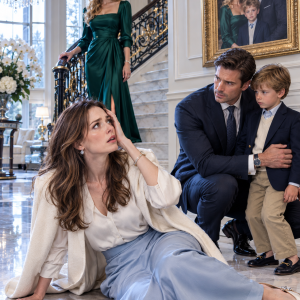
Mitchell leaned back.
“I have nothing to apologize for. Sophie was throwing a fit, and Allison refuses to discipline her.”
Allison placed her phone on the coffee table.
“Then there should be no problem listening to what happened.”
She opened an audio file.
The recording had begun accidentally while her phone was inside the pocket of her cardigan during the birthday party. At first, it captured music and distant voices. Then came the unmistakable sound of contact, Sophie’s frightened cry, and Mitchell’s voice rising above the yard.
“Yes, I did it. Maybe now she’ll learn.”
Diane’s response followed immediately.
“It was barely a tap. Stop making this bigger than it is.”
Then Robert’s voice could be heard blaming Allison for allowing Sophie to wander near the decorations.
When the recording ended, nobody spoke.
Mitchell’s expression tightened, but before he could respond, Allison’s cousin Rebecca leaned forward from the far end of the sofa.
“He did something similar to my son.”
Every face turned toward her.
Rebecca’s son, Owen, was eight now, but the incident had occurred when he was four. At a family cookout, he had spilled soda on Mitchell’s new shirt. Mitchell grabbed him by the shoulders and pushed him backward into a dining chair.
Diane interrupted.
“That happened years ago, and Mitchell was going through a very stressful period.”
Rebecca’s voice shook, though she did not look away.
“You told me to keep quiet. You said reporting it would split the family.”
Allison’s uncle Patrick cleared his throat.
He recalled an evening when several children had hidden in a guest room because Mitchell was shouting in the hallway. Mitchell kicked the door hard enough to crack the frame.
Another cousin admitted that she had stopped bringing her daughters to gatherings whenever Mitchell was present because he mocked them, shouted at them, and once threw one of their phones across a room.
The stories came slowly at first, then faster.
A broken lamp.
A chair shoved across a kitchen.
A teenage nephew grabbed by the jacket.
A waitress reduced to tears after Mitchell berated her over a delayed order.
For years, each event had been treated as separate and unimportant. Now, spoken aloud in the same room, they formed a pattern nobody could dismiss.
Mitchell stood so abruptly that the chair tipped backward.
“This is an ambush.”
Allison remained seated.
“No. This is what happens when people finally remember out loud.”
He pointed at her.
“You turned everyone against me.”
“Your choices did that.”
Mitchell stormed out, slamming the front door behind him.
Diane stared at Allison with angry tears in her eyes.
“Are you satisfied? You humiliated your own brother.”
Allison picked up her phone.
“The recording wasn’t the first thing I shared.”
Robert’s face changed.
“What does that mean?”
“I made a formal report. The hospital record, the photographs, and the messages have already been submitted.”
Diane pressed a hand against her chest.
“You involved authorities without telling us?”
“I told you what happened. You decided protecting Mitchell mattered more.”
Over the following weeks, several relatives agreed to give statements. Others refused, saying they did not want to choose sides.
Diane and Robert began contacting family members privately, encouraging them to reconsider what they remembered. Rebecca received messages warning that one careless statement could ruin Mitchell’s career and damage his relationship with his own children.
She sent screenshots to Allison, who forwarded them to the investigator.
Temporary protective conditions were issued, preventing Mitchell from contacting Allison or approaching Sophie while the case was reviewed.
A few days later, Robert left a message from an unfamiliar number.
“Withdraw everything. Families have survived far worse than this.”
Allison listened once, saved the recording, and placed it inside the growing digital folder.
By then, Rebecca had remembered an old home video.
What it contained would make it impossible to describe the incident with Sophie as a single loss of patience.
What the Old Video Revealed

Rebecca arrived at Allison’s apartment on a cold Saturday morning carrying a flash drive inside a plastic storage bag.
She had found the file while sorting old family videos. It was recorded four years earlier during Owen’s birthday party.
In the video, children were sitting on the floor opening presents. Owen picked up a remote control from a side table. Mitchell crossed the room, grabbed his arm, pulled him upright, and pushed him against a padded chair.
Diane immediately stepped in front of the camera.
“Turn that off. People misunderstand things when they only see part of the story.”
Robert lifted Owen to his feet but did not comfort him.
“You’re fine. It was an accident. Stop making such a fuss.”
Allison watched the recording twice.
The details were different, but the pattern was identical. Mitchell acted in anger. A child became frightened. Then Diane and Robert quickly rewrote the moment so that Mitchell remained misunderstood and the child became troublesome.
The investigator added the video to the case and conducted new interviews.
An aunt admitted that Mitchell had once locked his own children in a dark bedroom during a dinner because he believed they were being too loud. Patrick described seeing him shake a teenage nephew by the shoulders after the boy laughed at an innocent joke. Another cousin explained that Mitchell had broken her daughter’s phone after the girl tried to record him insulting a restaurant employee.
As more stories surfaced, Allison was forced to examine her own silence.
She remembered holiday dinners when she quietly cleaned up objects Mitchell had thrown. She remembered advising younger relatives not to argue with him because that was simply how he behaved. She remembered comforting Rebecca after the incident with Owen while also asking her not to make a decision she might regret.
At the time, Allison had believed she was keeping the peace.
Now she understood that peace built around one person’s anger was not peace at all. It was merely obedience with better manners.
The protective conditions remained in place. Mitchell was required to attend a psychological evaluation and participate in an anger-management program while the matter moved forward.
Allison gave copies of the protective paperwork to Sophie’s preschool. She provided photographs of Mitchell, Diane, and Robert and made the instructions clear: none of them were permitted to collect her daughter.
Diane responded with a six-page letter explaining Mitchell’s childhood, his disappointments, and the pressure he carried as the family’s oldest son.
She did not ask once how Sophie was doing.
Robert sent a shorter message.
“One mistake should not destroy a family.”
Allison saved both without replying.
Several weeks later, she agreed to attend a mediated meeting with Mitchell. She did not go in search of reconciliation. She went because she wanted to hear whether he could finally accept responsibility without blaming anyone else.
He looked tired when he entered the room, and his usual confidence seemed thinner.
“I made a mistake,” he said.
Allison studied him.
“Are you sorry Sophie was hurt, or are you sorry there were consequences?”
His jaw tightened.
“I lost control for one second. I’m not some kind of monster.”
“Nobody called you that. But you frightened a little girl, and people have been covering for you for years.”
Mitchell struck the tabletop with his palm.
“Nobody understands what all of you make me feel.”
The mediator became still.
Allison reached for her purse.
“That is exactly what we understand now. You believe your feelings give you permission to make everyone else afraid.”
She left without another word.
It was the last conversation she had with her brother.
A Different Kind of Family
In the months that followed, Allison’s parents continued trying to weaken the case. They offered to help Rebecca with an overdue loan if she would revise her statement.
Rebecca recorded the conversation and gave it to the investigator.
When Diane called Allison from another relative’s phone, her voice was exhausted and bitter.
“How far are you willing to take this?”
“As far as I need to so you stop protecting him.”
“He is my son.”
“Sophie is your family too.”
Diane had no answer.
Some relatives stopped speaking to Allison. They said she had exposed private matters and embarrassed people who had never harmed her personally.
Others began calling quietly.
A cousin spoke about growing up afraid of Mitchell’s temper. An aunt apologized for looking away at Robert’s birthday party. Patrick admitted that he had spent years telling himself it was not his place to interfere.
One afternoon, a fifteen-year-old relative named Madison asked to speak with Allison alone.
“I thought when grown-ups got angry, kids were supposed to stay quiet and wait for it to be over.”
Allison knelt so they were at eye level.
“You never have to accept being hurt just because an adult is angry.”
The formal process moved slowly, and the family never returned to what it had once been. But Allison no longer believed returning was the goal.
A year after the birthday gathering, Sophie turned three.
Allison held a small party in the shared garden behind her apartment building. Rebecca came with Owen, along with several relatives who had supported them. There were cupcakes, bubbles, paper flowers, and bright ribbons tied to the low branches of a maple tree.
In the middle of a game, Sophie knocked over a cup of pink lemonade.
The drink spread across the patio.
Sophie froze.
Her shoulders rose, and she looked from one adult to another, waiting for anger.
Rebecca crouched beside her and smiled.
“It’s okay, sweetheart. It was an accident.”
Sophie turned toward her mother.
Allison opened her arms.
“You’re not in trouble. Go play.”
The little girl hesitated only a moment before running back toward the ribbons, laughing as they lifted in the breeze.
Allison watched her daughter reach for one without flinching.
For months, people had accused her of destroying their family. They said she had chosen outsiders over loyalty and punishment over forgiveness.
But standing in that garden, Allison understood the truth with a clarity she had never felt before.
She had not destroyed her family.
She had interrupted a silence that had been wearing them down for years.
And perhaps, in time, the people who remained would learn that love did not mean hiding what happened, protecting the person who caused fear, or asking a child to carry the cost of everyone else’s comfort.
Sometimes love meant speaking plainly.
Sometimes it meant leaving the room.
And sometimes it meant showing a little girl that when she reached toward something beautiful, no one had the right to make her afraid.