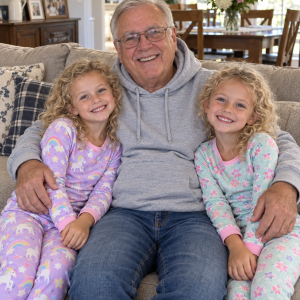
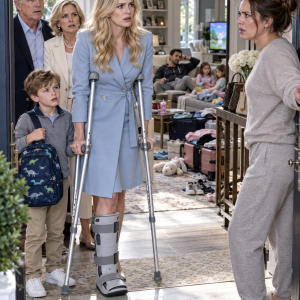
“Grandma says not to.”
After a deputy confirmed that Garrett had been taken outside, Rachel told Ellie to turn the lock. The child emerged with swollen eyes and the phone beneath her pajama top. She saw her mother’s leg and stopped.
“Can I hug you?”
Rachel swallowed hard. Even then, after everything the child had witnessed, Ellie was asking permission.
“Always, honey. Come here.”
Ellie knelt carefully and rested her head against Rachel’s shoulder. Then she pulled out the phone.
“Grandma?”
“I’m still with you,” Linda answered.
Only then did Ellie allow herself to sob, because the person who had promised to remain on the line truly had remained.
The Blue Backpack

At the medical center, Rachel learned that her leg would need a brace and several weeks of rest. She told the deputies exactly what had happened without accepting Garrett’s claim that she had simply fallen, and she repeated the sentence about Friday.
A family-support advocate named Marissa Cole sat beside her while an officer took the report. She spoke quietly, never rushed an answer, and explained each form before asking Rachel to sign it. When Rachel apologized for needing a question repeated, Marissa set down her pen.
“You don’t have to apologize for taking your time,” she said. “Tonight, you get to understand everything before you agree to anything.”
The sentence seemed ordinary, yet it brought tears to Rachel’s eyes. Garrett had spent years hurrying her into decisions and then criticizing the choices she made under pressure. Even ordering dinner had become a test in which there was somehow always a wrong answer. Sitting beneath the pale hospital lights, Rachel began to recognize how unfamiliar patience had become.
Linda arrived with her silver hair uncombed and her cardigan buttoned incorrectly. After thirty years repairing clocks and jewelry, her hands were usually steady, but they trembled as she knelt before Ellie.
“Did you hear me the whole time?”
“Yes.”
“And you kept the door locked?”
Ellie nodded and raised two fingers. Linda closed her hand gently around them.
“You did exactly what you were taught. You don’t have to be brave anymore tonight.”
The evening seemed nearly over when Ellie opened the overnight bag Linda had packed and said, “Daddy made me a bag too.”
Rachel looked up. “What bag?”
“The blue one in his car. He packed it yesterday.”
“What did he say it was for?”
“Our long trip on Friday.”
Rachel felt a chill move through her. “Was I going too?”
Ellie shook her head. “He said you needed a very long rest. He said we were going somewhere people use different words, and I would learn them.”
Separate memories suddenly joined: Garrett requesting Ellie’s birth certificate, taking over every preschool pickup, changing the shared banking password, and asking about the fastest route north. Rachel had never realized the incidents belonged to one plan.
The next morning, investigators found the blue backpack beneath a blanket in Garrett’s SUV. It contained Ellie’s clothes, identification papers, a prepaid phone, and $3,100 in cash. Beside it lay a reservation near Burlington, Vermont, directions toward the Canadian border, and an email telling Ellie’s school she would not return after Friday because of a “family relocation.” Rachel’s name appeared nowhere.
A folded note listed four reminders: leave at 5:45 before Rachel wakes, avoid the interstate at first, turn off the regular phone, and call after crossing the border.
Garrett had prepared to take their daughter far from home without telling Rachel. Her announced weekend visit to Linda threatened to remove his opportunity.
All you had to do was hold it together until Friday.
Now she understood.
Later that afternoon, Rachel regained access to the family account and discovered that Garrett had been transferring small amounts into a separate fund for almost three months. Together, the withdrawals formed enough money to remain away for weeks.
The discoveries continued over the following days. A second email account contained messages to a short-term rental agent in northern Vermont. Garrett had described himself as a father beginning a new position and claimed that Ellie’s mother would “join them later,” though no arrangements had ever been made for Rachel. His search history included questions about replacing a child’s school records, using prepaid phones, and crossing into Canada by smaller roads. None of those facts alone explained everything, but together they revealed careful preparation rather than a sudden decision made during an argument.
Marissa helped Rachel organize copies of the messages, account statements, school notice, and travel reservation. For the first time in years, Rachel saw the value of writing things down exactly as they happened. Garrett had often relied on exhaustion and confusion, telling her that she had remembered his words incorrectly or misunderstood his intentions. Paper did not become uncertain when challenged. Dates remained dates, withdrawals remained withdrawals, and the blue backpack remained exactly where investigators had found it.
Linda’s expression hardened. “You and Ellie are coming home with me. This ends today.”
Rachel’s body tightened before she could stop it. Her mother was speaking from love and fear, yet Rachel had spent too long being told where she would live and what was best for her.
“Mom, we will stay with you because we need a safe place, but it has to be my choice.”
Linda opened her mouth, then closed it.
Ellie, coloring beside the window, looked up. “Mommy chooses.”
Linda nodded slowly. “Yes. Mommy chooses.”
Those two words became the first new thing they built together.
At the temporary family-court hearing, Rachel sat with her braced leg extended beneath a wooden table while Garrett remained across the room with his attorney. He studied his hands as the travel documents were described. Rachel expected to feel triumphant when the judge ordered that Ellie remain with her and prohibited unsupervised contact during the investigation. Instead, she felt relief mixed with grief for the family life she had kept hoping Garrett might someday choose.
Outside, Linda asked whether Rachel wanted to talk. Rachel said no. They drove home in silence, where Ellie was building a tower with Howard. When she saw her mother, she ran forward, remembered the brace, and slowed to a careful walk. That small act—joy adjusting itself into tenderness—meant more than any speech could have.
Learning to Choose Again
The weeks that followed were not simple. Rachel had to repeat the story and describe how gradually Garrett had limited her access to money, transportation, friends, and ordinary decisions. The hardest question came one evening on Linda’s old green sofa.
Some mornings Rachel woke before sunrise convinced that she had forgotten something important. She would check the lock, look into Ellie’s room, and then sit at the kitchen table until the feeling passed. Other days she became angry with herself for not leaving sooner, although Marissa repeatedly reminded her that people who control a household rarely reveal the full pattern at once. They introduce one restriction, offer an apology, wait for life to feel normal, and then introduce another. By the time the pattern becomes visible, the person living inside it has often been trained to question her own judgment.
Rachel began meeting weekly with a counselor who asked her to make small choices without explaining them. At first, the exercise sounded almost childish. She chose which chair to sit in, which route to take home, and whether she wanted tea or coffee. Yet each choice exposed the same instinct: before answering, she tried to imagine what someone else preferred. Gradually, she learned to notice the instinct without obeying it.
“Is Daddy mad at me because I called Grandma?”
Rachel rested her crutches against the wall. “You did nothing wrong.”
“But the phone was a secret.”
“It was a secret meant to keep you safe. You never have to hide it again.”
“Can I call Grandma whenever I’m scared?”
“Yes.”
“Even if somebody tells me not to?”
“Even then.”