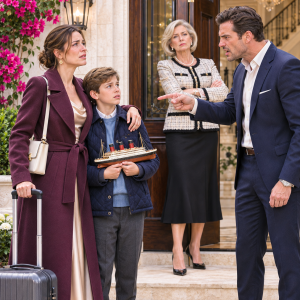
What Owen Finally Told Us
Owen stayed in the hospital for observation.
Fortunately, doctors expected him to recover fully, but his hand needed time to heal and the concussion required careful monitoring.
The hardest part came the following afternoon.
Owen looked at Graham and said:
“Dad, this wasn’t the first time.”
Graham’s face went still.
Owen told us about incidents we had never known about.
A twisted finger.
A shove in a stairwell.
Threatening messages he had deleted because he was afraid we would confront Bryce and make everything worse.
Then Owen said:
“I thought you would tell me to understand him because he didn’t have a dad.”
Graham lowered his head.
For a long time, he could not speak.
Finally, he sat beside Owen’s bed.
“I should have protected you before it ever got this far.”
Owen looked at him.
“You didn’t want to believe me.”
Graham nodded slowly.
“You’re right.”
There were no excuses.
No speeches.
Just the truth.
And sometimes the truth hurts more than anger.
The Evidence Nobody Could Ignore
A detective interviewed Owen at the hospital.
I gave him everything I had saved.
Photos.
Screenshots.
Dates.
Descriptions of previous incidents.
What I had once considered an overly cautious collection of family problems suddenly became a clear timeline.
Investigators also obtained permission to examine Bryce’s phone.
What they found showed that the problem was larger than one argument between cousins.
Bryce had been hiding serious personal problems for months.
He owed money to several people.
He had repeatedly pressured his mother for cash.
Colleen had sent it without asking questions because she was afraid of losing him.
Judith had covered other mistakes because she believed protecting Bryce meant loving him.
Together, without intending to, they had created a world where he rarely faced consequences.
That world finally collapsed.
Graham Made His Choice
For weeks, Graham received calls from relatives.
Some were sympathetic.
Others were furious.
One uncle told him:
“Family matters should stay inside the family.”
Graham answered:
“It stopped being a private family matter when my son stopped feeling safe around his own relatives.”
Colleen came to our house once.
She begged Graham to convince us to “make things easier” for Bryce.
Graham did not invite her inside.
“I love you because you’re my sister,” he told her. “But loving you does not require me to sacrifice my son for your comfort.”
Then he closed the door.
I had waited years to hear him draw that boundary.
I only wished Owen had not paid such a high price for Graham to finally find his voice.
The Family Afterward
The legal process took months.
Bryce ultimately faced consequences for what happened to Owen as well as separate issues discovered during the investigation.
I cared less about the exact punishment than I thought I would.
What mattered most was that nobody could pretend anymore.
Judith blamed me.
She sent Graham a long letter accusing me of tearing apart the family.
He read it once.
Then he put it away.
“She still thinks you caused this,” he said.
“I didn’t create what happened,” I replied. “I just stopped helping everyone hide it.”
Graham looked at me for several seconds.
“I know that now.”
Owen Learned to Build Again
Recovery was slow.
For months, Owen hated closed doors.
He became nervous before family events even when we promised Bryce would not be there.
We found a counselor who helped him work through the fear.
Graham went to counseling too.
He finally admitted that his lifelong habit of avoiding conflict had not created peace.
It had only transferred the cost of that conflict onto the people who were least able to defend themselves.
One afternoon, several months later, I heard Owen laughing in the garage.
He and Graham were rebuilding an old desktop computer from spare parts.
Owen held up a cable.
“You plugged this into the wrong port.”
Graham frowned.
“Are you sure?”
“One hundred percent.”
“I build forty-story buildings for a living.”
Owen laughed.
“Then it’s a good thing this is a computer.”
Graham threw a shop towel at him.
Owen threw it back.
I stood in the doorway watching them, realizing how long it had been since laughter in our house sounded effortless.
That night, Graham asked me:
“Do you think he’ll really be okay?”
I looked toward Owen’s bedroom.
His keyboard was clicking again.
For months after the incident, that room had been almost completely silent.
Now he was creating something.
“Yes,” I said. “Not because he’ll forget what happened. Because now he knows we believe him.”
Protecting the reputation of a family should never become more important than protecting the person inside that family who is quietly asking for help.
When someone repeatedly makes other people uncomfortable or afraid, calling each incident a misunderstanding does not create peace; it only gives the pattern more time to grow.
Children and teenagers often stay silent because they are watching how adults react, and every excuse we make for harmful behavior teaches them whether speaking up will actually make them safer.
Loving a relative does not mean protecting that person from every consequence, because sometimes consequences are the first real opportunity they have to recognize that their choices must change.
A parent should never be more afraid of offending grandparents, siblings, cousins, or extended relatives than they are of losing the trust of their own child.
Silence may keep a family dinner comfortable for one evening, but unresolved fear can follow a child into school, friendships, sleep, confidence, and every relationship they build afterward.
People who ask you to “keep the family together” should also be willing to ask whether the family they are protecting is actually a safe and healthy place for everyone inside it.
Setting boundaries can feel cruel when you have spent years being taught that loyalty means endless forgiveness, but a healthy boundary is often what finally separates genuine love from unhealthy enabling.
Apologies matter, but the strongest apology a parent can give is not a speech; it is changing their behavior so their child never again has to wonder whose side they will choose.
Family is not proven by sharing a last name, sitting around the same holiday table, or defending each other at any cost; family is proven by creating a place where the most vulnerable person in the room knows they will be heard, believed, protected, and never asked to suffer quietly just to keep everyone else comfortable.