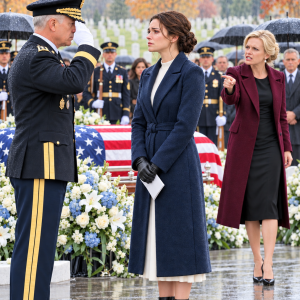
Mrs. Parker’s doorbell camera had captured Lily trying her key, making repeated phone calls, huddling beneath the porch roof, and finally standing before Margaret as the older woman told her she could no longer live there.
The documents also referred the matter to child welfare officials and requested a protective order preventing Margaret from approaching Lily or visiting her school.
Bethany dropped the papers onto the dining table.
“She can’t do this to us.”
Walter, standing near the kitchen doorway, answered quietly.
“Yes, she can.”
For the first time, uncertainty crossed Margaret’s face. It was not remorse, but it was the beginning of fear.
She called Allison seventeen times that night.
Allison answered none of them.
The first voicemail contained accusations. The second blamed Allison for dividing the family. By the fifth message, Margaret’s carefully controlled voice had disappeared.
“You’ll regret embarrassing me like this, and that girl needs to learn who makes the rules in this house.”
Allison listened once and forwarded the recording to her attorney, Diane Mercer.
On Saturday morning, Allison returned with Lily, Diane, two police officers, and a locksmith. Lily held a worn stuffed rabbit tightly against her chest.
“You don’t have to go inside,” Allison told her.
“My drawing notebook is upstairs.”
That notebook held the feelings Lily could not express aloud. She had drawn empty chairs when her father stopped visiting regularly, narrow cages when Margaret began calling her a burden, and small houses without doors whenever she felt unwelcome.
Allison took her hand.
“Then we’ll get your notebook.”
The locksmith opened the door within minutes.
Margaret appeared in the hallway with her shoulders straight and her chin lifted.
“You brought police officers against your own mother?”
Allison held up the court order.
“I brought them to my daughter’s legal residence.”
Bethany stepped from the dining room.
“You’re breaking up the family over one mistake.”
“One?” Allison asked.
Bethany had no answer.
They both knew it had never been one mistake.
There had been the Christmas when Lily’s presents disappeared because Margaret decided she had not been grateful enough. There had been family dinners when Bethany’s son was served first while Lily was told to wait. There had been countless quiet remarks about Allison’s unsuccessful marriage and the child Margaret treated as evidence of that failure.
For years, Allison had believed that keeping the peace meant protecting her family. Standing in that hallway, she finally understood that peace without safety was merely fear dressed in good manners.
Upstairs, Lily’s bedroom looked almost untouched, which somehow made the rejection more painful. Her photograph with Allison at Lake Erie had been placed facedown in a drawer. Her school certificates were stacked in a corner, and the stuffed rabbit she had owned since preschool sat inside a cardboard box marked for donation.
Lily stared at the box.
Allison removed the rabbit and placed it in her arms.
“Your grandmother doesn’t get to decide what matters to you.”
Downstairs, Margaret was speaking to one of the officers in a gentle, practiced voice.
“Lily is overly sensitive. I was simply establishing boundaries.”
The officer looked directly at her.
“Changing a lock and leaving a child outside in severe weather is not a reasonable boundary.”
Margaret’s smile tightened.
As Allison and Lily prepared to leave, Margaret stepped toward the girl.
“Come here, Lily.”
Lily froze.
Allison moved between them.
“Do not speak to her.”
“I’m her grandmother.”
“You gave up the right to use that word as a weapon.”
Margaret’s composure finally broke.
“After everything I did for you! I gave you somewhere to stay when your marriage fell apart.”
“Dad provided that home,” Allison replied. “You used it to make my daughter feel unwanted.”
Bethany began to cry.
“Where are we supposed to go?”
Allison looked at her sister’s expensive handbag, carefully manicured hands, and the leased SUV parked outside. Bethany had lived there for three years without contributing to the mortgage, taxes, or utilities.
“You have thirty days to decide.”
Walter had remained silent throughout the confrontation. As Allison reached the door, he spoke.
“Allison, I’m sorry.”
It was far too late to repair what had happened, yet it was the first honest sentence anyone had offered in that house.
During the following weeks, Diane uncovered another problem. Margaret had been withdrawing money from the trust to pay Bethany’s credit-card bills, personal purchases, and travel expenses, labeling them as household maintenance.
Then Allison received an envelope from her father’s former attorney. Inside was a letter Richard had written shortly before he passed away.
Allison opened it in her parked car.