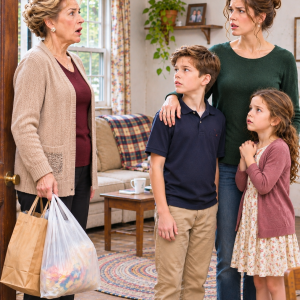
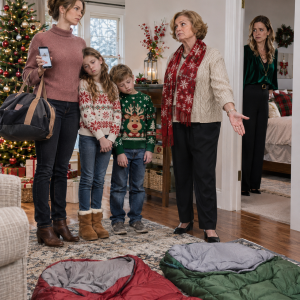
“Margaret Hale. County Family Services. I’m completing Ms. Carter’s final home assessment.”
For once, my mother had no immediate answer.
Margaret continued in the same even voice.
“The prior family record has already been reviewed as part of this case.”
Melissa’s face changed.
She looked at Mom, then at Dad.
“Wait. You told social services Claire couldn’t take Hannah?”
My mother waved a hand.
“You don’t understand the circumstances.”
“Did you?”
“Melissa, not now.”
Aaron, who had barely spoken all morning, set the folded moving blankets on the floor.
“I asked in the car whether Claire had agreed to this,” he said. “You all told me she had.”
Melissa turned toward him.
“Aaron—”
“She obviously didn’t.”
He looked down the hallway at the children’s names.
“And I’m not moving somebody’s bed out of a house so we can take over rooms meant for two kids.”
The older mover cleared his throat.
“Ma’am, without the homeowner’s permission, we can’t remove property.”
My mother seemed to realize that every person in the room was looking at her.
Not as the family organizer.
Not as the woman who always knew best.
Simply as someone who had arrived at another adult’s house with a moving truck and assumed possession.
She tried one final argument.
“Claire, we are your family.”
I nodded.
“Yes. Which is why I kept giving you chances to treat me like family.”
She opened her mouth, but I continued.
“This house isn’t available to Melissa. No bedroom is available to Melissa. The children are coming here because they need permanence, and I will not apologize for making room for them.”
Dad looked older than he had when he entered.
“Claire…”
“I need all of you to leave.”
There was no shouting.
No slammed furniture.
No grand final speech.
The movers returned to the truck.
Aaron walked out first.
Melissa followed after a long moment.
Dad paused by the door, but Mom called his name from the driveway.
Then they were gone.
The whole confrontation, the one I had imagined for years in a dozen dramatic versions, ended with nothing more theatrical than the sound of tires pulling away from my house.
Coming Home
Margaret remained for a few minutes.
I expected criticism.
Instead she sat at my kitchen table and closed her folder.
“You handled that appropriately.”
I laughed once, mostly from nerves.
“It didn’t feel appropriate.”
“Boundaries rarely feel graceful when people have spent years teaching you not to have them.”
She looked toward the hallway.
“Those rooms are ready.”
Two weeks later, she called.
My hands started shaking when I saw her number.
“Claire?”
“I’m here.”
There was warmth in her voice.
“The placement has been approved.”
I sat down on the kitchen floor.
“Really?”
“Really. We’ll arrange their transition for Saturday.”
The children arrived with two county workers and several mismatched bags.
Sophie stood at the bottom of the porch steps, holding Ben’s hand. At eight years old, she already watched adults with the careful attention of someone who had learned that plans could change without warning.
Ben looked past me into the house.
“Do we sleep here tonight?”
“Yes.”
He looked at Sophie, then back at me.
“And tomorrow?”
My throat tightened.
“Tomorrow too.”
Sophie asked the harder question.
“How long?”
I crouched so we were closer to eye level.
“As long as you need this to be home.”
She did not run into my arms.
I was glad she didn’t feel she had to.
Trust is not something children owe adults for providing a bedroom.
It is something adults earn slowly.
So I carried the bags.
Sophie chose where everything went.
Ben discovered the stars on his ceiling and spent twenty minutes switching them on and off.
We ate grilled cheese sandwiches because I had planned a beautiful dinner and then realized nobody wanted anything complicated.
Afterward, Sophie stood at the bookshelf.
Her hand froze over the faded cover of the lighthouse story.
“My mom had this book.”
I sat beside her.
“I know.”
She looked at me.
“How?”
I picked it up carefully.
“Because this is the same copy.”
She frowned.
I opened the cover and showed her Grandma Evelyn’s handwriting.
“My grandmother read it to me when I was little. Later I read it to your mom.”
Sophie traced the worn corner.
“Did you know her a lot?”
“I did.”
“Did you like her?”
The question was so small that it nearly undid me.
“I loved her very much.”
Sophie lowered her eyes.
After a moment, she whispered, “Can you read it?”
So that first night, Ben climbed under his blanket while Sophie sat beside him, and I read a story that had traveled through four generations of our family.
Halfway through, Ben pointed toward the window.
A pale beam moved across the distant water.
“Look.”
Sophie turned.
Far across the dark shoreline, the lighthouse swept its slow arc through the night.
The children watched it come and go.
Come and go.
Always returning.
When I finished reading, Sophie was quiet.
Then she asked, “Will the light still be there tomorrow?”
“Yes.”
“Even if there’s bad weather?”
“That’s when it matters most.”
She seemed to consider that.
Then she leaned against my shoulder.
Only slightly.
Only for a moment.
But I understood what it meant.
For years my family had treated my empty bedrooms as evidence that my life was missing something. They looked at me and saw a woman without a husband, without children, without the kind of household they considered complete, and they assumed unused space belonged to whoever demanded it loudly enough.
They had misunderstood both me and the house.
Those rooms had never been empty.
They had been waiting.
And perhaps I had been waiting too—not for someone to give my life meaning, because a life does not need permission to matter, but for the chance to offer what Grandma Evelyn had once offered me: one steady place in a world that sometimes changed too quickly.
A few months after Sophie and Ben moved in, I finally hung the old brass tide clock in the hallway.
Below it, I framed the sentence Grandma Evelyn had written inside the lighthouse book.
Steady things matter, even when nobody applauds them.
Every evening, as the house settles and the children prepare for bed, the real lighthouse turns beyond our windows.
Some nights nobody notices.
It shines anyway.
I think that was the lesson Grandma had been trying to teach me all along.
A home is not defined by how many bedrooms it has, how much it costs, or whether other people think you deserve it.
A home is the place where nobody has to earn the right to stay.
And after all those years of being told I was the daughter who needed nothing, I finally understood that strength had never meant living without anyone.
Sometimes strength simply meant becoming the person who left the light on.