“Daddy! I told you!”
I sank to my knees, one hand still holding his. I wanted to pray, to cry, to ask a dozen questions, but I could do none of those things properly. Hannah was alive, and she needed help.
The Questions at the Hospital

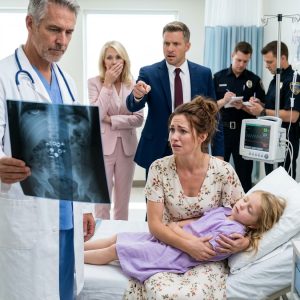
At the hospital, a nurse led me to a small waiting room with gray walls and a vending machine that hummed too loudly. My hands shook so much that I couldn’t drink the water she brought me. After what felt like hours, a physician named Dr. Patel came in.
“Mr. Mercer?”
I stood.
“How is my wife?”
“She’s alive, but her condition is very serious. Our intensive care team is supporting her breathing while we assess how her body and brain have been affected.”
I gripped the back of a chair.
“Do you think she’ll wake up?”
“It’s too early to know. We’re doing everything we can, and we’ll keep you informed as we learn more.”
I nodded, trying to absorb the answer without turning it into something better or worse than what he had said.
Then I asked the question that had been circling in my mind since the cemetery.
“How could she have been reported as having passed away when she was still alive?”
Dr. Patel didn’t speculate.
“We need to review the entire sequence: the original examination, her medical history, any medications, and the procedures that were followed. We’ll also involve the appropriate specialists and investigators. I don’t want to guess before we have evidence.”
I appreciated his honesty, though it didn’t ease the fear in my chest. Hannah had warned me the night before. Grant had hurried the arrangements. Now the medical team was asking about medications.
Sergeant Miller came to the hospital later that evening and asked whether Hannah had been taking anything new or had mentioned unusual symptoms. I told him she had generally been healthy, then remembered something she had said about two weeks earlier.
“She mentioned feeling dizzy one afternoon,” I told him. “She said it passed after she sat down.”
“Did she see a doctor?”
I wasn’t sure. I had been on a long inspection that day, and she had told me about it over dinner.
“I don’t know. She may have called someone at work.”
The sergeant wrote that down and asked if Hannah had been worried about anything. I remembered her phone call during dinner, her grip on the phone by the kitchen window, and the way she had asked me not to dismiss what I saw.
The Notes She Left Behind
Then I remembered the notes she left around the house.
The next morning, while Caleb stayed with my sister, I returned home with Sergeant Miller’s permission to look for Hannah’s phone and any medical paperwork. Her phone was not on the kitchen counter or bedside table. Grant had taken it, he said, because he wanted to keep it safe while the family made arrangements.
I searched the desk where Hannah kept school forms and found a small envelope with my name written on it. Inside was one of her notes, folded in half.
“If I feel dizzy again, I’m going to call the clinic and ask for a full review. Please remind me not to put it off.”
It was dated two weeks earlier.
Beneath it, I found a printed appointment reminder from a neighborhood clinic, along with a list of questions in Hannah’s handwriting. She had noted the time she felt dizzy, what she had eaten, and a medication she had recently been given for a lingering infection. There was nothing in the note that explained what had happened, but it proved she had been trying to find answers.
I took the papers to Sergeant Miller. He photographed them and asked me not to disturb anything else.
By that afternoon, the hospital had begun a formal review with the clinic and the physician who had first examined Hannah. The process was slow and careful, which was difficult to bear but necessary. I learned that the original assessment had been made during a rushed overnight call, after Hannah had become unresponsive at home. The initial report had recorded that no signs of life were detected, but the full examination notes were incomplete, and the information about her recent medication had never been provided.
Grant had known about the medication. He had picked up the prescription for Hannah after she felt dizzy and offered to help because he said he knew the clinic’s process. When the investigators asked him why he had not mentioned it, he said he thought it was unrelated and had been trying to spare me from more paperwork.
That explanation didn’t answer why he had pushed for a quick funeral or why he had tried to stop the examination at the cemetery. Sergeant Miller told me that those questions were still being investigated, and that they would not assume intent without evidence.
When he finally spoke to me alone, Grant looked smaller than I remembered.
“I panicked,” he said. “I thought the doctors knew what they were doing, and I didn’t want you to blame yourself for not asking more questions.”
I looked at him for a long time.
“You didn’t let me ask any.”
His eyes dropped.
“I know.”
I wanted to hear a better explanation, one that would make the last few days feel less frightening, but there was no sentence he could offer that would give me back the hours Hannah had spent without care. The investigation would have to determine what had gone wrong and whether anyone had failed her. My job was to wait, to care for Caleb, and to hope that Hannah would have the chance to tell us herself.
A Hand Around Mine

The following days moved between hospital chairs, phone calls, and the soft routine of keeping a seven-year-old fed and reassured. Caleb asked every morning whether his mother had woken up. I learned to answer honestly without taking away his hope.
“The doctors are helping her, and we’re going to keep visiting.”
He brought one of Hannah’s notes in his pocket and touched it whenever he felt anxious. I brought the wooden box from my desk to the hospital, not because I thought Hannah could hear me read them, but because they were part of her life, and I wanted the room to feel less like a place where everyone was waiting for news.
On the ninth day, Dr. Patel came to the family room with a different expression. He told us Hannah had opened her eyes briefly and responded to a simple request. She was still weak, and her recovery would take time, but she was beginning to respond.
Caleb gripped my hand.
“Can we tell her I’m here?”
“Yes,” I said. “We’ll tell her as soon as we’re allowed.”
When we entered her room, I stood beside her bed and took her hand carefully. It was warm. I didn’t ask her to speak or move. I simply leaned close enough that she might hear me.
“Hannah, it’s Owen. Caleb is here, and we love you. You don’t have to hurry. We’re right beside you.”
Her eyelids fluttered. Caleb held his breath.
Then Hannah’s fingers curled faintly around mine.
I had once thought a life changed in a single moment, as if a door slammed shut and everything on the other side became unreachable. But when Hannah’s hand moved against mine, I understood that some moments are not endings or beginnings by themselves. They are the small, fragile bridges between what we fear and what we may still be able to save.
I looked at Caleb, who was smiling through tears, and thought of the promise Hannah had asked me to make. I had not understood it then. I understood it now: pay attention, ask questions, and trust the quiet warning inside you when someone you love is trying to tell you that something is wrong.
The investigation continued, and there were still answers we didn’t have. But Hannah was in the room with us, her hand resting in mine, while Caleb told her about the sunflower seeds he had saved for spring. Outside the window, the afternoon light lay pale across the hospital grounds, and for the first time in days, I let myself imagine a tomorrow that included all three of us.