PART 1 — THE DAUGHTER SHE WOULDN’T WALK DOWN THE AISLE
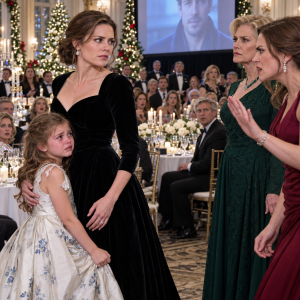
My mother had walked both my sisters down the aisle as if they were miracles in lace. On my wedding morning, she looked at me in my white dress, adjusted one of her pearl earrings, and said, “I refuse to walk my greatest regret to the altar.”
For several seconds, nobody in the bridal room moved. My veil was still caught between my fingers, and behind Mom, my sisters Paige and Lauren exchanged the same small smile they had used since childhood whenever one of our parents found a new way to remind me where I ranked. Paige glanced at the makeup artist packing her brushes and said, “Emma, please don’t start crying now. You’ve already paid her once.”
My father, Thomas Stone, stood near the door in his gray tuxedo and gave me the weary expression he usually reserved for situations he believed I had created merely by reacting to them. “Your mother has a right to her feelings,” he said. “You two have never had an easy relationship.”
I was twenty-nine years old, ten minutes from walking into a church filled with nearly two hundred people, and somehow my parents had managed to make me feel fourteen again.
My fiancé, Daniel, took one step toward my mother, but I touched his arm before he could speak. “Don’t,” I said quietly. “Not today.”
Mom gave a humorless laugh. “See? That’s exactly what I mean. Everything has to become a performance with you.”
I looked at her carefully. “You came into my bridal room and called me your greatest regret. What response were you hoping for?”
She didn’t answer that. Instead, she smoothed the front of the pale blue dress I had paid for and said, “I’m not going to stand in front of everyone and pretend we’ve had some beautiful mother-daughter relationship. Paige and Lauren appreciated what we gave them. You spent your entire life keeping score.”
That part was true. I had kept score because nobody else seemed interested in the numbers.
When Paige turned sixteen, Mom and Dad bought her a used BMW. When I turned sixteen, Dad told me insurance for three teenage drivers was already expensive and gave me the keys to his twelve-year-old Buick when he didn’t need it. Lauren spent a semester in Paris. I worked thirty hours a week through college because the education account my grandmother had supposedly established for me had somehow contained far less money than everyone remembered.
Whenever I asked questions, Dad called me ungrateful. Mom preferred difficult.
Eventually I made a career out of asking questions for a living.
I became a forensic accountant.
Mom hated the irony.
The bridal-room door opened before anyone could say more, and my eighty-one-year-old grandfather Arthur stepped inside leaning on his black cane. He looked from me to my mother and seemed to understand from the silence that he had interrupted something ugly.
“What’s going on?”
Mom immediately smiled. “Nothing, Dad. Emma is upset.”
Grandpa looked at me. “Emma?”
I could have protected her. I had spent most of my childhood doing exactly that because telling the truth about Mom usually created a second argument about why I had embarrassed her.
That morning, I stopped.
“Mom says she won’t walk me down the aisle because I’m her greatest regret.”
Grandpa’s hand tightened around his cane.
“Margaret,” he said, “you said what?”
Mom’s smile disappeared. “This is between Emma and me.”
“Not anymore.”
Dad stepped forward. “Arthur, don’t make this bigger than it is.”
Grandpa ignored him. He came to me, held out his hand and asked, “Would you let an old man walk you instead?”
My throat tightened. “Grandpa—”
“You were never a regret.” His thumb pressed gently against my hand. “Not to the people who were paying attention.”
Mom looked away.
It was a cruel thing for her to hear on my wedding morning, but it was not the sentence that frightened her.
That came next.
Grandpa leaned closer and said, “And after the ceremony, I think it’s time we finish the conversation about your grandmother’s account.”
Mom’s head snapped toward him.
For eighteen months, Grandpa and I had been quietly trying to understand what happened to money my grandmother Evelyn left for my education. I had started asking after discovering an old tax document among Grandpa’s records showing an account balance that made no sense compared with what I had received.
Grandma had established an education trust when I was six. Grandpa was the original trustee, but after a stroke when I was fifteen, he temporarily transferred administrative responsibility to my parents while he recovered. By the time I started college, Mom and Dad told me market losses and tuition expenses had reduced the fund to $18,400.
I believed them.
Then, eighteen months before my wedding, I found a statement showing that the trust had held more than $146,000 shortly before my eighteenth birthday.
There should have been plenty for college.
Instead, I had graduated with student loans.
As a forensic accountant, I knew better than to accuse someone before I could prove where the money had gone. Grandpa and I requested archived statements, tax records and trust documents. What emerged wasn’t one dramatic theft. It was worse because it was ordinary.
There were reimbursements labeled as educational expenses that had nothing to do with me. A $14,000 transfer coincided with the down payment on Paige’s condo. Another withdrawal matched the month Lauren opened her boutique. Smaller amounts had gone toward family expenses that my parents later described as loans to themselves.
The money had not vanished.
It had been redistributed.
Mostly away from me.
My parents didn’t know how much Grandpa and I had found because our attorney, Marcus Reed, had advised us not to confront them until the records were complete. Marcus happened to be Daniel’s oldest friend, which was why he was also standing as best man that morning.
The wedding was never supposed to become the confrontation.
My mother’s sentence changed that.
The organ began playing outside, and one of the coordinators appeared at the door. Mom lifted her chin as if the interruption had rescued her.
“We are not discussing money at Emma’s wedding.”
Grandpa studied her. “Funny. You didn’t mind discussing how much you regretted her.”
I squeezed his hand. “Grandpa, walk me down the aisle. That’s all I want right now.”
For once, he listened.
When the church doors opened, nearly two hundred faces turned toward us. Paige and Lauren were already standing near the front in champagne dresses. Mom sat in the first pew beside Dad, perfectly composed again, and anyone watching would have thought she was simply an emotional mother waiting for her youngest daughter’s wedding to begin.
Grandpa and I had gone perhaps ten steps when Mom leaned toward Dad and whispered something.
Grandpa stopped.
I felt his hand tighten around mine.
“What?” I whispered.
He was looking toward my parents. “She just told him I’m confused.”
“Keep walking.”
He hesitated, then nodded.
That decision probably saved my wedding.
We reached the altar without a public scene. Daniel took my hand, and when I looked at him, I remembered that the point of the day had never been my parents. It was the man standing in front of me.
We said our vows.
Grandpa cried.
Mom didn’t.
After the ceremony, the reception began at a restored hotel several blocks from the church. I had planned to avoid my parents until Daniel and I left, but Mom found me before dinner in a private hallway near the ballroom.
Dad and my sisters were with her.
“What exactly has Arthur been telling you?” she asked.
There was no congratulations.
No comment about the ceremony.
Just that.
I looked at Dad. “Is that really the first thing you want to ask me after my wedding?”
Dad lowered his voice. “Your grandfather has been confused about finances for years. If he’s filling your head with nonsense about that old education account, you need to remember he wasn’t well when we took over.”
I had spent eighteen months wondering whether they would deny the withdrawals.
Now I had my answer.
“How much was in the trust when I turned eighteen?” I asked.
Mom folded her arms. “Emma, not today.”
“Approximately.”
“I don’t remember.”
“Dad?”
He looked irritated. “It was years ago.”
I nodded. “That’s interesting, because both of you signed annual statements.”
Paige rolled her eyes. “Can we not do forensic-accountant Emma at your own wedding?”
“I asked one question.”
Lauren laughed. “You always ask one question. Then another. Then another until everybody’s miserable.”
Daniel appeared behind me before I could answer. Marcus was beside him, carrying a slim navy portfolio.
Mom saw it.
Her face changed.
Not dramatically. She didn’t gasp or scream. She simply stopped speaking.
That was enough.
Marcus approached us and said, “Emma, you asked me to bring this if the trust came up today.”
I had.
Three days earlier, after Mom complained that Grandpa was becoming “obsessed with old money,” I had asked Marcus to bring copies of the final accounting to the reception in case my parents confronted him.
I hadn’t expected them to confront me first.
Dad stared at the portfolio. “What is that?”
I took it from Marcus but didn’t open it.
“The answer to the question you both keep pretending you can’t remember.”
Mom’s eyes stayed fixed on the folder.
“Emma,” she said quietly, “don’t do something ugly on your wedding day just because you’re angry with me.”