The Woman Wearing My Face

Part One: The Things We Build With Our Hands
The first time my mother-in-law told me I would never be anything more than a woman who worked with hair, we were sitting around her dining room table in an expensive neighborhood outside Philadelphia, surrounded by relatives who had spent most of the evening congratulating my husband on accomplishments that, as far as I could tell, had never quite materialized.
“You can put on expensive clothes and call yourself a businesswoman, Caroline, but underneath all that, you’re still just a hairdresser,” Patricia Whitmore announced, setting down her wineglass with enough force to interrupt every conversation at the table.
My husband, Nathan, stared at his plate, while I carefully folded my napkin and looked across at the woman who had spent twelve years finding new ways to remind me that I had married above my station.
“You’re right about one thing, Patricia,” I replied. “I do work with hair. In fact, the theater where you spent twenty years telling everyone you were indispensable has been buying custom wigs from my company for the past six seasons.”
Nobody spoke for several seconds, and although I took no particular pleasure in embarrassing her, I couldn’t help noticing how quickly she changed the subject.
Patricia had worked as a theatrical makeup artist in Philadelphia before retiring, and she had always considered herself part of the city’s artistic society, despite having spent most of her career backstage. What bothered her about my success, I eventually realized, was not the work itself but the fact that I had managed to turn a trade she considered ordinary into something she could no longer dismiss.
Fourteen years earlier, I had opened my first wig-making studio in a narrow storefront in Lancaster, Pennsylvania, using money saved from years of working in salons and taking whatever additional jobs I could find. When the final payment for the lease came due, I sold several pieces of jewelry my grandmother had given me and cut off my long auburn braid, which I had worn since I was a teenager.
I never sold the braid. Instead, I placed it beneath a glass display dome on a burgundy velvet cushion, where it remained throughout the years when my business grew from one sewing table into a workshop employing seventeen women.
We created custom hairpieces for regional theaters, historical productions, and people recovering from medical treatments that had changed their appearance. Some customers wanted to look exactly as they had before, while others simply wanted to feel comfortable walking into a grocery store without attracting curious glances.
Those moments mattered more to me than the invoices.
After securing a major contract with a national production company, I finally had enough money to pursue a dream I had carried for nearly a decade: purchasing an old costume-making building in downtown Philadelphia and transforming it into a training school and expanded workshop.
The property would cost $780,000, a considerable portion of my available business funds, but its large windows, original workrooms, and long history of craftsmanship made it feel as though it had been waiting for someone like me.
The owner, an elderly gentleman named Arthur Bellamy, had operated a theatrical supply business there for decades, and although another buyer was interested, he seemed pleased by my plans to preserve the building’s original purpose.
Unfortunately, that other buyer was Vanessa Cole, a former business partner I had parted ways with after discovering that she was misrepresenting inexpensive synthetic hairpieces as premium handmade products.
When Vanessa learned I wanted the building, she approached me during a property viewing with the same polished smile I remembered from our final business meeting.
“Be careful about putting all your hopes into one purchase, Caroline,” she said. “Money has a funny way of becoming unavailable when you need it most.”
I dismissed the remark as another attempt to unsettle me.
I should have paid closer attention.
Around that time, Patricia persuaded me to hire a young woman named Emily Foster, whose mother had known her through a local women’s organization. Emily was twenty-three, quiet, and remarkably skilled at ventilating individual strands of hair into delicate lace foundations, although she often seemed distracted whenever her phone rang.
One afternoon, after we fitted a handmade hairpiece for a retired schoolteacher who had recently completed a difficult course of treatment, Emily stood beside me as the woman studied her reflection and began crying with relief.
I showed Emily how to stitch a tiny crimson flower beneath the lining, a tradition I had started years earlier so that our work would carry a small, personal signature.
“Most people will never notice it,” I explained, “but we’ll always know that someone cared enough to put it there.”
Two weeks later, Patricia visited the workshop with several theater friends, and while the others admired our displays, I noticed her examining the braid beneath its glass dome.
“Surely you wouldn’t mind letting me hold it for a moment,” she said.
“I’d rather you didn’t. It means a great deal to me.”
Her expression tightened.
“Goodness, Caroline. It’s only hair.”
The following morning, the braid was gone.
The glass dome remained untouched, but the security camera had been turned toward the wall, and the electronic access record showed that Emily had been the last employee inside the building.
When I confronted her, she immediately began crying.
“I’m sorry, Mrs. Whitmore. You don’t understand what they told me would happen.”
“Who told you?”
She covered her mouth and shook her head.
Before I could persuade her to explain, my phone rang.
It was Patricia.
“Caroline, sweetheart, if you want to keep your marriage and buy that lovely building, perhaps it’s time you learned that family members are supposed to share.”
For the first time, I understood that the missing braid might be only the beginning.
Part Two: A Familiar Stranger
Nathan came home that evening already knowing I had dismissed Emily, which was curious because I had told nobody outside the workshop.
“Mom says you humiliated that poor girl over an old piece of hair,” he complained, dropping his keys onto the kitchen counter.
I explained the security footage and the access records, but he barely listened.
“You always assume people are trying to take advantage of you.”
For the next several days, he behaved with an attentiveness I hadn’t seen in years, bringing me coffee before I got out of bed, offering to prepare dinner, and repeatedly suggesting that we spend a long weekend at his uncle’s cabin in the Pocono Mountains.
Under different circumstances, I might have welcomed the attention, because our marriage had grown increasingly distant after several of Nathan’s business ventures failed and I became responsible for most of our household expenses.
Instead, his sudden kindness made me uneasy.
Vanessa appeared at my workshop later that week, offering to purchase the Philadelphia building jointly, and when I declined, she glanced toward the empty display dome.
“I hope your bank doesn’t complicate things for you,” she remarked.
That Saturday, Nathan and I attended a theatrical premiere where Patricia was seated a few rows away with Emily. During intermission, I left my handbag beside my seat while greeting an old client, and when I returned home, I discovered that my driver’s license was missing.
My cash, credit cards, and phone were still there.
Only the identification had disappeared.
The following morning, I reported the missing license, contacted my bank, and requested additional safeguards on my accounts. The branch manager explained that suspicious activity involving the reported identification could temporarily restrict transactions while the bank verified ownership.
I also replaced the personal security phrase Nathan had known for years.
He seemed offended when I mentioned it.
“Do you really think all this is necessary?”
“Until I know what’s happening, yes.”
Two days later, Arthur called with unexpected news. A family obligation required him to leave Pennsylvania that evening, and because Vanessa had offered to complete the purchase immediately, he needed my agreement finalized by three o’clock.
It was already eleven thirty.
I gathered my paperwork, left instructions with my workshop manager, and drove directly to the bank, where I intended to arrange the necessary certified funds.
As I approached the entrance, the longtime security attendant, a kindly man named Frank, stared at me in confusion.
“Mrs. Whitmore? Didn’t you just go inside with your husband?”
I stopped walking.
“What did you say?”
“About twenty minutes ago. You were wearing a tan coat, and Mr. Whitmore had his arm around you.”
Through the glass partition, I could see Nathan standing beside a woman whose height, clothing, and long auburn hair looked remarkably like mine.
For a moment, I wondered whether I was imagining things, until the woman lifted her hand to adjust a loose strand near her cheek.
I recognized the movement immediately.
Patricia had a distinctive way of curling her little finger whenever she touched her hair, a habit I had observed at countless family gatherings, and the pale marks on her fingers showed where she normally wore several heavy rings.
The woman beside my husband was his mother.
She was wearing my coat, a carefully constructed wig made from my missing braid, and enough professional makeup to disguise the features that might otherwise reveal her age.
Nathan leaned close to her.
“Mom, we should leave. The other branch already turned us down.”
“Keep your voice down,” Patricia whispered. “They haven’t stopped us here, and we’re not walking away without that money.”
“What if Caroline finds out?”
“She’ll be at the workshop until evening. By then, Vanessa will have everything she needs.”
I moved away before either of them noticed me and asked to speak privately with the branch manager.
Within minutes, she confirmed that someone had attempted to initiate a substantial transfer from my business account earlier that morning using the missing identification, and the bank had placed a temporary restriction on the funds.
“I need to complete a property purchase this afternoon,” I told her.
She looked genuinely sympathetic.
“I understand, but we can’t release the funds until the verification process is complete.”
My account was safe, but my purchase was suddenly in jeopardy.
When the manager offered to have security intervene immediately, I asked whether the staff could first document the attempted transaction while she arranged for the appropriate authorities to attend.
Then I returned to the customer area and quietly took my place behind Nathan and the woman pretending to be me.
Related Posts

At a Charity Gala With Nearly 200 Guests, My Husband Walked In With His Mistress Wearing My Anniversary Dress. I Stood Frozen Until My 9-Year-Old Daughter Squeezed My Hand and Whispered, “Mom, Don’t Cry. I Have Something on My Phone.” Then She Walked Straight Toward Her Father—and What She Played Made His Confident Smile Disappear…
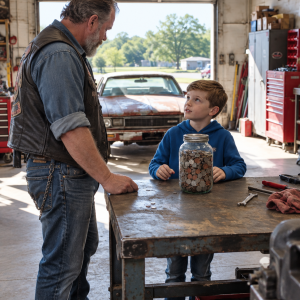
A 10-Year-Old Boy Walked Into A Biker Garage With $83.40 He’d Saved For A Bicycle, Begging Them To Fix His Mother’s Car Before She Lost Her Job. The Bikers Repaired It For Free And Refused His Money — But After He Left, They Found A Forgotten Quarter On The Workbench. One Year Later, When The Boy Returned, The Mechanic Showed Him An Old Notebook. What He Discovered Inside Left Him Speechless…

“Not Today, Sweetheart,” I Told My 6-Year-Old About the Red Shoes I Couldn’t Afford. She Didn’t Cry—She Drew Them on an Old Receipt Instead. I Thought No One Was Watching… Until the Wealthy Stranger Behind Us Spoke.

My 4-Year-Old Son Was in the ICU With a 104°F Fever When My Mother Ordered Me to Leave Him and Attend My Sister’s 18th Birthday Party—Then Disowned Me When I Refused. She Had Mocked My “Broke Contractor” Husband for Five Years, So I Handed Him the Phone. Twenty Minutes Later, She Was Finally Learning Who He Really Was.