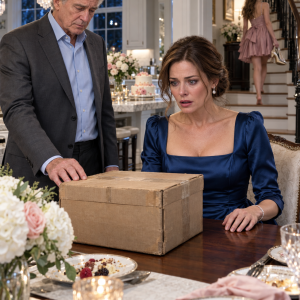
The connection reached into every part of Clara’s recent life. Graham had altered the lodge log, arranged the false signature, replaced Adrian’s medical sample, and ordered June’s payments canceled. The man with the black ring had not merely observed events. He had designed them.
While Clara was still absorbing the truth, June’s residence called. Her mother had quietly slipped away during the night after several years of fading memory. In one of her final clear moments a week earlier, she had told an aide to remind Clara about the sewing table.
Clara found the table in a storage unit containing her parents’ remaining furniture. Taped beneath its lowest drawer was a narrow ledger in Thomas’s handwriting. It listed route numbers, vehicle plates, altered service dates, and payments to supervisors. On the last page, he had written that if he failed to return home, the records would explain why.
Clara sat on the dusty floor holding the ledger against her chest. The debt that had shaped her choices was not her father’s failure; it was punishment for his courage.
The Choice on the Rooftop
With the ledger, Dr. Bell’s statement, Evelyn’s documents, and the lodge recording, federal investigators began building a case. Adrian voluntarily opened Blackwood Freight Systems’ internal records, even after his attorneys warned that the decision could cost him contracts, property, and control of the company.
Graham first tried persuasion, offering enough money to provide lifelong care for Clara’s child and threatening to ruin Thomas’s name if she refused.
“My father’s name survived you once,” Clara told him. “It will survive you again.”
Two evenings later, Clara went to June’s former residence to collect a small box of photographs. In the underground parking level, she heard footsteps matching hers. A man emerged from behind a concrete column and moved quickly toward her.
Clara did not run toward the empty exit. Years in health care had taught her to notice emergency systems before she needed them. She turned, broke the protective cover on the fire alarm, and pulled the handle.
Sirens filled the garage, doors opened, and the quiet level crowded with staff, visitors, and security officers. The man disappeared into the confusion, but cameras captured his face.
Miles arrived and took Clara to St. Catherine’s, where Adrian was meeting investigators. Before they reached the administrative floor, the building’s security team received word that Graham had entered through a maintenance corridor with two former company guards. He was trying to reach a records room containing archived shipping drives.
The confrontation moved upward through a stairwell and ended on the hospital roof beneath heavy rain. Miles reached the door first. One of Graham’s men shoved him hard against a metal railing, and he fell awkwardly, injuring his shoulder and ribs. Clara dropped beside him, checked his breathing, and told a security officer how to position him safely.
Adrian appeared with two investigators. Graham backed toward the parapet, clutching a drive case, his black ring catching the rooftop lights.
“You were never strong enough to run this family,” Graham called to Adrian. “Everything I did kept the Blackwood name standing.”
“You kept yourself standing,” Adrian answered. “You used the rest of us as walls.”
Graham tried to move along the slick edge. His foot slid, and he struck the roof hard. The drive case skittered away. For a few seconds, no one approached. He was conscious but struggling for air, one hand pressed to his chest.
This man had taken her father from the road, burdened her with false debt, endangered her mother’s care, and turned her unborn child into an accusation. If everyone waited, nature might close the account for them.
She crossed the roof and knelt beside him.
“Clara, don’t,” Adrian said, not as an order but as a plea born from everything Graham had done.
She checked Graham’s pulse and began emergency care while directing an officer to call the cardiac team.
Graham stared up at her in disbelief. “Why would you help me?”
“Because you don’t get to decide who I become,” Clara replied. “And because you are going to stand in a courtroom and tell the truth about my father.”
Adrian finally understood the strength Clara had described on the day she signed their agreement. It came from choosing one’s principles precisely when abandoning them would be easiest.
Graham recovered. So did Miles.
A Life Chosen Freely

Proceedings began the following spring. Thomas’s ledger matched company archives, Dr. Bell testified about the altered report, Evelyn acknowledged her role, and the physician who switched the sample agreed to cooperate.
Faced with evidence from every direction, Graham admitted to the false loans, manipulated reports, replaced sample, and forged signatures. He received a long federal sentence.
Adrian sold properties, surrendered questionable accounts, and removed the Blackwood name from the company. The legal business became an audited medical-equipment distributor, and forty percent of its shares funded scholarships for children of health-care and transportation workers.
Clara chose a modest brick home near St. Catherine’s, where no corridor was closed to her. Adrian attended every appointment she invited him to, assembled a crib badly, rebuilt it carefully, and learned that babies ignored most plans made for them.
Their daughter, Rose, arrived in April with Clara’s dark hair and Adrian’s gray eyes. When the nurse placed her in his arms, Adrian removed his gloves without being asked. His scarred hands trembled, but Rose curled her fingers around one of them and held on.
Several weeks later, Adrian asked Clara to meet him on the hospital rooftop garden, where she had eaten countless solitary dinners between shifts. Evening light rested over Richmond, softening the buildings and turning the river beyond them silver.
He handed her an envelope containing their marriage contract and confirmation that every family obligation had been cleared without condition. Clara owed the Blackwoods nothing.
“On the day we signed this, you asked what would happen if one of us changed our mind,” Adrian said. “I finally have an answer. You’re free. No agreement, no debt, no security team, and no family name following you.”
Clara held the contract between both hands. “And if I choose to stay?”
Adrian slowly removed his gloves. He had begun doing it more often, though never without a moment of hesitation.
“Then it will be because you chose me,” he said. “And I’ll spend the rest of my life trying to become worthy of that choice.”
Clara looked through the glass doors at Rose sleeping beside Natalie. She remembered the moment Adrian believed a report before he believed her, but also his decision to open the company records, sit beside June during her last lucid afternoon, and wait through two nights at the hospital when Rose arrived early.
People did not change through one beautiful promise, but through repeated choices no audience saw. Adrian had not erased what he had done, but he had stopped defending it and begun the harder work of becoming honest.
Clara tore the contract once, then again, and placed the pieces in a metal waste bin. There was no dramatic flame, only the quiet sound of paper becoming powerless.
“Then we begin without terms,” she said.
Adrian reached for her hand with his bare fingers. “Without terms.”
For years, others had assigned a price to Clara’s choices. Creditors measured her by false debt, the Blackwoods by a contract, and Graham by how easily fear could be used against her. Even Adrian had once mistaken financial protection for trust.
Truth had never belonged to the grandest house or strongest signature. It lived in a hospital note, an overlooked recording, a hidden ledger, and the steady word of a woman who refused to sell what she knew.
As Clara stood above the city with her daughter sleeping nearby and Adrian’s ungloved hand holding hers, she understood that freedom was not simply the absence of debt. It was the right to choose love without coercion, compassion without weakness, and a future no one else had written for her.
The story had begun with an agreement designed to keep two lives safely separate. It ended with no agreement at all—only two imperfect people, a child who had exposed a family’s oldest lie, and a truth that had finally found its way into the light.