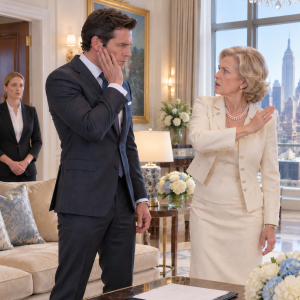
Her expression became firm.
“I am not selling you my husband’s letter.”
There was no anger in her voice, only dignity, and Grant lowered his eyes.
“I also don’t want people saying this was resolved because Mr. Whitaker rescued the poor woman who works in his house.”
Only an hour earlier, that was precisely the story Grant had been preparing to tell himself. He would leave money, feel generous and return home without examining anything deeper.
“Then tell me what repairing it would look like,” he said.
Nora pointed to Luke’s letter.
“First, find out whether he was right.”
Grant waited.
“And if he was, stop treating him as though speaking up was the thing he did wrong.”
It was far more difficult than writing a check. A check would cost Grant money; this could require him to examine decisions made by his own family, procedures he had inherited and a signature unquestionably belonging to him.
“I’ll investigate it.”
Nora shook her head.
“Don’t promise me that because you heard me asking for twenty-eight dollars. Do it because the signature is yours.”
The room grew quiet.
Grant looked once more at the authorization.
“You’re right.”
He did not offer money, and he did not apologize in a way that required Nora to comfort him. Before leaving, he returned every original document to the blue envelope and placed it in her hands.
“This belongs to your family.”
The Record No One Wanted Reopened

Grant reached the headquarters of Whitaker Freight Systems before seven the following morning. For the first time in years, he did not begin his day with market reports, quarterly forecasts or expansion figures. Instead, he ordered a complete reconstruction of Luke Bennett’s case using existing company records and copies of the documents Nora had provided.
His instructions were simple: no one was to dismiss the matter because it was old, uncomfortable or connected to a Whitaker—including Grant himself.
The first few days produced fragments rather than answers. Longtime employees remembered Luke questioning the overnight route policy, though several had been told he left because he could not cooperate with management. Others recalled that he had continued asking for a formal safety review after leadership had declared the subject finished.
No one remembered him asking for money. No one remembered threats or an attempt to embarrass the company.
Gradually, the central question changed. It was no longer why Luke had created conflict, but why a good-faith concern about drivers had been transformed into a test of personal loyalty.
Grant kept returning to the page bearing his signature. The summary he had approved made the situation look simple. Luke’s letter showed that it had never been simple at all.
A week into the review, Walter joined Grant in his office.
“You need to understand something before you decide what comes next,” he said. “You can correct the record without turning this into a hunt for everyone involved.”
Grant looked through the window at the loading yard below.
“I don’t want a hunt.”
“But you also can’t call it a clerical misunderstanding.”
Grant turned back toward him.
“Then I won’t.”
The review ultimately found that Luke’s warning had deserved a full, impartial evaluation and that ending his employment while the underlying issue remained unexamined had been wrong. It did not declare that every conclusion in his letter was automatically correct. It established something more basic and, in Grant’s mind, more important: Luke had raised a legitimate concern in good faith, and the company had answered by making the messenger the problem.
Grant ordered that conclusion added permanently to the internal record. He also instructed the company to determine whether other employees had been unfairly affected by the same scheduling policy and to correct whatever could still be corrected.
One task, however, he refused to delegate.
The Paper That Changed the Story
Grant telephoned Nora before returning to her apartment. When she opened the door, Mason was awake in a small seat beside the kitchen table.
Grant carried one sheet of paper.
No check. No flowers. No elaborate gift intended to make him appear thoughtful.
He explained the findings plainly: Whitaker Freight Systems acknowledged that Luke had raised a legitimate concern that should have been reviewed, and the company’s response to him had been improper. His internal record would no longer suggest that he had acted dishonestly or in bad faith.
Nora read the page slowly, then began again from the top.
“Does this mean everyone agrees with him?”
“No,” Grant answered. “It means we will no longer pretend that speaking was his wrongdoing.”
For the first time, his answer seemed to satisfy her.
“He would have understood that.”
She did not embrace Grant or assure him that everything was forgiven. She folded the paper carefully and slipped it into the same blue envelope beside Luke’s letter.
“There is something else,” Grant said.
Her expression tightened. “If it is payment for those documents, the answer is no.”
“It isn’t.”
While reviewing Luke’s case, Grant had also examined the way household workers at his residence were paid. For years, he had accepted the agency’s rates as reasonable without asking whether those rates allowed the people performing the work to live reasonably.