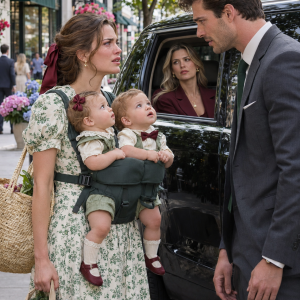
The envelope had been intended for me. Camille said she had planned to bring it to me after the charity dinner, but Charles had stopped her. Brooke overheard their argument and kept the envelope.
A few days later, Brooke came to Seattle carrying it.
Inside were partnership agreements, bank records, and a handwritten note from my father.
Audrey, if you are reading this, Charles has failed to keep the promise he made me.
My father explained that he had placed money from his business sale into a protected account intended for me. Charles had promised to manage it until I turned twenty-five. He had no right to keep it.
At the bottom, Dad had written: Do not let money make you bitter. Recover what is yours, but remember that your life will always be worth more than any account balance.
I pressed the letter against my chest. For years, I had thought my father left me only memories and a modest savings account. Now I had his voice again, telling me what mattered.
Brooke had one more document: a private DNA report Charles had ordered. It showed that Graham was not Charles’s biological son. A comparison with Thomas Hale’s stored sample showed a very strong biological match.
But that was not the last secret.
The Son Graham Had Never Met

Brooke told me the baby she was carrying was not Graham’s, but the child was related to him. The likely father was a close male relative.
At first, we thought that meant a cousin. Then Brooke explained that Graham had a son of his own, a twenty-year-old named Miles Hale, whose existence had been hidden from him.
Miles was the child of Rachel Morgan, Graham’s college girlfriend. Rachel had tried to contact him several times, but the letters had been redirected to Charles. When Miles grew up and learned the truth, he had contacted Charles directly. Charles arranged a DNA test and then tried to pay him to disappear.
Brooke had met Miles at the January charity dinner. She was researching the old architectural plans for the Riverside project, and he had come to learn more about Thomas Hale’s work. She had not known who he was when they spent time together. By the time she began seeing Graham, she still did not know the connection.
The dates now made sense. The baby was Miles’s child—and Graham’s grandchild.
When Graham learned the truth, he drove to his parents’ home and confronted Charles.
“You knew I had a son?” he asked.
Charles did not deny it. He said he was trying to protect Graham from a stranger who might be after money.
“He didn’t ask you for money,” Graham said. “You offered it.”
Charles argued that he had kept the family together, but Graham finally understood that his father had kept everyone dependent on him instead.
The next day, Graham met Miles at a café. He recognized him before Miles reached the table, not because they looked exactly alike, but because they shared a familiar tilt of the head when they were unsure what to say.
“I’m sorry,” Graham told him.
“For what?”
“For not knowing.”
Miles showed him copies of the letters Rachel had sent. They had all been received at the company office, then redirected to Charles. Graham held them with shaking hands, understanding how many birthdays, school events, and ordinary afternoons had passed without him.
When he called me, his voice was different.
“I want to see Molly and Willa,” he said.
“You had months.”
“I know.”
He didn’t ask me to bring them. He asked whether they might be willing, and agreed that if Molly refused, he would leave without pressuring her.
When he visited Seattle, Molly wouldn’t hug him. Graham didn’t complain. He sat on a park bench and apologized to both girls, telling them plainly that he had chosen work and other priorities over being present.
Molly told him he had missed everything: her award, Willa’s recital, and all the times she had waited by the door, hoping he might come.
“I know,” he said, and for once he didn’t offer an excuse.
Willa asked whether he still wanted a boy more than he wanted them.
“No,” he said. “I was wrong to make you feel that way.”
It wasn’t forgiveness, but it was the beginning of a more honest relationship. Graham visited regularly after that, called when he promised, and learned that being a father was not a title he could reclaim whenever his life became difficult.
What We Chose to Build
The legal dispute unfolded without the dramatic courtroom scenes people imagine. Records showed the transfers, the agreements, and the company’s use of my inheritance. The original money, with its value over time, was worth far more than I had known. My attorney also found that my father had another beneficiary in his trust: a daughter named Anna, my half-sister, whom I had met once as a child and then forgotten.
Charles had told Anna that I wanted nothing to do with her. He had told me nothing about her at all.
When we met near the Brighton waterfront, she brought a photograph of our father standing between us at a summer picnic. I remembered the day: Anna sharing her lemonade with me and helping me build a stone castle beside the river.
“I thought you hated me,” she said.
“I thought I didn’t have a sister.”
We talked for hours. Anna was an urban planner, and I was an architect. Our father’s love of buildings had reached both of us, even though we had grown up apart.
Rather than divide the restored trust, we decided to build something with it. Miles joined us, and Graham offered to manage the construction work. Camille proposed a scholarship program for daughters of company employees. Brooke, now focused on co-parenting with Miles, helped organize community outreach.
We called the project Bennett Commons: affordable homes, a school, a library, community gardens, and training programs for young people who wanted to work in design and construction. The idea came from another paragraph in my father’s letter: Build homes people can afford. Build classrooms where children can imagine more. Build something that outlives money.
Life in Seattle became more settled. I led a sustainable housing project, and Molly and Willa found friends and routines of their own. Graham remained in their lives without pretending that our marriage could be restored. He attended school events, made the calls he promised to make, and accepted that the girls’ trust would grow at their pace.
I eventually met Adrian Wells, a structural engineer who spilled coffee on my project notes during our first conversation. He apologized, I teased him about improving the color palette, and we kept talking. He never tried to rescue me or compete with my daughters. He listened to Molly’s questions about physics and let Willa explain the plot of her favorite fantasy series as if the fate of the world depended on it.
When Adrian proposed, he did it in my kitchen while Willa was making pancakes and Molly was insisting they could not legally count as dinner. I said yes.
A week before the wedding, my sister found one final letter from Dad. He had left another parcel of land in trust, to be released if Anna and I freely combined our interests for a public project. The land was outside Seattle and large enough to support hundreds of homes, a school, and a library.
The letter ended with a sentence we had already begun to live by: Build something that outlives what you keep for yourselves.
We named the new neighborhood Bennett Commons. At its opening, children ran across the courtyard, families carried boxes into their homes, and Willa proudly pointed out the dragon painted on the library wall.
I stood at the podium with Molly and Willa in the front row.
“A legacy isn’t what you control,” I told the crowd. “It’s what you share, what you repair, and what you choose to build for people who will come after you.”
After the ceremony, Molly showed me the sign they had placed on one of the buildings: THE AUDREY BENNETT CENTER FOR WOMEN IN DESIGN AND ENGINEERING.
I laughed, then cried, while my daughters hugged me.
Years earlier, Graham had told me to take the girls because he had a son on the way. He had thought he was choosing a future that mattered more than the family he already had. Instead, his choices uncovered secrets that had been buried for decades, brought a son into his life, restored my father’s history, and reunited two sisters who had once played together beside a river.
I left my divorce with two daughters, three suitcases, and no idea what came next. I had not lost my family. I had left one narrow definition of family and discovered a wider one—made of honest apologies, promises kept, and people who chose to show up.
Willa slipped her hand into mine.
“Ready to go home?”
I looked at the homes we had built, at my daughters, my sister, Adrian, and the people gathered around us.
“Yes,” I said.
And together, we walked home.
Sau khi ly hôn, Audrey đưa hai con gái sang Seattle bắt đầu cuộc sống mới, trong khi chồng cũ phát hiện đứa con sắp chào đời không phải con mình.
Những bí mật về khoản thừa kế bị chiếm đoạt, người con trai thất lạc và cô em gái Audrey chưa từng biết dần được hé lộ.
Từ những tổn thương ấy, họ cùng xây dựng một khu nhà và trường học cộng đồng, còn Audrey tìm thấy tình yêu mới và định nghĩa gia đình theo cách của riêng mình.