The Man Who Kept the Lights On

The Call After Midnight
For sixteen years, Caleb Rowan spent his nights keeping the lights on in the Penobscot County Administration Building in northern Maine. His official title was mechanical systems technician, though most employees simply thought of him as the gray-haired man who changed filters, repaired radiators, and appeared with a toolbox whenever an old pipe began knocking behind the walls. He liked the work because machines were honest. A boiler either held pressure or it did not; a broken switch never smiled across a conference table while concealing what it had done.
No one in the building knew that Caleb had once been a federal field investigator specializing in public corruption. In those years, he had followed money through shell companies, entered rooms under borrowed names, and helped frightened witnesses reach safe places before powerful people realized they had spoken. Then he met Elise, and when their son Noah was born, Caleb traded coded calls and guarded hotels for school concerts, Sunday pancakes, and a job whose greatest emergency was usually a frozen water line.
He had never regretted becoming ordinary.
At 12:18 on a rainy October night, Caleb was checking a leaking valve in the basement when Elise called. She never telephoned during his shift, and before he answered, some quiet instinct told him that his life had already divided into a before and an after.
“Caleb, it’s Noah,” she said, struggling to steady her voice. “He’s at St. Anne’s. There was an incident on Mill Road. Please come now.”
The wrench slipped from his hand.
“Is he awake?”
“Yes, but both his knees are badly injured.”
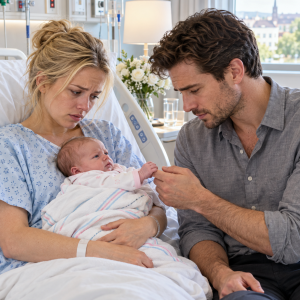
He remembered almost nothing about the drive except the rain pressing silver lines across the windshield. At the hospital, he found Elise outside a treatment room with both arms folded tightly across her chest, as though she were physically holding herself together. Through the glass lay their seventeen-year-old son, captain of the high school cross-country team, his legs wrapped in thick white dressings and his face drained of color.
Dr. Amelia Frost, an orthopedic specialist Caleb had once helped during a federal investigation, met him in the corridor. Her expression held the careful honesty of someone who would not offer comfort she could not support.
“The damage around both kneecaps is severe,” she told him. “We can repair much of it, but his recovery will be long. I cannot promise what his movement will look like afterward.”
Caleb placed one hand against the wall.
“Who was responsible?”
Amelia glanced toward the uniformed officers near the elevators.
“Police Chief Grant Hollis.”
Everyone in Ashford knew Hollis. He had been chief for eleven years, and he carried authority with the relaxed confidence of a man who believed every door would open before he touched it. Complaints about him appeared occasionally, then vanished. Witnesses revised their accounts. Families moved. County employees who asked too many questions found themselves reassigned or dismissed.
When Caleb entered Noah’s room, his son opened his eyes and reached for him.
“Dad, he knew who I was.”
Caleb sat beside the bed.
“Tell me from the beginning.”
Noah had been walking home after late practice when Hollis pulled alongside him and demanded that he empty his pockets. Noah asked what rule he had broken. The chief became angry, then noticed the surname printed on Noah’s team jacket.
“He asked if I was your son,” Noah whispered. “When I said yes, he smiled. Before he left, he told me to give you a message.”
Caleb leaned closer.
“He said the county should have left the lower archive sealed.”
For a moment, the room narrowed to the slow pulse of a monitor. Caleb had never told Noah about the Harbor File, the unfinished investigation that had ended his federal career. Nearly two decades earlier, Caleb’s unit had traced stolen public funds through municipal construction projects across New England. Most of the network had been exposed, but its central record—a collection of accounts, payments, protected identities, and recorded promises—had disappeared before investigators could secure it.
Noah tightened his hand around his father’s fingers.
“Dad, I’m scared I’ll never run again.”
Caleb bent and kissed his forehead.
“Then we take one day at a time. Running is something you do, son. It is not the measure of who you are.”
Hours later, while Noah was in surgery, Caleb sat alone in the parking garage and opened a list of contacts he had not touched in sixteen years. He called Adrian Cole, once the best surveillance specialist in their unit and now a fire investigator in Portland.
Adrian answered on the second ring.
“Gray Fox?”
Caleb looked toward the hospital windows.
“I need the old team, but listen carefully: no retaliation, no threats, and nobody lays a hand on Hollis. We find evidence, we protect our families, and we let the law see all of it.”
After a pause, Adrian said, “Then tell me where to meet you.”
The People Who Remembered
By dawn, Adrian had arrived with Nolan Pierce, a university cybersecurity professor who could recover information from machines their owners believed empty, and Rebecca Shaw, a federal prosecutor known for building cases so carefully that even well-protected officials eventually ran out of places to hide.
They met in a quiet hospital cafeteria while rain rattled against the windows. Nolan opened his laptop and showed Caleb eight years of withdrawn complaints against Hollis and several officers under his command. Adrian had found property records suggesting that the chief owned far more than his salary could explain. Rebecca had traced county contracts to companies connected to Council Executive Conrad Voss, the polished public official whose office Caleb had serviced every night for more than a decade.
Amelia appeared at the cafeteria door shortly after four in the morning. Noah had made it through surgery, she said, but certainty would have to wait. When they were allowed into his room, Noah told Caleb one more detail: a dark SUV had been parked across Mill Road, and someone inside had recorded the entire encounter. Hollis had seen the vehicle and had not seemed concerned.
Before Caleb could ask more, a volunteer brought him an envelope left by an elderly woman. Inside was a memory card and a note: Your son was used to make you look.
Nolan opened the card on an isolated computer. The video clearly contradicted the chief’s report that Noah had rushed him. It also showed the rear window of the dark SUV lowering just long enough to reveal Conrad Voss. Through enhanced audio, they heard Hollis ask what would happen after Caleb began searching.
Voss answered, “He will lead us to the Harbor File.”
Elise entered as the recording played. She looked from the screen to the three strangers and then to her husband.
“Who are these people, Caleb?”
“Friends from my former work.”
“The work you said you could never discuss?”
He nodded.
Her disappointment was quieter than anger, and therefore harder to bear.
“Our son is in that room because someone knows your history. I respected your silence when it protected other people, but it is not protecting us now.”
Caleb started to answer, but Nolan raised one hand. The final seconds of the recording showed Voss giving Hollis an instruction.
“When Rowan opens the lower archive, follow him. He is the only person left who knows the access sequence.”
Caleb shook his head.
“I never knew there was an archive.”
A voice behind them said, “You walked over it every night.”