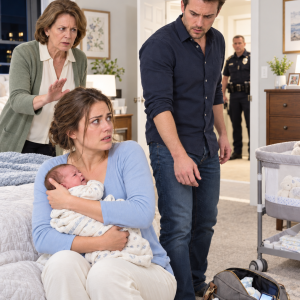
“Appreciating what you did for me doesn’t mean allowing you to treat my wife and daughter this way.”
Lorraine pointed at Claire.
“She caused all of this.”
“No. You don’t get to place this on her.”
Not every guest suddenly became courageous. Some left with embarrassed apologies. One woman quietly told Claire she was sorry for asking her to refill a pitcher without noticing how distressed she looked. Another muttered that family matters belonged behind closed doors.
Perhaps that belief had helped the situation continue.
Too much had already happened behind closed doors.
After the medical team explained the follow-up care Claire and Emma needed, I told Lorraine she could no longer stay with us.
“You need to sleep somewhere else tonight.”
She looked at me as if I had betrayed her.
“You’re throwing your own mother out because of her?”
“I’m asking you to leave because of what you did.”
“I am your mother.”
“Yes, you are.”
“Then act like my son.”
I looked at Emma, still pressed against Claire’s side.
“I’m also her father, and I should have acted like one much sooner.”
Lorraine packed a suitcase while I remained with Claire and Emma. During that hour, my wife told me the story in fragments. It had begun with criticism about meals and housekeeping, then expanded into schedules, rules about leaving the house, restrictions on purchases, and constant attacks on the way she raised Emma.
Whenever Claire resisted, Lorraine reminded her that I worked too hard to be bothered with small complaints.
She also repeated one warning: “Ethan will always believe his mother.”
The worst part was that I had given Claire reason to believe it.
“I’m sorry,” I said.
Claire stared at the keys in her hand.
“I don’t need one apology, Ethan.”
She was right. A sentence could not repair months of deliberate blindness.
“Then tell me what you need now.”
She thought for a moment.
“When Emma or I tell you something is wrong, believe us before you need proof with your own eyes.”
“I will.”
“And don’t make decisions about your mother without talking to me—not even if she apologizes later.”
“Especially then.”
When Lorraine emerged with her suitcase, she said I would regret choosing Claire over my family.
Emma lifted her head.
“Mommy is family.”
For once, Lorraine had no reply.
I opened the front door. I did not insult her, push her, or demand a confession she was unwilling to give. I simply held the door while she carried her own suitcase across the threshold.
A Home Without a Key

During the weeks that followed, our house did not immediately become peaceful. At first, it merely felt unfamiliar.
Emma repeatedly asked whether her grandmother was coming back. Claire checked the locks before bed and carried her recovered keys from room to room. I rearranged my work schedule, declined unnecessary travel, and began facing the uncomfortable truth that being a dependable husband and father involved more than earning money.
I started with small things.
I listened without interrupting. I asked questions instead of making assumptions. Most importantly, I stopped defending my mother whenever Claire described something I did not want to hear.
Lorraine and I eventually spoke again. She insisted that she had only been teaching discipline and refused to describe her behavior as control. I could not force her to understand, but I could prevent her from repeating it inside our home.
I told her that any future contact with Emma would require Claire’s agreement and our daughter’s sense of safety. Lorraine argued, attempted to negotiate, and then stopped calling for a while.
It hurt.
But something can be painful and still be right.
Claire needed more time to recover her confidence than I expected. One afternoon, several weeks later, she left her keys on the kitchen table while she took a shower. When she returned, she stood in the doorway staring at them, exactly where she had placed them.
Neither of us spoke.
We did not need to.
Emma’s hands healed gradually, but one habit lingered. Whenever she wanted a snack, she would look at us and ask, “Am I allowed to eat now?”
Claire and I always gave the same answer.
“You never have to earn food, sweetheart.”
Eventually, she stopped asking.
Several months later, we decided to empty the cabinet at the end of the hallway. Claire opened the drawer Lorraine had once kept locked. Her bank card was back in her wallet, her keys hung beside the front door, and nothing of importance remained inside except the little brass key that had once guarded it.
Emma appeared carrying a box of crayons, a notebook, and several folded drawings.
“Can I keep my things in here?”
Claire looked at me, then knelt beside our daughter.
“Of course. This is your home too.”
Emma filled the drawer with crayons and pictures, including one of the three of us standing beneath a bright yellow sun, our hands joined together. Then she pushed the drawer closed.
There was no lock.
A moment later, she ran toward the kitchen, where Claire had placed a bowl of sliced watermelon on the table.
This time, no one told her she had to wash a single dish before she could eat.