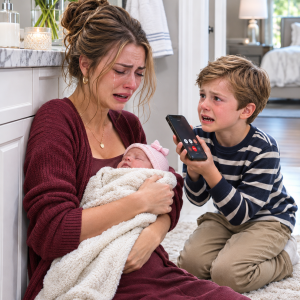
The Christmas My Daughter Taught Me to Stand Up for My Family

My mother was passing a bowl of roasted potatoes to my aunt when she suggested that I leave my six-year-old son at home the following Christmas, and what I remember most clearly about that moment was how ordinary everything around her seemed.
The candles were burning, Christmas music was playing softly in the adjoining living room, and twenty-three members of our extended family had gathered around the dining table in my parents’ home outside Grand Rapids, Michigan. Beyond the windows, snow was collecting on the branches of the maple trees, while the familiar fragrance of freshly baked bread and cinnamon drifted through the house.
It should have been the kind of afternoon children remembered fondly for the rest of their lives.
Instead, my mother looked directly at me and said, “Next Christmas, sweetheart, I think everyone would enjoy themselves more if you found somewhere else for Oliver to spend the day.”
She spoke so casually that, for a moment, I wondered whether I had misunderstood her.
My little boy was sitting nearby in a powder-blue sweater, his feet dangling above the floor, with a small plastic dinosaur tucked beside his dinner plate. Earlier that afternoon, he had accidentally knocked over a glass of cranberry juice, and although he had immediately apologized and helped me clean the tablecloth, my mother had continued looking at him with unmistakable disapproval.
Now he lowered his head, concentrating on the mashed potatoes he had barely touched.
I glanced around the table, waiting for someone to object, but my father suddenly became interested in his dinner, my aunt reached for her water glass, and several of my cousins exchanged uncomfortable looks without saying a word.
My name is Rebecca Bennett, and at thirty-four, I was raising two children on my own while working as a pharmacy technician and picking up additional weekend shifts at a local assisted living community.
My thirteen-year-old daughter, Natalie, was thoughtful, independent, and remarkably protective of her little brother, while Oliver was a gentle child who loved dinosaurs, building blocks, and asking questions about practically everything he encountered.
They were the greatest blessings of my life, although my mother, Eleanor, had a way of making me feel that raising them without a husband was evidence of some personal failure.
For years, I had responded to her criticism by working harder, giving more, and asking for less, convinced that if I could somehow become the daughter she wanted, she might eventually become the mother I needed.
That afternoon, however, someone at the table finally decided that enough was enough.
And it wasn’t me.
The Only Person Who Spoke Up
My mother’s expectations had governed our family for as long as I could remember, although she rarely needed to raise her voice to get what she wanted.
She could express disappointment through a carefully timed sigh, make an innocent observation sound like a personal criticism, and turn the smallest disagreement into a conversation about gratitude and family loyalty.
When my parents needed $1,200 to replace their heating system two winters earlier, I had withdrawn nearly everything from my savings account. When my father’s truck required $800 in repairs, I had put the expense on my credit card, even though I was already struggling to cover Oliver’s speech therapy.
Yet when I asked my mother to watch him for one Saturday so I could attend Natalie’s regional basketball tournament, she claimed her aching joints made it impossible, only to host an elaborate luncheon for her friends that very afternoon.
I had never confronted her about it, just as I had never confronted her about countless other disappointments.
But as I sat there on Christmas Day, searching for the right words to excuse my son’s innocent mistake, the sound of a chair scraping across the hardwood floor interrupted my thoughts.
Natalie had stood up.
She was wearing jeans and a cream-colored sweater, having refused the uncomfortable burgundy dress my mother had insisted she wear, and although her hands were trembling slightly, her expression was remarkably composed.
“Grandma, would you mind repeating what you just said?”
My mother looked at her with raised eyebrows.
“Excuse me?”
“What you said about Oliver. I’d like you to say it again, but this time, look at him when you say it.”
My aunt Judith immediately leaned forward.
“Natalie, that’s enough. Your grandmother deserves your respect.”
Natalie glanced toward her brother before answering.
“And doesn’t he deserve some respect, too? He’s six years old. He spilled a drink, Grandma. That’s all he did.”
My mother straightened her shoulders, visibly offended that a child would question her in front of the family.
“Rebecca, I suggest you remind your daughter how young ladies are supposed to behave.”
Natalie wasn’t finished.
“Mom worked extra hours to buy half the food we’re eating today because you asked her to. She’s always helping everybody here, and you just told her that her little boy isn’t welcome at Christmas.”
The room became so quiet that I could hear the clock ticking above the fireplace.
My mother turned toward me, her cheeks reddening.
“Are you seriously going to sit there and let your daughter embarrass me in my own home? Perhaps if you spent more time teaching your children manners, we wouldn’t be having this conversation.”
I felt the familiar urge to apologize, but before I could respond, Oliver slipped his little hand into mine.
His eyes were filling with tears.
“Mommy, did I make Christmas bad for everybody?”
Something inside me changed when I heard those words, because I suddenly understood that every time I had accepted my mother’s treatment of me, I had also been showing my children what they should accept from others.
And I couldn’t allow that lesson to continue.
The Christmas Dinner We Left Behind

I placed my napkin beside my plate and stood.
“Oliver hasn’t done anything wrong, Mom, and neither has Natalie.”
My mother stared at me.
“Rebecca, don’t make this into something bigger than it needs to be.”
“You’ve just told a six-year-old child that his family would be happier without him. How much bigger does it need to get?”
My father, Richard, finally looked up.
“Honey, can we please discuss this another time? It’s Christmas.”
For years, I had mistaken my father’s quietness for kindness, but that afternoon, I realized that his unwillingness to intervene had allowed my mother to behave this way without consequences.
“Dad, you heard everything she said, and you didn’t say a word. Oliver was sitting right here, waiting for somebody to tell him that he belonged.”
My father lowered his eyes.
I turned back toward my mother.
“I’ve spent years trying to make you happy, helping with your bills, rearranging my schedule, and apologizing whenever you were disappointed in me. But my children aren’t going to spend their lives earning the right to be part of this family.”
I reached for Oliver’s hand and asked Natalie to collect our coats.
Nobody followed us into the hallway, although I could feel the attention of every person in the dining room as Natalie helped her brother put on his winter jacket.
Just as I opened the front door, my mother called after me.
“If you’re willing to walk away from your own family over something so insignificant, don’t expect me to welcome you back when you change your mind.”
I turned toward her one last time.
“I’m not walking away from my family, Mom. I’m taking my family home.”
Then I stepped outside with my children, leaving behind the beautifully decorated house, the expensive Christmas dinner, and the approval I had spent most of my adult life trying to obtain.
The drive home was slow because of the snow, and for several miles, none of us spoke.
Eventually, Natalie turned toward me.
“Mom, are you upset with me?”
I reached for her hand while we waited at a traffic light.
“Sweetheart, you did something today that I should have done a long time ago. You stood up for someone who needed you, and I’m incredibly proud of you.”
Her expression softened, and tears gathered in her eyes.
“I just don’t like how Grandma treats you. You always pretend everything’s fine when we’re there, but sometimes I see you crying after we leave.”
I had believed I was hiding those moments from my children, but Natalie had noticed far more than I realized.
“Things are going to be different from now on,” I promised her. “Neither of you will ever have to apologize for belonging to this family.”
The First Time I Said No
After putting Oliver to bed that evening, I received a call from my cousin Melissa, who lived near Lansing and had spent several years keeping a comfortable distance from our extended family.
Apparently, my aunt had already circulated a version of events in which I had caused an unnecessary scene and spoiled Christmas for everyone.
I told Melissa what had actually happened.
When I finished, she remained quiet for several seconds.
“Becca, you’ve been taking care of your parents for years, and they’ve made you feel guilty every time you’ve needed anything in return. You know this isn’t really about a spilled drink, don’t you?”
I did know, although admitting it was painful.
Three days later, my mother called.
There was no mention of Christmas, no inquiry about Oliver, and certainly no apology.
Related Posts
My Mother Lost Her Temper With My 5-Year-Old Daughter, And My Little Girl Fell Down The Stairs While I Was At Work. She Was Rushed Into Emergency Surgery, But Instead Of Calling Me, My Parents Told The Hospital, “Her Mother Abandoned Her. Don’t Contact Her.” A Surgeon Found My Number In Her Medical Records And Called Me Himself. When I Begged Him To Tell Me If My Daughter Would Be Okay, He Fell Silent — Then Revealed Something That Made Me Realize The Fall Down The Stairs Was Only Part Of The Story…
My Father Took Away My 20-Year-Old Daughter’s Dinner Plate in Front of 20 Relatives at His 70th Birthday Party After My Sister Called Her “The Family’s Little Embarrassment” Because of Her Stutter. When I Stood Up for Her, Mom Said, “Look at You, Still Begging Us to Accept Her.” I Took My Daughter’s Hand and Told Dad He’d Just Enjoyed His Last Dinner at My Expense. He Laughed, and My Sister Mocked Me. On the Drive Home, I Made One Phone Call. By 9 the Next Morning, Dad Was About to Discover What I’d Been Doing for His Family for the Past 12 Years — and What I Had Just Decided to Stop.
My 5-Year-Old Daughter Could Barely Breathe, But When I Begged My Father To Drive Us To The Hospital, He Covered His Luxury Car Keys And Said, “Children Aren’t Allowed In My Car.” My Mother Shrugged. “Figure It Out Yourself.” Then My Wealthy Aunt Quietly Stood Up, Picked Up Her Own Keys, And Turned To My Parents. My Father’s Face Went Pale Before She Even Finished Speaking — And That Was When I Realized There Was Something About Their Comfortable Life They Had Never Told Me…