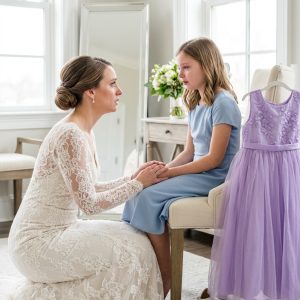
She reached for his arm.
“I did not know she spent it,” she pleaded. “I knew she opened the envelope, but she told me the money was safe.”
“And Paige’s savings?” he asked.
Mallory lowered her eyes.
“I knew the family helped. I did not know how much.”
“But you never asked where it came from.”
Mallory began to cry.
“I was overwhelmed. I thought everything would work out after the wedding.”
Graham remained quiet for a long time.
Then he walked to the microphone.
The guests waited.
“I am not making a permanent decision about our relationship tonight,” he said. “But the wedding celebration and the signing of the final documents will not continue.”
A murmur moved through the room.
Mallory covered her mouth.
Graham continued.
“A marriage should not begin while questions about trust, money, and honesty remain unanswered. I care about Mallory, but we need time to understand what happened and whether we can rebuild from it.”
He did not publicly insult her. He did not announce that he hated her. He simply postponed the beginning of their married life because he no longer felt confident in the truth he had been given.
Thomas reclaimed the remaining money and told Judith that the missing amount needed to be returned.
He also asked for copies of the wedding invoices and financial records.
As guests began leaving, Katherine knelt beside Miles.
“You did nothing wrong,” she told him. “You were hungry, and you told the truth. Adults are responsible for what happens after that.”
Miles finally ate the dinner roll she had given him.
The Apology That Came Too Late
In the parking lot, Connor followed me to the car.
“Paige, please wait.”
I placed Miles in his booster seat and closed the door.
“Your son looked at you for protection,” I said. “You told me to deal with it later because you were worried about embarrassing your mother.”
Connor’s face fell.
“I was afraid everything would explode.”
“It already had. You simply asked Miles and me to stand in the middle of it quietly.”
He wiped his eyes.
“I failed both of you.”
Miles watched through the open car window.
Connor crouched beside him.
“Buddy, I should have defended you immediately. I am sorry.”
Miles looked at him for several seconds.
“Next time, can you say something before Mommy has to?”
Connor nodded.
“Yes. I promise I will.”
I did not forgive him in that parking lot.
A promise spoken after damage is not the same as change proven over time.
Miles and I stayed with my parents.
What Changed After the Wedding
Three days later, Connor arrived with a signed repayment agreement from Judith, copies of every transfer, and proof that he had taken out a small loan against property he inherited from his grandfather.
He replaced my eighteen thousand dollars in full.
He also returned the missing five thousand dollars to Thomas and Katherine.
“I am not asking you to come home,” he said. “I am asking for the opportunity to become someone you can trust again.”
Over the following months, Connor attended counseling and stopped allowing his mother to control his decisions.
When Judith blamed me for the postponed wedding, Connor corrected her.
“Paige did not create this situation,” he said. “Your choices did.”
Graham and Mallory postponed their plans indefinitely.
They attended counseling separately and later met to discuss whether their relationship could survive.
They did not rush back to the altar.
Mallory eventually called me.
“I became so focused on having the wedding I imagined that I stopped asking who was sacrificing to make it possible,” she admitted. “I am sorry for taking your help for granted, and I am especially sorry that Miles was treated that way.”
Judith’s apology took longer.
When she finally came to my parents’ home, she wore no pearls and carried no expensive handbag.
She brought a box of cupcakes but left it unopened on the porch.
She knelt in front of Miles.
“I took something away from you when you had done nothing wrong,” she said. “You fell because of me, and then I tried to make you feel ashamed. I am sorry.”
Miles glanced at me, then back at her.
“You have to ask before taking my food.”
Judith nodded through tears.
“You are right.”
The apology did not erase the past.
Visits remained supervised. Boundaries were written down and followed. Judith was no longer permitted to make decisions for our household or use guilt to demand money.
One year later, I used my restored savings to purchase a modest three-bedroom house with a sunny kitchen and a small backyard.
Connor did not move in immediately.
For a full year, he showed up consistently. He defended our boundaries, kept his promises, and learned that avoiding conflict is not the same as protecting a family.
Eventually, we began rebuilding our marriage.
Slowly.
Carefully.
Honestly.
On the day we received the house keys, Miles ran from room to room laughing.
Then he stood in the kitchen and asked, “Can we have cupcakes here whenever we want?”
I smiled and pulled him close.
“In this house, nobody will ever make you feel guilty for being hungry or telling the truth.”
Keeping the peace may appear loving on the surface, but when peace requires a child or a vulnerable person to remain silent, it is no longer peace—it is permission for harmful behavior to continue.
A family should never measure loyalty by how much money, comfort, or dignity one person is willing to surrender while everyone else benefits without asking questions.
Children may not understand every detail of an adult conversation, but they often recognize dishonesty, fear, and unfairness long before adults are willing to admit those things exist.
Apologies only become meaningful when they are followed by consistent actions, respected boundaries, and a willingness to accept consequences without blaming the person who finally spoke up.
Avoiding confrontation may feel easier in the moment, but silence often protects the person creating the problem while leaving innocent people to carry the emotional cost.
Expensive flowers, elegant venues, designer clothing, and impressive photographs cannot create a strong marriage when honesty and mutual trust are missing beneath the surface.
Parents must understand that children remember who protected them during frightening moments, just as clearly as they remember who looked away and asked them to wait.
Financial generosity should come from genuine choice and transparent agreement, not from guilt, pressure, manipulation, or the fear of being labeled selfish by relatives.
Rebuilding trust is possible, but it requires patience, humility, accountability, and months of changed behavior rather than one emotional promise made after everything has fallen apart.
The truth spoken by one small child may have interrupted a beautiful celebration, but it also gave an entire family the chance to stop pretending, face reality, and build healthier lives on something more honest than appearances.