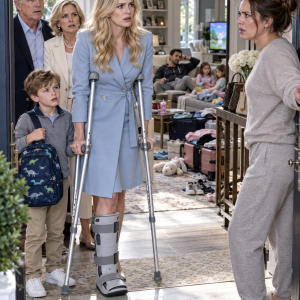
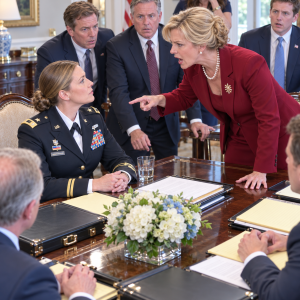
“Is this true?”
Ryan shook his head impatiently. “Dad, you don’t understand how these applications work.”
His father kept looking at the page.
“I understand one question. Did Elena sign this?”
Silence answered for him.
Natalie covered her mouth.
“Ryan.”
He turned toward her.
“I did it for us.”
The tears that filled her eyes this time were different from the ones she had used at Mom’s dinner table. There was no audience in them, no expectation that someone would immediately solve the problem.
She looked frightened.
“What else haven’t you told me?”
Ryan reached for her hand, but she stepped away.
That should have ended it.
Instead, Mom grabbed my arm.
“Elena, please.”
I looked down at her fingers and then at her face.
“Please what?”
Her voice became almost a whisper.
“Sign a real authorization.”
For a moment, I genuinely thought I had misunderstood her.
“What?”
“Temporarily. Just until Ryan gets the financing and gets the company stable again.”
There it was.
The request they had hidden for weeks beneath words like family, baby, space and help.
“No.”
Mom’s face tightened.
“He could lose everything.”
“It isn’t mine to save.”
“Your sister is having a baby.”
“And that doesn’t turn my house into Ryan’s collateral.”
Tears appeared in her eyes.
“Families make sacrifices for each other.”
I looked at the hand still gripping my arm and remembered the bedroom I had surrendered at sixteen, the car that took six weeks to come back, and the thousands of dollars that had quietly transformed from a loan into something nobody mentioned anymore.
For most of my life, I had been the person my family called after somebody else made a bad decision.
“You didn’t protect Natalie, Mom.”
She blinked.
“Excuse me?”
“You spent thirty years making sure she never had to sit with the consequences of anything.”
Mom released my arm.
“Don’t talk about your sister that way.”
“I’m not talking about her. I’m talking about you.”
Natalie had lowered herself back into her chair. Her hands rested protectively over her stomach, but she was listening.
“Every time Natalie had a problem, you found someone else to absorb it. Most of the time, that person was me.”
Mom shook her head.
“Because you can handle things.”
I nodded once.
“Being able to handle something doesn’t make it my responsibility.”
Across the room, Dad was standing near the doors.
He had not spoken once.
Mom saw him too.
“Robert, say something.”
He remained still.
“Tell her she’s taking this too far.”
Dad walked toward the table and picked up the loan application.
Ryan immediately moved closer.
“Mr. Bennett, I can explain.”
Dad raised one hand.
“Did you use Elena’s address?”
Ryan exhaled.
“We needed it to complete the application.”
“Without asking her?”
“We were going to work it out as a family.”
Mom interrupted.
“Robert, this is not helping.”
Dad kept his eyes on Ryan.
“Is that my daughter’s signature?”
Nobody answered.
Mom’s face flushed.
“If Elena would cooperate for once, none of this would be happening.”
Dad closed the blue folder.
After thirty-six years of avoiding almost every conflict in our family, he finally looked at my mother and said the one thing I had stopped expecting him ever to say.
“Elena isn’t fixing this, Linda.”
Mom went still.
Dad tapped the folder.
“She didn’t create the problem.”
Nothing dramatic happened after that.
Nobody applauded.
Nobody delivered a perfect speech.
But the structure our family had relied on for decades suddenly lost one of its supports.
Mom no longer had Dad’s silence.
Ryan no longer had my house.
Natalie no longer had the comfortable version of her marriage she had arrived with.
And I no longer had to play emergency services for all three of them.
Dad looked at Ryan.
“You should leave.”
Ryan stared at him.
“Mr. Bennett—”
“Now.”
Ryan picked up his phone and walked out.
Natalie did not follow him.
Three weeks later, the lender formally closed the application. My attorney submitted documentation regarding the unauthorized use of my information and the disputed signature, and from there the consequences arrived in the least cinematic way possible: emails, certified letters, meetings and lawyers.
Ryan learned that real consequences often come in very boring envelopes.
Natalie moved back in with our parents.
Ryan’s business closed several months later, and their marriage did not survive until the baby’s birth.
I did not rescue her.
That was harder than changing the locks.
When Noah was born, I went to the hospital with diapers, baby clothes and a soft blue blanket.
No check.
No loan.
No spare key.
Natalie watched me place the blanket beside the bassinet.
“I thought you hated me.”
I looked at my nephew sleeping between us.
“I never hated you.”
Her eyes filled.
“Then why wouldn’t you help me?”
I pulled the blanket gently over Noah’s legs.
“Because for years, we confused helping you with making sure you never had to face a consequence.”
Natalie looked down.
This time, she did not argue.
Over the following months, she found an administrative job at a medical clinic, sold the expensive SUV and began paying down debts in her own name. She did not transform overnight into a completely different person.
But she started.
My relationship with Mom changed more permanently.
She still believed I had been unnecessarily harsh, and perhaps she always would. Dad, however, started admitting something he had avoided for decades: remaining silent while one person was repeatedly pressured to sacrifice was not neutrality.
One Sunday, he stopped by my house alone.
He stood outside studying the electronic lock.
“Your mother hates that thing.”
I smiled.
“Then it’s working.”
He laughed, and for once there was no request attached to his visit.
By November, the guest room was gray again.
My books were back on the shelves, my work folders were stacked neatly on the desk, and there were no paint samples, moving boxes or ultrasound pictures attached to my refrigerator.
One rainy evening, I sat in that room drinking coffee while finishing paperwork for another Gulf assignment.
The house was quiet.
For years, quiet had made me feel guilty because it usually meant someone in my family was dealing with a problem I could probably solve.
That night, it simply felt like my house.
Before leaving for my next rotation, I stood on the porch with my suitcase and locked the door behind me.
The electronic lock gave one clean click.
Months earlier, I had changed it because I needed to keep my family out.
This time, I did not check the handle twice.
I put my suitcase in the car, glanced once at the upstairs guest-room window, and drove away.
The house had never become mine because I changed the locks.
It had always been mine.
The difference was that I had finally stopped handing everyone else a key.