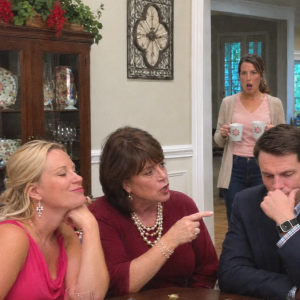
“Why didn’t you tell me the projects were running so far over budget?”
Bryce rubbed his jaw.
“I thought the market would improve. We had buyers interested.”
“Interested isn’t the same as committed,” Gerald said.
Martin removed his glasses.
“I should have asked more questions.”
Nathan spoke quietly.
“I tried to raise those questions last fall.”
Martin looked at him.
“I know.”
Judith folded her arms and said she hoped everyone was satisfied. She accused me of enjoying the situation. Nathan turned toward her.
“This isn’t about proving anything. Dad trusted Bryce because he’s the oldest, and he dismissed my concerns because they weren’t what he wanted to hear. You’ve spent years treating people like they matter more or less depending on where they fit in this family.”
Judith reminded him that they were in a business meeting.
“Then stop making business decisions about favorites,” he said.
Nobody interrupted him.
Gerald recommended postponing the leadership announcement until the company had completed a management review and improved its cash forecast. Martin agreed. The meeting ended without a grand apology or a triumphant speech, just a roomful of people gathering their papers and facing difficult work.
As Nathan and I started toward the parking lot, Martin caught up with us.
“Paige, I suppose you want an apology.”
I thought of the girls at the Christmas table, of June folding the silver wrapping paper because she liked the snowflakes, and of Willa asking whether her grandmother hated her.
“I wanted my daughters to have a grandfather,” I said.
Then Nathan took my hand, and we walked to the car.
That evening, the doorbell rang while we were finishing dinner. Judith stood on the porch holding two neatly wrapped presents. The gift tags read, “To Our Precious Granddaughters.”
I stepped outside and closed the door behind me.
“I brought them something,” Judith said.
“I can see that.”
She adjusted the boxes in her arms.
“I thought maybe we could put Christmas behind us.”
“What happened wasn’t a misunderstanding.”
Her mouth tightened.
“Martin was upset. Everyone was tired. Things got out of hand.”
“You laughed when Dana called my daughters a disappointment.”
Judith looked down at the presents.
“I didn’t mean anything by it.”
“Then why did you say it?”
She hesitated before explaining that when she was growing up, boys carried on the family name.
“I understand that’s how you were raised,” I said. “It doesn’t have to be how you treat my children.”
She asked if we could start over. I looked at the boxes and asked whether she had come because she missed the girls or because Martin’s business was in trouble.
Her expression shifted.
“Can’t it be both?”
Maybe it could. But the gifts didn’t answer the question the girls needed answered.
“If you want a relationship with them, you need to acknowledge what happened. They don’t need expensive presents. They need to know you care about them when there isn’t an audience, and that you won’t embarrass them for being girls or compare them to Lucas.”
Judith stood quietly for a moment, then carried the presents back to her car.
When I went inside, Nathan was waiting in the hallway.
“How did it go?”
“She isn’t ready.”
He nodded.
“Neither am I.”
We sat back down with the girls, who were still finishing dinner. Willa was telling June about a girl at school who had brought a frog-shaped eraser. I listened, grateful for the ordinary conversation around our table. Nobody had to wonder whether they belonged.
A Beginning, Not a Finish

Summer passed gradually. Nathan settled into his new job, and he came home talking about projects rather than family arguments. Cedar Creek continued receiving payments under the written agreement, though a few arrived late. Hearthstone sold unused equipment, reduced its speculative projects, and hired an outside operations manager. It was not an easy recovery, but the company began making changes it should have made earlier.
In August, June and Willa started second grade. Nathan took pictures of them on the porch before school. Their backpacks looked nearly as large as they were, and Willa insisted on wearing her purple sneakers.
A week later, Martin sent Nathan a handwritten letter. In it, he acknowledged that he had favored Bryce because he was the oldest, and had dismissed Nathan’s concerns even when they were sound. He wrote that he was ashamed of taking the girls’ plates and that they had done nothing to deserve what happened. He asked if he could apologize to them in person.
Nathan read the letter twice, then passed it to me.
“What do you think?”
The letter wasn’t perfect, but Martin wasn’t blaming the children or asking us to forget. He was admitting that he had been wrong.
“Let’s ask the girls how they feel.”
We explained the letter to June and Willa. They wanted to know whether they would have to hug their grandfather, and whether Judith would be there. We told them they didn’t have to hug him, and that they could leave whenever they wanted. We would meet Martin alone at a public park in Asheville.
On a Saturday morning in September, Martin was already waiting on a bench beneath an oak tree. He had brought no gifts. When he saw the girls, he stood.
“Hello, girls.”
“Hi, Grandpa,” June answered.
He knelt beside the bench.
“I owe you both an apology. I was wrong to take your dinner away and to make you feel unwanted. You didn’t deserve any of that. I was the grown-up, and I should have behaved better.”
June studied him before asking the question I had expected.
“Do you still like Lucas better?”
Martin swallowed, then answered honestly.
“I treated Lucas better, and that was wrong. It wasn’t because there was anything wrong with you. I made bad choices, and I’m sorry.”
Willa looked down at her shoes.
“Do you still have the angel I made?”
Martin said he had found it in a drawer.
“I made the halo myself.”
“I know,” he said. “I should have hung it on the tree.”
“Yes,” I said. “You should have.”
He lowered his eyes.
“I know.”
We stayed at the park for about twenty minutes. The girls told him about school, their teacher, and a book June was reading. Martin listened without turning the conversation toward Lucas or the family business. There were no hugs that morning and no promises about future holidays. Trust had to be rebuilt through ordinary choices, made consistently over time.
Judith had not offered a genuine apology, so Nathan and I kept visits limited. We wouldn’t ask the girls to spend time with someone who continued to dismiss their feelings, and we wouldn’t teach them that obligation was the same as affection.
Later that month, June and Willa took part in their school science fair. June built a model bridge out of craft sticks, testing its strength and adding supports where it sagged. Willa made a display about how plants draw up water. Nathan helped carry their projects into the school gym and asked them to explain how each one worked.
Watching him stand proudly beside them, I thought of the years when his father had spoken as though the family business mattered most because a boy might someday inherit it. Nathan was teaching our daughters something better: curiosity, effort, and skill belonged to anyone willing to learn.
After the fair, we stopped for ice cream. Willa somehow got chocolate on her elbow, and June laughed as she passed her a napkin. Nathan looked through the photographs he had taken while I watched the girls talk.
I thought about the Christmas tree at Martin and Judith’s house, the bicycle beside the fireplace, the untouched ornaments, and the two empty places at the dinner table after Martin took away the girls’ plates. For years, I had believed keeping peace meant swallowing insults. I told myself that family required compromise and that patience might eventually teach everyone to be kinder.
But those moments had not felt small to my daughters. They understood when their cousin received presents and they did not. They understood when their grandparents missed their school events. They understood when their handmade gifts were left on a table. And they understood when someone removed their dinner and told them to leave.
We couldn’t change what had happened, but we could decide what happened next. We could tell our daughters that kindness was not something they had to earn by being quiet, that being girls did not make them less valuable, and that adults could be wrong. They could love someone and still set limits on how that person treated them.
Nathan had spent much of his adult life trying to become the kind of son his father would be proud of. In the process, he had nearly forgotten that he was already the husband and father his own family needed. Leaving Hearthstone cost him a job he once thought he would keep forever, but it also freed him from measuring every choice by whether Martin approved.
Martin’s letter stayed in a drawer. Forgiveness wasn’t something we could file away after one apology; it would depend on what he did next. He began checking in with Nathan and asking about the girls’ school activities. Sometimes their conversations were awkward. Sometimes Nathan came home saying his father had listened in a way he never had before. I didn’t know what their relationship would become, and I couldn’t promise the girls that every relative would learn to treat them as they deserved.
But I could promise that they would never have to earn their place in our home.
One evening, June climbed onto the couch beside me while I was reading.
“Mommy, do you think Grandpa is really sorry?”
I put down my book.
“I think he’s trying to be.”
She considered that.
“Does that mean everything is okay now?”
“Not everything. Sometimes people need time to show they’ve changed.”
She leaned against my shoulder.
“Can we still love him if we aren’t ready to visit much?”
“Of course, sweetheart.”
From the kitchen, I heard Nathan helping Willa rinse paintbrushes after another craft project. School papers covered the counter, and purple sneakers sat beside the back door. The dishwasher hummed in the background. Our house wasn’t perfectly tidy, and our lives weren’t perfectly settled, but there was peace in those ordinary sounds.
It was the kind of peace that didn’t require anyone to stay silent about being hurt.
I used to think family peace meant making sure nobody became upset. Now I understand that real peace depends on respect: who listens when a child speaks, who admits being wrong, who chooses kindness when no one is watching, and who stands beside you when silence would be easier.
That Christmas, our daughters left their grandparents’ home without presents. They came back to grilled cheese, tomato soup, pajamas, and a familiar movie. They had no expensive toys waiting beneath our tree, but they knew their parents would choose them, even when doing so made someone else unhappy.
The moment that changed our family was simple. Two little girls sat looking at empty places at the table. Their father stood, reached for my hand, and said, “We’re leaving.”
There was no dramatic speech and no instant repair. There was only a decision that told our children their dignity mattered more than anyone’s approval.
You should never have to make yourself smaller to deserve love. The people who care about you won’t ask you to surrender your dignity just to keep a seat at their table. And sometimes, walking away from a place where you are unwelcome is the first step toward discovering where you truly belong.