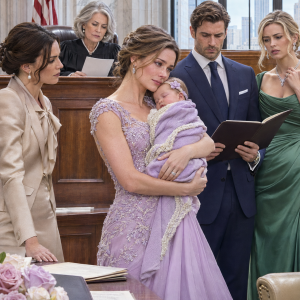
The courtroom screen flickered.
Our kitchen appeared.
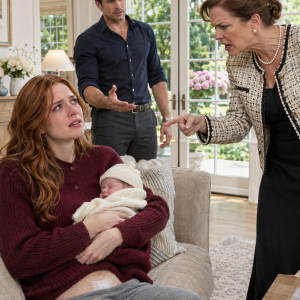
There I was, visibly pregnant, standing behind the island.
The blue folder lay in front of me.
My recorded voice filled the room.
“I’m not signing it.”
Then Nathan’s.
“I’m your husband.”
And mine again.
“That doesn’t make you my father’s heir.”
No one moved.
On the screen, Nathan came around the island.
His arm extended.
My body lurched forward.
The pot shifted.
I dropped out of view.
Then Diane’s voice rang through the courtroom.
“Nathan, get the papers out of here.”
I had watched the recording many times with Rebecca and the investigators.
Watching it there was different.
My daughter was asleep against my chest.
Nathan was sitting only a few yards away.
The footage continued.
Nathan climbed onto the chair and pulled down the camera.
Then came the audio he had never known existed.
Diane’s voice:
“Once she signs, we need to move fast.”
Nathan answered:
“After today, she’ll sign.”
He lowered his eyes.
Diane began crying quietly behind him.
I felt no victory.
Mostly, I felt tired.
The prosecutor presented the messages Diane had sent me.
The repeated pressure.
The custody references.
The financial paperwork prepared before the kitchen incident.
Finally, she introduced Nathan’s loan agreement.
The lender testified that Nathan had assured him an inherited property would soon become available as collateral.
When it was my turn to testify, I handed Sophie to Rebecca and walked forward.
Nathan finally looked at me.
For the first time in months, there was no confidence in his face.
The prosecutor asked, “Mrs. Carter, did you simply lose your balance that morning?”
“No.”
“Did your husband push you toward the stove?”
“Yes.”
“Why didn’t you immediately tell him there was a remote copy of the recording?”
I looked directly at Nathan.
“Because when he believed one camera could protect me, he destroyed it. I wasn’t going to tell him where the other copy was.”
Nathan closed his eyes.
His attorney requested a brief recess.
As we left the courtroom, Diane managed to come close enough to speak.
“Emily.”
I kept walking.
“Please.”
I stopped.
She swallowed.
“He’s Sophie’s father.”
For months I had imagined what I might say if she ever used those words.
When the moment came, my answer was simple.
“He was her father that morning in the kitchen too.”
Diane said nothing else.
Keep Copies
The proceedings continued for several days.
Nathan’s attorneys argued that what happened in the kitchen had been a moment of anger rather than a planned attempt to pressure me.
The prosecutor answered with the loan documents.
The prepared property-transfer papers.
The messages.
The destroyed camera.
The private lender.
And Nathan’s own recorded sentence:
“After today, she’ll sign.”
The court ultimately found him responsible on several serious charges involving family violence, coercion, injury, and interference with evidence.
Diane faced a separate case concerning her participation in the pressure and later intimidation.
But the ruling I cared about most came through family court several weeks later.
I received primary custody of Sophie, along with protective measures that limited Nathan’s contact while the legal process continued.
The Asheville house remained entirely mine.
Nathan’s debts remained entirely his.
Exactly where they belonged.
The first night Sophie and I stayed alone in my father’s house, I barely slept.
She was in a portable crib beside my childhood bed while I walked slowly through rooms I had known most of my life.
Dad’s old radio still sat on a garage shelf.
His tool chest was still marked with strips of faded masking tape in his handwriting.
A bundle of unused security cable hung beside the workbench.
The house smelled faintly of dust, pine cleaner, and the wooden shelving he had installed years ago.
For a long time, I had believed the house mattered because it was the last valuable thing my father had left me.
That night, I understood that its value had very little to do with money.
It had given Sophie and me somewhere to go.
Months later, I converted Dad’s old workshop into a home office.
I never sold the property.
Instead, after Rebecca introduced me to a local nonprofit, I began volunteering a few hours each month with women who were trying to understand financial control inside their own relationships—hidden debts, pressured signatures, shared accounts they could not access, documents they had been told not to question.
I never told anyone what decision to make.
I simply told them what I wished someone had told me earlier.
Keep your records.
Understand what you sign.
Know what belongs to you.
And make sure someone you trust knows what is happening.
One Saturday afternoon, while cleaning a cabinet in Dad’s workshop, I found a gray plastic box behind a stack of old equipment manuals.
Inside were tax records, photographs, warranty documents, several backup drives, and a small USB stick.
Across the front of the stick, written in my father’s blocky handwriting with a black marker, were two words:
“KEEP COPIES.”
I sat on the workshop floor holding it for a long time.
Growing up, I thought Dad meant receipts.
Contracts.
Insurance policies.
Important photographs.
Now I understood his advice differently.
Keep proof.
Keep choices.
Keep access to something that belongs only to you.
Keep one door unlocked in case someone else tries to close every exit.
That evening I carried Sophie into the backyard.
She had recently started walking and was still at the stage where every few steps ended with her sitting suddenly in the grass and looking mildly offended by gravity.
She chased a yellow rubber ball across the lawn while I watched from the porch.
The old brick house stood behind us.
My father’s keys were in my pocket.
My name was still on the deed.
And for the first time in a very long while, the future did not feel like something another person was negotiating on my behalf.
Nathan had believed owning my father’s house would give him power over me.
He never understood that the house itself was only wood, brick, wiring, and memories.
The real power was something else.
It was the ability to say no when someone demanded a signature.
It was knowing where the records were kept.
It was trusting the part of myself that recognized something was wrong even when two people stood in front of me insisting otherwise.
And most of all, it was walking into that kitchen eight months pregnant, believing I had very few choices, then walking out of a courtroom months later with my daughter safe in my arms, my father’s keys still mine, and the quiet certainty that no signature would ever again give another person ownership of my future.