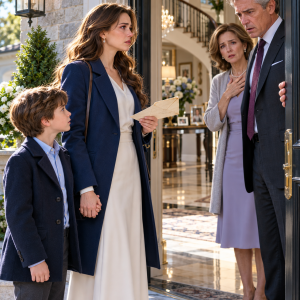
Laura wrote in her journal, concealed the recorder, and tried to send a message from an old phone without active service. Technicians later recovered the unsent words: “Ethan, help us. Nolan came in. Your mother took my phone. I cannot get out.”
The message never left the device. Alone, injured, and denied assistance, Laura did not survive that sealed room. Investigators described her final hours as the foreseeable result of violence, confinement, intimidation, and deliberate abandonment.
At five-thirty the next morning, Diane unlocked the door. Instead of calling emergency services, she called Barbara.
“Is she still breathing?” Barbara asked on the recovered recording.
“No,” Diane replied.
“Then close the room. I’m coming.”
Barbara arrived before six and built a false scene with sleep medication and a forged loan agreement bearing Laura’s imitated signature. Their story would portray a lonely, indebted school employee whose husband was always away. Diane answered Erin’s messages from Laura’s phone to delay questions.
Pike joined the cover-up because he cared only about the shipment. When Diane told him Laura was gone, he asked whether Nolan had secured the materials. He had ordered the control room to block my calls and threatened a dispatcher who wanted to inform me.
Pike planned to blame Nolan as the household thief, Mason as the driver, and me as the security manager who had sold the information. Laura’s recordings dismantled everything.
Police found Mason with the materials and Diane’s letter pledging our home against Nolan’s debt. His phone revealed payments connecting him to Pike, who was arrested near a private airfield with cash, route maps, and falsified company files.
The Cost of Silence
Once separated, each person moved the blame. Nolan said our mother had promised protection; Diane blamed Barbara; Barbara cited family embarrassment; Pike blamed Nolan; and Mason called himself a debt collector.
None of them spoke of Laura as a person. To them, she had become an obstacle, an inconvenient daughter-in-law, a witness they believed could be silenced because she had married into the family rather than been born into it.
Dad admitted through his letter board that he had seen Nolan stealing a key. When he tried to warn us, my mother moved the board beyond his reach and told me his stroke had made him confused.
“Why didn’t you press harder?” I asked him, though part of me already knew the answer.
He took several minutes to spell his reply: “I feared the family would break. I wanted to protect my younger son. My silence protected the person causing harm.”
There were different degrees of responsibility, but I could not tell him he carried none. Silence had given danger room to grow, and my own refusal to listen had done the same.
I visited Diane once before the hearings. She leaned toward the glass and said, “Help your brother. Sending him away won’t bring Laura back.”
“You still believe he is the only person worth saving.”
“He’s your brother.”
“Laura was someone’s daughter. She was my wife and your granddaughter’s mother. She asked you for a doctor, and you took her phone.”
My mother wept, but even then her tears seemed rooted in fear for Nolan rather than sorrow for Laura.
“I loved her like a daughter,” she whispered.
“No. You don’t lock a daughter away to protect the man who violated her trust.”
That was the last time I visited.
Nolan received a lengthy sentence for assault, confinement, attempted theft, and destroying evidence. Diane was held responsible for confinement, refusal of aid, threats, and concealment; Barbara for falsifying documents and destroying evidence; Pike and Mason for extortion, conspiracy, information theft, and the planned robbery.
The verdicts did not return Laura to us, nor did they erase Maisie’s fear whenever she heard a key turn.
My company cleared me of Pike’s scheme but found that I had violated protocol by bringing restricted materials home. I lost my position and did not appeal; innocence of conspiracy did not erase poor judgment.
The Little Cottage

I took a maintenance job and moved with Maisie and Dad into Laura’s cottage, a two-bedroom home shaded by an old pear tree. It was the safe beginning she had prepared for us.
Maisie began therapy. For months she slept with her shoes beside her pillow, ready to run. Whenever I needed to close a door, I announced it first.
“Maisie, Dad is closing it now. You can open it whenever you want.”
Little by little, the shoes returned to the floor.
One afternoon, I found a drawing on the kitchen table: three people beneath enormous sunflowers, and a woman in a lavender scarf standing nearby.
“Who’s that?” I asked.
“Mommy,” Maisie said. “She’s standing where nobody can lock a door.”
I stepped onto the porch so my daughter would not see me cry.
Dad continued rehabilitation. The first name he learned to say clearly was Laura’s. In December, the three of us visited her resting place. Maisie left a letter beside the flowers: “Mommy, we live in the cottage now. Grandpa is with us, and Dad comes home early.”
I unfolded the lavender scarf I had carried home that terrible afternoon and placed it beside her letter.
“I came back, Laura,” I whispered. “I only wish I had listened before I left.”
Dad steadied himself against his therapist’s arm, worked his lips with immense effort, and said, “I’m sorry, daughter.”
For years I believed being a good husband meant providing and solving problems when I had time. Laura needed a man who believed her when she said she was afraid. I had mistaken postponement for protection, and that knowledge remains with me.
Family ties do not turn abuse into a private matter, and shielding a child from consequences is not love when the cost is another person’s safety. The silence meant to preserve our family was the very thing that allowed it to fall apart.
Laura had been called dramatic, ambitious, disloyal, and unstable simply because she refused to ignore what was happening inside our home. In the end, the evidence showed that she had tried to protect everyone: Maisie, Dad, me, and even Nolan, whom she offered one final chance to step away from Pike’s plan.
Nobody listened soon enough.
Now, whenever Maisie tells me something frightened her, I stop what I am doing, kneel to meet her eyes, and listen until she has finished. It is a small promise compared with all we lost, but it is one I intend to keep for the rest of my life.