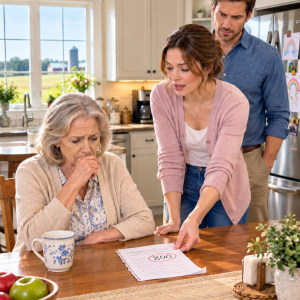
During the argument, Vanessa tore it.
Hannah tried calling her father, received no answer, and finally went to the neighbor’s house because she no longer felt comfortable staying alone with Vanessa.
When Andrew eventually answered the neighbor’s calls, he sent Vanessa to bring Hannah back.
A passing driver later reported seeing Vanessa’s car drift unexpectedly before leaving its lane, and investigators had identified phone activity close to the time of the accident.
They were still determining precisely how the phone had been used.
One message from Andrew stood out.
“Did you pick her up? I don’t want another argument with Meredith.”
Vanessa’s reply complained that Hannah had been difficult and that Andrew needed to discipline her when they got home.
I sat quietly, trying to reconcile the man I had once trusted with the father who had chosen to conceal so much.
I could understand fear, embarrassment, and even a terrible mistake.
What I could not understand was allowing those feelings to become more important than telling the truth about our daughter.
Part Three: The Courage to Speak for Her

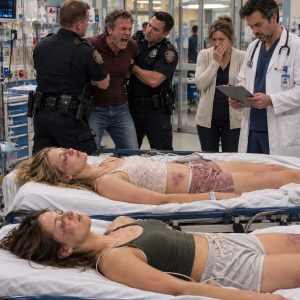
I found Andrew and Vanessa near the hospital elevators that afternoon, and when Vanessa saw Caroline standing beside me, her expression hardened.
“Are you finished making us look like terrible people?” she asked.
I looked directly at her.
“Hannah went to a neighbor because she was afraid to come home with you. I know about the photograph, and I know you were driving.”
Vanessa folded her arms.
“That girl exaggerates everything. She’s been trying to turn Andrew against me since we moved in together.”
“She’s twelve years old,” I answered. “She isn’t competing with you. She needs adults who make her feel safe.”
Andrew tried to interrupt, reminding us that we were standing in a hospital.
“Exactly,” I said quietly. “And Hannah is upstairs while we’re down here arguing about whose reputation needs protecting.”
Vanessa walked away without another word.
Andrew remained, staring at the floor.
Eventually, he admitted that he had been afraid I would seek changes to our custody arrangement if I learned what had happened.
“I thought I could explain everything after Hannah got better,” he whispered.
“Then start explaining it now, and don’t leave anything out.”
Within days, Caroline filed an emergency request in family court to establish clearer medical communication and temporary decision-making arrangements during Hannah’s recovery.
I did not ask the court to remove Andrew from her life, because despite everything that had happened, I knew Hannah loved her father.
I asked for reliable access to her medical information and safeguards that would prevent important decisions from becoming tangled in our personal disagreements.
At the hearing, Andrew’s attorney emphasized that he had remained at the hospital while I was overseas.
I did not dispute it.
When the judge invited me to speak, I explained that military service had required difficult absences, but that I had always arranged Hannah’s care and remained involved in her life.
“Your Honor, I’m not asking anyone to punish my former husband for moving on,” I said. “I’m asking that our daughter never again be placed in a position where the adults responsible for her care hide information because they’re afraid of each other’s reactions.”
The judge issued temporary orders clarifying medical communication and allowing me to coordinate aspects of Hannah’s treatment and rehabilitation under appropriate supervision.
Andrew retained access to information and suitable visitation.
Walking out of the courthouse, I felt no sense of triumph.
My daughter was still in the hospital, and a legal order could not tell me whether she would ever laugh at my terrible cooking again or complain when I reminded her to finish her homework.
That evening, I returned to her bedside, held her hand, and whispered the promise I had been repeating since my arrival.
“I’m here, sweetheart. You don’t have to do any of this alone.”
I squeezed her fingers twice.
She did not respond.
Several hours later, while I was downstairs getting coffee, Dr. Brooks called and asked me to return to the intensive care unit.
Hannah had begun responding more consistently to simple instructions.
When I entered the room, her eyes were partially open.
Dr. Brooks leaned toward her and spoke softly.
“Hannah, if you can hear me, try moving your right thumb.”
A few seconds passed before her thumb shifted.
He repeated the instruction.
She moved it again.
The doctor explained that these responses were encouraging, although it was too early to predict how much function she would regain.
I understood his caution.
Still, after so many days of uncertainty, watching her follow those two instructions felt like being given a small window into a room I had feared was closed forever.
Part Four: Learning to Begin Again
Hannah’s recovery came gradually, in uneven steps that taught me more about patience than anything I had experienced during my years in uniform.
Some mornings she opened her eyes and followed instructions, while on others she seemed exhausted by the smallest effort.
As her breathing improved, the medical team gradually reduced her dependence on mechanical support, and eventually she was able to breathe without the machine.
The first time she spoke, I was standing near the window watching a maintenance worker sweep fallen leaves from the hospital courtyard.
“Mom?”
Her voice was faint and rough, but I recognized it immediately.
I turned toward her, hardly trusting myself to answer.
“Right here, baby.”
She asked for water, and while the nurse checked whether she could swallow safely, I sat beside her and watched the familiar little movements of her face, grateful for something as ordinary as hearing her ask for a drink.
The weeks that followed were not easy.
Hannah had weakness along one side of her body, difficulty concentrating, and gaps in her memory, and her rehabilitation team worked carefully to help her regain everyday skills.
One afternoon, she tried lifting a plastic cup from a table, but her fingers loosened before she could bring it to her mouth.
The cup tipped, spilling water across the surface.
She stared at her hand, her eyes filling with tears.
“I used to be able to do that.”
I sat beside her and gently dried the table.
“I know, sweetheart.”
“What if I can’t anymore?”
I wanted to promise that everything would return exactly as it had been, that one day she would run across the backyard and climb trees and race me to the mailbox without thinking about the effort involved.
But I had learned that love sometimes required a more difficult kind of honesty.
“I don’t know how quickly things will improve,” I told her. “But I know we’ll keep practicing, and I’ll be here every time you need help.”