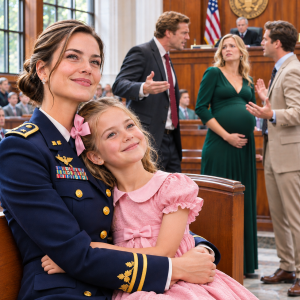
Savannah looked at her through tears.
“And you spent months telling me how much better I was than his wife. You didn’t want to hear anything that might ruin that, either.”
Loretta’s face changed.
“You’ve got some nerve blaming me for this!”
“I’m not blaming you. But Colt made his own decisions. I didn’t make him divorce Imogen.”
Colt stood and walked toward the window. According to him, it was the first time that day he had thought seriously about what he had said to me at the courthouse.
He had told me I had no place in his new family. He had demanded that I leave our home before the baby arrived. He had treated twelve years of marriage like an inconvenience standing between him and a future he hadn’t even bothered to question.
Now he couldn’t bring himself to look at the blankets bearing his surname.
Several days later, a DNA test confirmed that Colt was not the child’s biological father. Savannah eventually acknowledged that the likely father was a bartender she had briefly dated before her relationship with Colt became serious.
The baby was healthy and innocent of every decision the adults around him had made.
That mattered to me more than I expected.
The Call From Manhattan
I was unpacking groceries in my Geneva apartment when Ellis told me about the DNA results. Outside, snow was collecting along the balcony railing, and the lake was almost invisible beneath the morning fog.
“Are you all right?” he asked after explaining what had happened.
I sat down at the kitchen table.
“Is the baby being taken care of?”
“Yes, as far as I know.”
I nodded, although Ellis couldn’t see me.
For months, I had imagined what it might feel like to watch Colt regret leaving me. But there was nothing satisfying about a newborn entering the world surrounded by disappointment and accusations.
What hurt was remembering how quickly Colt had discarded everything we had shared for the promise of something better.
“He’s asking for a meeting,” Ellis continued. “His lenders want a credible restructuring proposal. He hasn’t been able to obtain replacement guarantees.”
“What does he expect from me?”
“He wants Shaw Meridian to reinstate its support temporarily.”
I looked at the brass fountain pen resting beside my unopened mail.
“Arrange the meeting. I’ll listen to him. But I’m not putting my family’s assets behind his promises again.”
The Man Who Suddenly Remembered His Wife
The settlement conference took place in January. I attended remotely from Geneva while Colt sat in Ellis’s Manhattan office with his attorney.
He looked exhausted. His expensive watch was gone, his collar was open, and the confident businessman I had watched walk away from our marriage seemed considerably older.
“Imogen, we’ve got four hundred employees depending on this company,” he began. “Whatever happened between us, surely you don’t want those people suffering because you’re upset with me.”
I folded my hands on the table.
“I asked Ellis to protect those employees before you even knew there was a problem.”
Colt glanced toward his attorney.
“Then help me keep the company. Give me six months. I’ll find another investor, and we can put all this behind us.”
“What will you do differently in those six months?”
“I don’t know yet. That’s why I need time.”
I opened the copy of the financing agreement Ellis had sent me.
“My father gave you an opportunity twelve years ago. I helped you build the company, and when you became successful, you told people I had nothing to do with it.”
Colt rubbed his forehead.
“I said some lousy things. I know that.”
“You told me sitting at home with your credit card didn’t make me a business partner. Do you remember saying that?”
He looked down.
“Yes.”
“Then why are you asking the woman who supposedly contributed nothing to save everything you built?”
Nobody spoke for several seconds. Colt’s attorney shifted in his chair, but Colt kept his eyes on the table.
Finally, he looked toward the camera.
“Because I can’t do it without you.”
Those were the words I had wanted him to say for years. Hearing them now, after the divorce and the hospital and the financial crisis, felt nothing like I had imagined.
“You could have appreciated me when you had me, Colt. You didn’t have to wait until you needed something.”
He began talking about our early marriage, the apartment in Queens, and the evenings we had spent planning our future. He reminded me that we had once promised never to abandon each other when things became difficult.
I listened until he finished.
“I remember those promises. I was still keeping mine when you decided yours no longer mattered.”
Ellis explained that a regional freight company had expressed interest in purchasing Briggs Logistics. An orderly sale offered a realistic opportunity to preserve operations, protect jobs, and satisfy creditors.
Colt would lose ownership of the business, but he would not necessarily lose everything.
“You’re really going to let them sell my company?” he asked.
“I’m going to let you make your own decisions with your own resources. That’s what you wanted when you divorced me.”
He covered his face with his hands.
I waited until he composed himself, then instructed Ellis to cooperate with the proposed sale, provided the employees received meaningful protection.
I wanted my family’s financial obligations resolved. I wanted the people who had worked for Briggs Logistics to keep their jobs. Whatever remained after legitimate debts were paid belonged to Colt.
For the first time in twelve years, I left him responsible for the consequences of his own decisions.
What Was Left After the Promises
The sale closed in April. The purchasing company retained nearly four hundred employees, including several people who had been with Colt since the little office above the tire shop.
The Hamptons estate was sold, the luxury vehicles went to auction, and the proceeds helped satisfy outstanding obligations. Colt eventually moved into a modest apartment in New Jersey and accepted a position with another transportation company.
Savannah left the penthouse he had rented for her and began making arrangements to establish her child’s biological paternity formally.
Loretta moved in with her sister in Pennsylvania. In early May, she sent me a handwritten letter describing her financial difficulties and the humiliation of explaining her changed circumstances to friends.
At the bottom of the second page, she asked whether I could lend her ten thousand dollars.
There was no apology for what she had said at the courthouse.
I folded the letter, placed it in a drawer, and went out for lunch. For once, another person’s financial emergency did not become my responsibility.
Later that month, I returned to Manhattan to sign the final documents at Ellis’s office. As I crossed the building’s lobby, I heard a familiar voice behind me.
“Immy?”
Nobody had called me that in years.
Colt stood near the elevators wearing an old navy suit. Without the expensive watch and the polished appearance, he looked remarkably like the young man who had once sat beside me at our kitchen table, worrying about payroll.
“Can I have a minute?”
I stopped.
He told me he had rehearsed what he wanted to say during the train ride from New Jersey. Now that I was standing in front of him, he couldn’t remember any of it.
“Then just tell me what you came to say.”
His eyes filled.
“I remember that bracelet you sold. Your grandmother’s bracelet. I remember you telling me it was just jewelry, even though I knew how much it meant to you.”
I tightened my hand around my handbag.
“I kept thinking I’d buy you another one someday,” he continued. “Then we got money, and somehow I stopped thinking about what you’d given up. I started thinking everything belonged to me.”
For a moment, I couldn’t answer. Of all the things I had expected him to remember, that bracelet was not one of them.
“I’m sorry, Imogen. Not because I lost the company. Not because of Savannah. I’m sorry because you deserved a better husband than the one I became.”
I believed that he meant it. But believing an apology and returning to the person who owes it are two very different things.
“I hope you remember that when you build your next life, Colt.”
He nodded.
“Do you think you’ll ever forgive me?”
“Maybe I already have. But forgiveness doesn’t mean I’m coming back.”
I stepped into the elevator. He remained in the lobby, and neither of us tried to stop the doors from closing.
The Signature That Changed Everything
The following winter, I established Meridian Hands, a small foundation providing startup loans to women who struggled to obtain traditional business financing.
Our first borrower was a former hospital cleaner who had spent years saving money to establish a medical supply company. She arrived at our Brooklyn office wearing an inexpensive coat and carrying a folder filled with carefully organized financial projections.
Three lenders had already turned her down.
When I told her that we had approved her application, she covered her face briefly, then laughed through her tears.
“I’m sorry. I promised myself I wouldn’t cry. My daughter keeps telling me I’m too old to start over, but I’ve wanted this for twenty years.”
“Then let’s make sure you get a good beginning.”
I placed the agreement in front of her and encouraged her to read every page. She asked thoughtful questions, made notes in the margins, and finally looked around the table for something to sign with.
I reached into my handbag and handed her my father’s brass fountain pen.
The last time I had used that pen to make a life-changing decision, a man had been sitting across from me, impatient for me to disappear from his future.
Now a woman sat in the same position, trembling with excitement because she finally had a future of her own.
After signing, she carefully returned the pen and asked whether she could call her daughter.
“Of course,” I told her.
She stepped into the hallway, and a moment later, I heard her laughing as she shared the news.
Outside the conference room windows, December snow was falling over Brooklyn. I capped my father’s pen, slipped it into my handbag, and went downstairs to celebrate with her.
For the first time in years, helping someone build a better life hadn’t required me to make myself smaller.