PART 1 — THE ACCUSATION THAT DESTROYED MY FAMILY
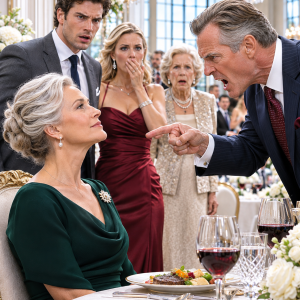
My cousin’s five-tier wedding cake crashed onto the floor with a sickening thud, sending buttercream across the polished wooden boards and leaving her expensive white gown covered in frosting.
Before anyone could help her stand, she pointed directly at me and screamed an accusation that would divide our family for months.
“Lucas pushed me into the cake because he couldn’t stand seeing me happy on my wedding day!”
I stared at her, holding a glass of sparkling water in one hand and white wine in the other.
I had been standing nearly seven feet away when she fell, and at least forty guests had witnessed the distance between us.
My name is Lucas Bennett, and I was twenty-nine years old when my thirty-one-year-old cousin, Brooke, accused me of deliberately ruining her wedding reception.
The ceremony took place on a beautiful Saturday in October at a renovated industrial warehouse outside Cincinnati, Ohio.
Until that afternoon, I’d believed the worst thing about attending Brooke’s wedding would be enduring another evening of her insulting jokes.
I was wrong.
Brooke struggled upright, her mascara running as she surveyed the ruined cake and the buttercream stains spreading across her wedding dress.
Her husband, Gavin, tried to steady her while several bridesmaids rushed forward with napkins.
Then she pointed toward me again.
“Everybody knows Lucas has been trying to sabotage my wedding for months, and now he’s finally done it!”
I placed the glasses carefully on a nearby table.
“Brooke, I didn’t touch you, and everyone standing here could see that I was nowhere near you when you fell.”
An uncomfortable silence spread across the reception hall.
I looked toward relatives who had been standing between us, expecting somebody to confirm what they’d witnessed.
Nobody spoke.
Then my mother, Elaine, approached and caught my arm.
“Please apologize to Brooke, Lucas, because she’s already upset and we don’t need another family argument ruining this day.”
I could hardly believe what I was hearing.
“Mom, apologizing would mean admitting I pushed her, and you know perfectly well that I didn’t.”
My aunt Cynthia hurried toward us, her face flushed with anger.
“My daughter is standing here crying in her ruined wedding dress, and you’re making excuses instead of taking responsibility!”
I reminded her that both my hands had been occupied.
She dismissed the explanation without considering it.
Around us, relatives looked down at their shoes, studied their phones, or pretended to examine the damaged decorations.
Their silence hurt more than Brooke’s accusation.
For the first time, I understood that being innocent wasn’t enough when everyone around me preferred avoiding conflict to acknowledging the truth.
PART 2 — THE FAMILY THAT ALWAYS NEEDED A SCAPEGOAT
I grew up in Springfield, Ohio, as the only son of Peter and Elaine Bennett.
My father died from a sudden heart attack when I was nineteen, leaving my mother and me struggling through a grief neither of us knew how to discuss.
After his death, I believed our relationship would become stronger because we were all each other had left.
Instead, I gradually discovered something painful about my mother’s character.
She loved me, but she feared confrontation so intensely that she would sacrifice almost anything to avoid upsetting another person.
Unfortunately, that often included my dignity.
Her older sister, Cynthia, had dominated their relationship since childhood.
Whenever Cynthia demanded something, Elaine usually surrendered rather than face her sister’s anger.
Brooke inherited the same habit.
She was two years older than me, exceptionally attractive, socially confident, and accustomed to being treated as the family’s most important young woman.
As children, we had once been close.
We spent summers at our grandparents’ lakeside cabin, catching frogs near the dock and eating colorful frozen treats until our tongues turned blue.
By high school, however, Brooke had begun treating me differently.
She criticized my clothes, mocked my interests, and told her friends I was awkward whenever I attended family gatherings.
If I protested, Cynthia accused me of being overly sensitive.
My mother always encouraged me to ignore the insults.
“Brooke doesn’t mean anything serious by those comments, sweetheart, and sometimes it’s better to let people have their little jokes.”
Those little jokes continued for years.
Brooke developed an extraordinary ability to transform ordinary disagreements into stories where she was an innocent victim.
Waiters who corrected her orders became disrespectful employees, friends who refused unreasonable favors became selfish, and I became her favorite target whenever she needed somebody to blame.
Three years before the wedding, Brooke began dating Gavin, an insurance adjuster who enjoyed discussing golf almost as much as Brooke enjoyed discussing expensive clothing.
They became engaged after fourteen months together.
Brooke immediately began organizing the wedding as though she were commanding a military operation.
She asked me to serve as an usher, despite having barely spoken to me during the previous two years.
I agreed because I hoped the wedding might improve our relationship.
Instead, her demands quickly became exhausting.
She expected me to take three days off work for wedding-related events, contribute four hundred dollars toward a family gift, and participate in an elaborate choreographed reception dance.
At the time, I was still earning a modest salary in an entry-level marketing position.
I accepted the gift contribution but declined the dance.
Brooke reacted as though I’d deliberately insulted her.
During the following three months, every disagreement became supposed evidence that I wanted her wedding to fail.
When I suggested an additional seafood option for the rehearsal dinner, she accused me of trying to control the menu.
When I requested permission to bring my girlfriend, Hannah, six weeks before the event, she complained that I was deliberately disrupting her seating arrangements.
By the time October arrived, I was exhausted from defending myself.
Nevertheless, I attended because I still wanted to believe our family could behave differently.
For forty-five minutes, the ceremony was beautiful.
Then the reception began.
PART 3 — FORTY WITNESSES WHO CHOSE TO SAY NOTHING

The wedding cake stood on a custom wooden platform near the dance floor.
It had five elaborate tiers, delicate sugar flowers, and a price tag of eight hundred dollars.
A specialized baker had driven two hours to deliver it, and Brooke insisted that guests admire the display before anyone was allowed to approach the dessert table.
Approximately twenty minutes into the reception, I was standing near the bar with two drinks.
Hannah had stepped into the restroom, and I was checking a message from a colleague.
A loud scraping noise made me look up.
Brooke’s high heel caught the raised edge of the cake platform.
Her body pitched sideways, and her elbow struck the display table.
The platform rocked violently before the entire cake toppled onto the wooden floor.
Brooke fell beside it.
For a moment, everyone appeared stunned.
Then she looked directly at me and accused me of pushing her.
I tried explaining what had happened, but the room had already decided that challenging Brooke would create more trouble than accepting her story.
Gavin helped his bride stand, avoiding my eyes whenever I looked toward him.
My uncle Martin, usually the most reasonable person in our extended family, stared silently toward the ceiling.
My cousin Tyler had witnessed everything from a nearby table, yet he suddenly became fascinated with his telephone.
Brooke’s maid of honor, Tessa, approached with an expression of theatrical disgust.
“Even if you didn’t physically push her, Lucas, arguing while she’s crying proves that you don’t care about her happiness.”
I stared at her.
“She’s accusing me of assaulting her in front of everyone, and you’re suggesting that defending myself is somehow cruel?”
Tessa walked away without answering.
Brooke leaned against Gavin and cried louder.
“I only wanted one beautiful wedding day, and Lucas couldn’t even allow me to have that!”
Cynthia demanded another apology.
My mother repeated that keeping peace was more important than proving who was right.
Something inside me finally broke.
“I won’t apologize for something I never did, and I’m finished accepting blame simply because everybody finds the truth inconvenient.”
Related Posts
Every Grandchild Had Their Own Bedroom at My In-Laws’ House—Except My Eight-Year-Old Daughter. For Years, She Slept on the Couch While Her Cousins Had Their Names on Their Doors. “There’s Just No Room for Her,” My Mother-in-Law Always Said. I Finally Had Enough When My Little Girl Asked Why Grandma Treated Her Differently. But the Next Day, My Wife Opened the Supposedly Locked Storage Room—and Found an Old Photograph That Revealed Why Her Mother Had Never Wanted Our Daughter Upstairs…

My Husband Threw Six Black Garbage Bags Filled With My Belongings And Our Newborn Daughter’s Things Outside Our House While I Was Still Recovering From Childbirth. Just Hours Earlier, He Had Demanded A Divorce Because Our Baby Girl Wasn’t The Child He Had Expected, Even Though We Had Spent Six Painful Years Trying To Have A Baby. I Took Our Daughter To My Parents’ Home, Unable To Understand His Cruelty. But The Next Morning, He Showed Up, Dropped To His Knees, And Began Confessing A Secret He Had Kept Hidden For Eighteen Years…

I Was Carrying Two Newborn Girls Out of the Snow When Their Mother Woke, Looked at Me, and Begged Me Not to Send Them Back—Then I Saw the Security Photo, Recognized the Man Who Had Left Them There, and Heard Her Name the One Person I Never Expected…

The Doctor Looked At Me In The Hallway And Said, “You’re Not Qualified To Help That Little Girl.” Before I Could Answer, Her Navy Commander Father Stepped Up And Said, “She’s The Only Person My Daughter Trusts”—Then The Girl Who Hadn’t Spoken In Six Weeks Turned Toward Me…