An idea occurred to me.
I leaned toward Edward and quietly explained it.
He listened carefully.
Then he smiled.
“Lauren, I believe you’ve just suggested something far more useful than another argument.”
PART 4 — THE GALA THAT BECAME A LESSON IN COMPASSION
Edward explained that his foundation was sponsoring Victoria’s charity event that evening.
Instead of canceling it, he wanted to transform the gathering into an opportunity for meaningful community assistance.
Because I had extensive event-management experience, he invited me to coordinate the new activities.
Victoria protested immediately.
“You cannot seriously expect me to let this woman interfere with my event!”
Edward looked directly at her.
“You can cooperate, or I can explain to the foundation’s board why I’m withdrawing my support for your leadership appointment.”
Victoria reluctantly agreed.
Before leaving, she warned me not to embarrass her in front of the guests.
“Then I suggest you treat everyone respectfully,” I replied.
Later that afternoon, I arrived at the elegant restaurant where the gala would take place.
The manager, Brian Mitchell, showed me the event arrangements.
Victoria had ordered imported desserts, elaborate floral decorations, and a champagne tower costing thousands of dollars.
I asked how much money the evening would actually provide to struggling families.
Brian hesitated.
“Only a small percentage of the revenue was designated for direct assistance.”
Edward looked disappointed.
“Brian, could your kitchen prepare two hundred hot meals if we supplied the necessary ingredients and additional staff?”
The manager nodded.
“We could organize that with enough volunteers and proper preparation.”
We immediately developed a practical distribution plan.
Edward financed the ingredients, transportation, and supplies.
I coordinated volunteers who would assemble two hundred grocery packages containing rice, pasta, canned vegetables, soup, and other essentials.
The hot meals would be delivered to families identified through local community organizations.
I also asked Edward to introduce me to donors interested in supporting a continuing food-assistance program.
“One evening of generosity is useful,” I explained. “But families facing food insecurity need reliable help long after the decorations come down.”
He agreed enthusiastically.
Before the event, I called Helen.
I explained that we would be preparing groceries for families experiencing circumstances similar to hers.
Then I invited her to share her experience, making clear that participation was entirely her choice.
She hesitated.
“Will the woman from the supermarket be there?”
“Yes, but nobody will require you to speak with her if you don’t want to.”
Helen considered the invitation.
“I’ll come, sweetheart, but please don’t expect me to wear a fancy evening gown.”
I laughed.
“Wear whatever makes you comfortable. Your story matters more than your clothes.”
By seven o’clock, wealthy donors were arriving beneath glittering chandeliers.
Victoria appeared wearing an expensive crystal-embellished gown.
She greeted guests with an elaborate smile.
“Welcome, everyone, to an evening celebrating generosity, kindness, and meaningful new beginnings!”
I exchanged a glance with Edward.
The evening was about to become much more meaningful than she expected.
PART 5 — THE FOUR-THOUSAND-DOLLAR DRESS AND THE FREE APRON

Victoria was preparing to deliver her opening speech when Edward stepped onto the stage.
“Ladies and gentlemen, tonight we’re introducing a more practical approach to generosity, and our gracious host will personally help lead the effort.”
The guests applauded.
Victoria’s smile tightened.
Edward gestured toward me.
“Lauren, would you explain what we’ve arranged?”
I approached the microphone.
“After dinner, we’ll prepare two hundred grocery packages and hot meals for local families. Our restaurant staff and volunteers have organized everything, and Victoria will demonstrate how guests can participate.”
The room filled with enthusiastic applause.
Victoria turned toward me.
“Demonstrate what, exactly?”
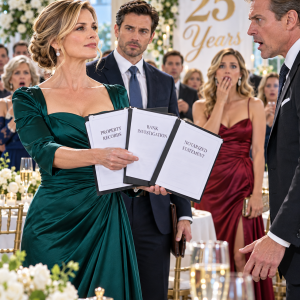
I lifted a clean kitchen apron.
“Congratulations, Victoria. You’re our first volunteer.”
Her mouth fell open.
“This dress costs four thousand dollars!”
I smiled.
“Fortunately, the apron is completely free, and it should protect your dress nicely.”
Several guests laughed.
Victoria reluctantly tied the apron around her waist.
She immediately asked why restaurant employees couldn’t perform all the packing.
I explained that the kitchen staff were preparing meals while volunteers assembled the grocery packages.
“You’ll begin with rice, canned vegetables, pasta, and soup. Each package needs to follow the same checklist.”
Victoria examined the supplies as though they were unfamiliar objects.
“Shouldn’t these labels face outward? Presentation is extremely important.”
I handed her another bag.
“For families receiving groceries, what’s inside the package matters considerably more than how impressive it looks.”
Twenty minutes later, Victoria approached Edward.
“I’ve packed six boxes, which should be more than enough to demonstrate my commitment.”
Edward glanced toward the remaining supplies.
“Excellent progress. That means there are only one hundred ninety-four left for the volunteers to complete.”
Victoria looked ready to explode.
However, the other guests were enjoying the activity.
Executives removed their jackets, wealthy donors rolled up their sleeves, and several families joined the packing stations.
For once, the gala’s most important achievement was happening away from the stage.
When the first delivery van arrived, I returned to the microphone.
“Before we finish tonight, I’d like to introduce someone who reminded me why this kind of work matters.”
Helen entered wearing her familiar blue coat.
Victoria recognized her immediately.
The older woman approached the microphone with visible nervousness.
“My grandson has been sick this week, and I was worried because I couldn’t afford enough food to prepare a proper meal.”
Her voice trembled.
“Sometimes ten dollars makes an enormous difference to a family. But being treated with kindness matters just as much, because needing help doesn’t make anyone less deserving of respect.”
The audience stood and applauded.
Victoria lowered her eyes.
I handed her one of the grocery packages.
“Would you be willing to give this first package to Mrs. Morris?”
After a long pause, Victoria accepted it.
“Mrs. Morris, I’m sorry for the way I treated you this morning.”
Helen smiled gently.
“Thank you for saying that. I hope you’ll remember how it feels when someone is struggling.”
For the first time, Victoria offered no defensive explanation.
PART 6 — A NEW DIRECTOR FOR THE FAMILY FOUNDATION
After the volunteers finished preparing the packages, the delivery vehicles departed for several community distribution centers.
Edward returned to the stage.
He thanked the donors and volunteers, then announced that the evening had inspired him to reconsider the foundation’s priorities.
“We have spent too much energy celebrating generosity and not enough time practicing it,” he admitted.
He explained that the foundation would establish a continuing community food-support initiative.
Then he turned toward me.
“Lauren Prescott demonstrated compassion this morning and organizational leadership tonight. I’d like to invite her to direct our new community food-assistance program.”
The audience applauded.
I was genuinely surprised.
Victoria sprang to her feet.
“You’re giving my position to her? She’s a complete stranger who happened to be shopping for milk this morning!”
Edward remained calm.